
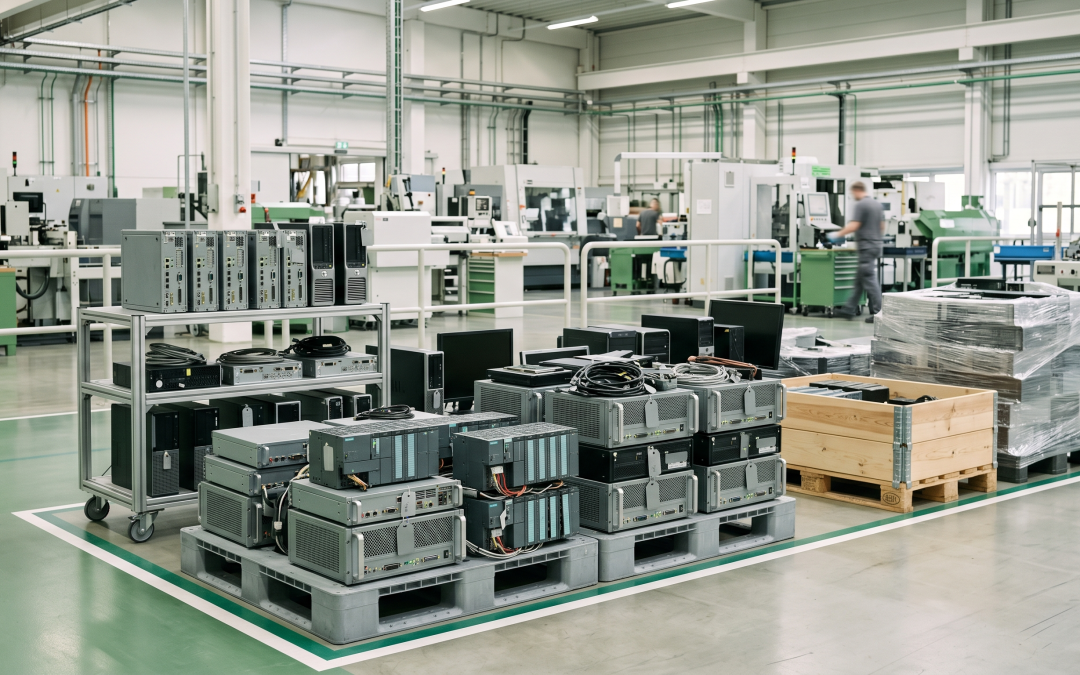
Manufacturing environments present unique IT asset disposition challenges that differ significantly from office-based ITAD. Factory floor technology operates in harsh conditions, industrial control systems contain sensitive operational data, and the convergence of IT and operational technology (OT) means disposal decisions have implications for both cybersecurity and production continuity.
The Manufacturing IT Environment
Modern manufacturing facilities rely on a complex mix of traditional IT and specialised industrial technology. The office environment uses standard computers, laptops, and networking equipment. The factory floor deploys programmable logic controllers (PLCs), human-machine interfaces (HMIs), industrial PCs, quality control systems, and an expanding array of IoT sensors and edge computing devices.
Between these two worlds sits a convergence layer of servers, networking equipment, and middleware that connects the factory floor to enterprise systems like ERP, MES, and supply chain platforms. This convergence layer is particularly sensitive from both a security and operational perspective.
Manufacturing ITAD must address all three layers, each with different equipment types, data sensitivity levels, and disposal requirements.
Operational Technology Disposal
Operational technology (OT) on the factory floor requires special handling during disposition. PLCs, HMIs, and industrial control systems contain configuration data, process recipes, and operational parameters that represent significant intellectual property. In some industries, this information could be used by competitors to replicate manufacturing processes.
OT equipment also contains network configuration data, including IP addresses, communication protocols, and authentication credentials for the industrial network. If this information were accessed by a malicious actor, it could potentially be used to compromise active systems in similar facilities.
Apply rigorous data destruction to all OT equipment before disposal. This may require working with the equipment vendor to understand the correct sanitisation procedure, as some industrial systems use proprietary storage formats that standard IT destruction tools may not address adequately.
Equipment Condition Challenges
Factory IT equipment operates in conditions that accelerate wear and reduce residual value. Dust, vibration, temperature extremes, and exposure to oils, chemicals, or moisture all take their toll. Equipment from the factory floor typically arrives at the ITAD provider in worse condition than office equipment, which affects both the disposal approach and value recovery expectations.
Industrial PCs and HMIs may be physically robust but internally contaminated with dust and particulates. Networking equipment in factory environments may have corroded connectors. Handheld devices used on the production line may have cracked screens and worn cases.
Set realistic expectations for value recovery from factory equipment. Standard IT equipment from the office areas of a manufacturing facility will perform similarly to any other office environment. But equipment from the factory floor will generally have lower resale value, and some items may be suitable only for material recovery through recycling.
Safety and Hazardous Materials
Manufacturing IT equipment may present additional safety hazards during disposal. Devices used in explosive atmospheres (ATEX or hazardous area equipment) may require special handling procedures. Equipment contaminated with industrial chemicals needs to be identified and communicated to the ITAD provider. Large UPS systems containing lead-acid or lithium batteries require specialist disposal.
Conduct a safety assessment of all equipment before it enters the disposition pipeline. Identify any hazards, decontaminate equipment where necessary, and communicate any remaining hazards to your ITAD provider. Material safety data sheets for any chemicals involved should accompany the equipment.
Production Continuity and Timing
In manufacturing, equipment disposal must be coordinated with production schedules. Decommissioning factory floor equipment typically requires a planned shutdown or at least a production pause. Coordinate ITAD activities with maintenance windows, production changeovers, or planned shutdowns to minimise impact on output.
For major technology upgrades, such as replacing an entire production line’s control system, plan the ITAD workstream alongside the installation project. The old equipment should be collected and removed as the new equipment is installed, keeping the factory floor clear and reducing the risk of confusion between old and new systems.
Maintain a clear labelling system to distinguish decommissioned equipment from active equipment. In a busy factory environment, it is easy for someone to reconnect a decommissioned device, particularly if it looks similar to active equipment. Use visible labels, tags, or colour-coded stickers to mark equipment that has been taken out of service.
Multi-Site Manufacturing Operations
Manufacturing companies with multiple sites face the same multi-location challenges as any distributed organisation, compounded by the diversity of equipment types across different factories. A food processing plant has different IT and OT equipment than an automotive assembly facility, even if both are owned by the same parent company.
Develop site-specific ITAD procedures within a group-wide framework. The framework should set standards for data destruction, environmental compliance, and documentation. Site-specific procedures should address the particular equipment types, operational constraints, and logistics of each facility.
Consider whether a single ITAD provider can service all your manufacturing sites or whether you need specialist providers for different equipment types or geographic regions. A provider with experience in industrial IT and OT disposition is valuable for factory floor equipment, even if you use a different provider for standard office IT.
Environmental Compliance
Manufacturing companies are typically subject to heightened environmental scrutiny from regulators, communities, and customers. Demonstrating responsible disposal of electronic waste is part of the broader environmental management that manufacturing companies must maintain.
Under Victoria’s e-waste landfill ban and similar regulations, all electronic waste from manufacturing operations must be recycled through approved channels. This includes not just IT equipment but also electronic components within manufacturing machinery that are replaced during maintenance or upgrades.
Track and report your e-waste volumes and disposal outcomes as part of your environmental management system. Many manufacturing companies hold ISO 14001 certification, and e-waste management should be integrated into the environmental management system that supports that certification.
EWV handles IT asset disposition (ITAD) end-to-end for Victorian businesses — from collection and data destruction through to certified recycling or refurbishment for resale. Get in touch for a tailored ITAD quote.