
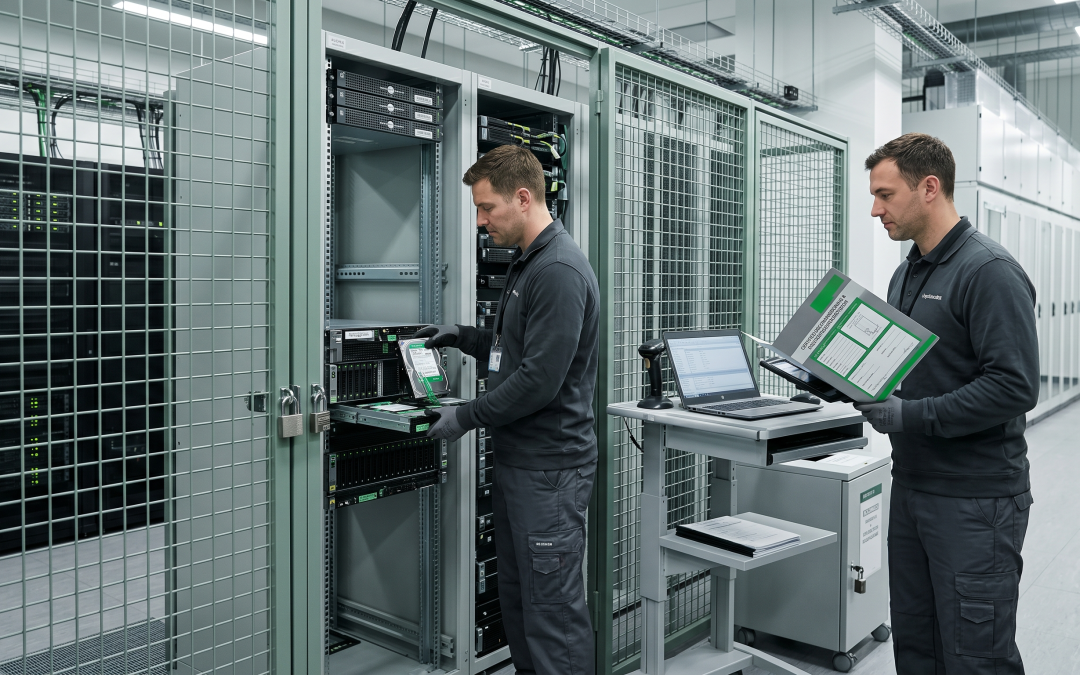
Financial institutions operate under some of the most stringent data security and regulatory requirements of any industry. Banks, credit unions, insurance companies, superannuation funds, and financial advisors all handle highly sensitive financial and personal data that requires the highest levels of protection throughout the IT asset lifecycle, including at the point of disposal.
The Regulatory Framework
Financial institutions in Australia are subject to a layered regulatory framework that directly affects IT disposal requirements. APRA’s Prudential Standard CPS 234 requires regulated entities to maintain information security capability commensurate with the threats to their information assets. This includes ensuring that data is securely destroyed when it is no longer needed.
The Privacy Act 1988 and the Australian Privacy Principles impose general obligations around the destruction of personal information. For financial institutions, these obligations are reinforced by APRA’s expectations and by the specific requirements of the Anti-Money Laundering and Counter-Terrorism Financing Act regarding record retention and destruction.
ASIC’s regulatory guidance on technology risk management applies to all Australian Financial Services Licence holders and adds another layer of expectation around the secure handling of technology assets. The ASX Listing Rules impose continuous disclosure obligations that make the secure destruction of market-sensitive information critical.
Financial institutions with international operations may also need to comply with overseas regulations including PCI DSS for payment card processing, GDPR for European customer data, and various banking secrecy and data protection laws in jurisdictions where they operate.
Data Classification and Destruction Standards
Financial institutions typically operate sophisticated data classification frameworks that should directly inform ITAD destruction requirements. Equipment that has processed the highest classification levels, including trading systems, customer account databases, and board-level communications, should undergo physical destruction rather than software-based sanitisation.
For equipment that has processed lower classification levels, certified software sanitisation to NIST 800-88 Purge level provides adequate assurance, provided the sanitisation is verified and documented. The key is ensuring that every device is matched to the appropriate destruction method based on its data classification.
Consider maintaining a matrix that maps data classification levels to required destruction methods. This removes ambiguity and ensures consistent application across the organisation. The matrix should be approved by the CISO and reviewed annually.
APRA CPS 234 Compliance
CPS 234 requires financial institutions to clearly define information security-related roles and responsibilities, maintain information security capability commensurate with the size and extent of threats, implement controls to protect information assets, and promptly detect and correct information security incidents.
For ITAD purposes, this translates to formal accountability for IT disposal within the information security function, documented procedures that reflect current best practice, regular testing and audit of disposal processes, and incident management procedures that cover disposal-related security events.
APRA expects regulated entities to manage third-party risks, including ITAD providers, through their third-party risk management framework. Your ITAD provider should be subject to the same due diligence, contractual protections, and ongoing monitoring as any other critical vendor.
Chain of Custody Requirements
Financial institutions require exceptionally rigorous chain of custody for disposed equipment. From the moment a device is decommissioned, every handoff must be documented with timestamps, signatures, and serial number verification. The chain should be continuous and unbroken from decommissioning through final destruction.
Many financial institutions require GPS tracking of equipment during transport, tamper-evident packaging or sealed cages, dedicated secure transport (not shared with other clients’ equipment), and real-time tracking systems that provide visibility of equipment location throughout the process.
The investment in rigorous chain of custody is proportionate to the risk. A single device from a financial institution’s trading floor or executive suite could contain information capable of moving markets or compromising customer accounts. The cost of tracking that device is trivial compared to the potential consequences of losing it.
Provider Selection and Management
Selecting an ITAD provider for a financial institution requires a thorough evaluation that goes beyond standard procurement. Key requirements include ISO 27001 certification as a baseline for information security management, relevant ITAD certifications such as R2 or e-Stewards, financial stability sufficient to sustain operations and honour contractual commitments, adequate insurance covering data breach liability, professional indemnity, and public liability, clean security incident history (request disclosure of any incidents in the past five years), and physical security at processing facilities that meets or exceeds financial sector expectations.
Conduct a comprehensive on-site assessment of the provider’s facility before engagement. Evaluate physical security, processing procedures, data destruction methods and verification, employee screening practices, CCTV coverage, and overall facility management. Many financial institutions require annual on-site audits supplemented by unannounced spot checks.
Trading Floor and Dealing Room Equipment
Trading floor equipment requires the highest level of disposition security. Trading terminals, Bloomberg and Reuters workstations, dealer boards, and associated servers process real-time market data, transaction records, and communication logs that could constitute material non-public information.
Best practice is to physically destroy all storage media from trading floor equipment on-site, so that data never leaves the institution’s premises. Mobile shredding units can be deployed to the trading floor or a nearby secure area to destroy media in the presence of authorised witnesses. The destroyed media is then transported as recycling material rather than as data-bearing equipment.
Branch Network Considerations
Financial institutions with retail branch networks face multi-site ITAD challenges similar to retail chains. Branch equipment includes teller workstations, ATMs (decommissioned units), back-office computers, customer-facing tablets, document scanners, and vault and security systems.
Develop a standardised branch decommissioning process that can be executed consistently across the network. Include ITAD in the scope of branch refurbishment and technology refresh projects. Coordinate collections to service multiple branches in a region efficiently.
EWV handles IT asset disposition (ITAD) end-to-end for Victorian businesses — from collection and data destruction through to certified recycling or refurbishment for resale. Get in touch for a tailored ITAD quote.