
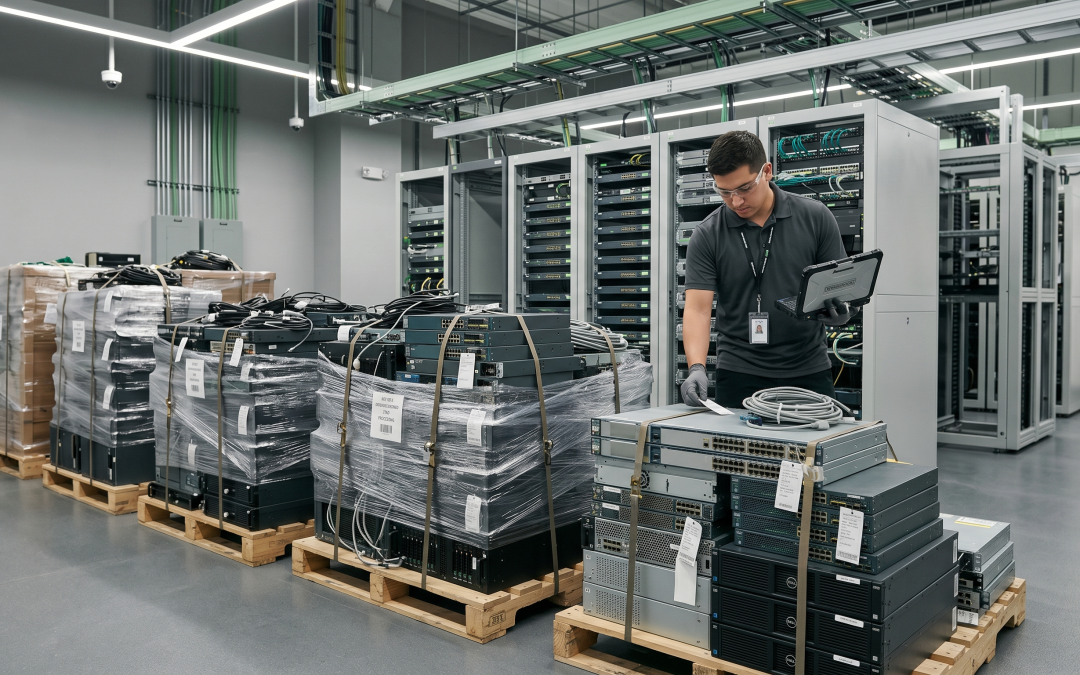
Telecommunications providers manage some of the largest and most complex IT and network equipment fleets in any industry. From core network infrastructure and data centre hardware to customer premises equipment and retail devices, the volume and diversity of equipment requiring disposition is enormous. The combination of network-sensitive data, regulatory obligations, and the sheer scale of telco operations makes ITAD a critical operational function.
The Telco Equipment Landscape
Telecommunications infrastructure spans multiple technology layers, each with distinct ITAD requirements. Core network equipment includes routers, switches, optical transport systems, and voice switching platforms that form the backbone of the network. Data centre hardware supports billing systems, customer management, service delivery platforms, and increasingly, cloud and virtualisation infrastructure. Access network equipment includes DSLAM cabinets, fibre distribution nodes, mobile base station electronics, and fixed wireless equipment. Customer premises equipment (CPE) includes modems, routers, set-top boxes, and business-grade networking gear deployed to millions of customer locations. And retail and corporate IT covers standard office equipment, point-of-sale systems in retail stores, and corporate data centre infrastructure.
The volumes can be staggering. A major Australian telco might process tens of thousands of network devices, hundreds of thousands of CPE units, and thousands of corporate IT devices annually.
Network Data Security
Network equipment contains data that is uniquely sensitive in a telecommunications context. Router and switch configurations contain the topology of the network, including IP addressing schemes, VLAN configurations, and routing protocols. Authentication credentials including RADIUS and TACACS+ configurations, encryption keys, and management passwords may be stored on devices. Customer data flows through network equipment, and while most data is transient, some systems cache or log traffic information.
If network configuration data from a telco were accessed by a malicious actor, it could potentially be used to identify vulnerabilities in the network, plan targeted attacks, or compromise customer privacy. The Telecommunications Act 1997 and the Telecommunications (Interception and Access) Act 1979 impose specific obligations around the protection of communications data that extend to equipment disposition.
Apply rigorous data destruction to all network equipment. At minimum, perform a factory reset followed by configuration verification that all custom settings have been removed. For equipment from sensitive parts of the network, physical destruction of storage components provides the highest assurance.
Customer Premises Equipment at Scale
Managing the return and disposition of CPE is one of the biggest ITAD challenges for telcos. Millions of modems, routers, and set-top boxes are deployed to customer premises across the country. When customers churn, upgrade, or when equipment reaches end of life, the reverse logistics of collecting, testing, and dispositioning this equipment requires industrial-scale processes.
Most telcos operate CPE return programs where customers send back equipment in prepaid satchels or drop it at retail stores. Returned equipment is consolidated at regional warehouses, tested, and either refurbished for redeployment or sent for recycling. The decision between refurbishment and recycling depends on the device model, age, condition, and current network requirements.
CPE that is not returned represents both a financial loss (the cost of the device) and an environmental concern. Improving return rates through clear customer communication, easy return processes, and potentially charging for unreturned equipment helps manage both issues.
Value Recovery from Network Equipment
Telecommunications network equipment can have strong secondary market value. Enterprise-grade routers, switches, and optical equipment from major manufacturers like Cisco, Juniper, Nokia, and Ericsson are in demand globally. Equipment that is one or two generations behind current can be particularly valuable to smaller operators, developing-market telcos, and network labs.
The value recovery opportunity in telco ITAD can be substantial. A major network refresh that replaces core routing equipment worth millions at original cost can generate significant returns through the secondary market, partially offsetting the capital cost of the upgrade.
Work with ITAD providers who specialise in telecommunications equipment remarketing. The telco secondary market is specialised, and providers with established buyer networks and technical expertise in testing and certifying used network equipment will achieve better outcomes than generalists.
Regulatory and Compliance Considerations
Telcos operate under industry-specific regulatory requirements that affect ITAD. The Telecommunications Act requires carriers and carriage service providers to protect the confidentiality of communications. The Critical Infrastructure Act classifies telecommunications as a critical infrastructure sector with specific security obligations. ACMA regulations impose requirements around equipment compliance and disposal.
Ensure your ITAD program addresses these specific regulatory requirements in addition to the general obligations under the Privacy Act and environmental legislation. Your compliance team should review ITAD procedures against the full regulatory framework applicable to your operations.
Environmental Scale
The environmental impact of telco e-waste is significant due to the sheer volumes involved. A responsible telco ITAD program can divert thousands of tonnes of electronic waste from landfill annually and recover valuable materials including copper, gold, silver, and rare earth elements from network equipment.
Track and report environmental outcomes as part of your sustainability program. Telcos face increasing investor and public scrutiny of their environmental practices, and a well-documented ITAD program contributes positively to ESG reporting and corporate reputation.
EWV handles IT asset disposition (ITAD) end-to-end for Victorian businesses — from collection and data destruction through to certified recycling or refurbishment for resale. Get in touch for a tailored ITAD quote.