
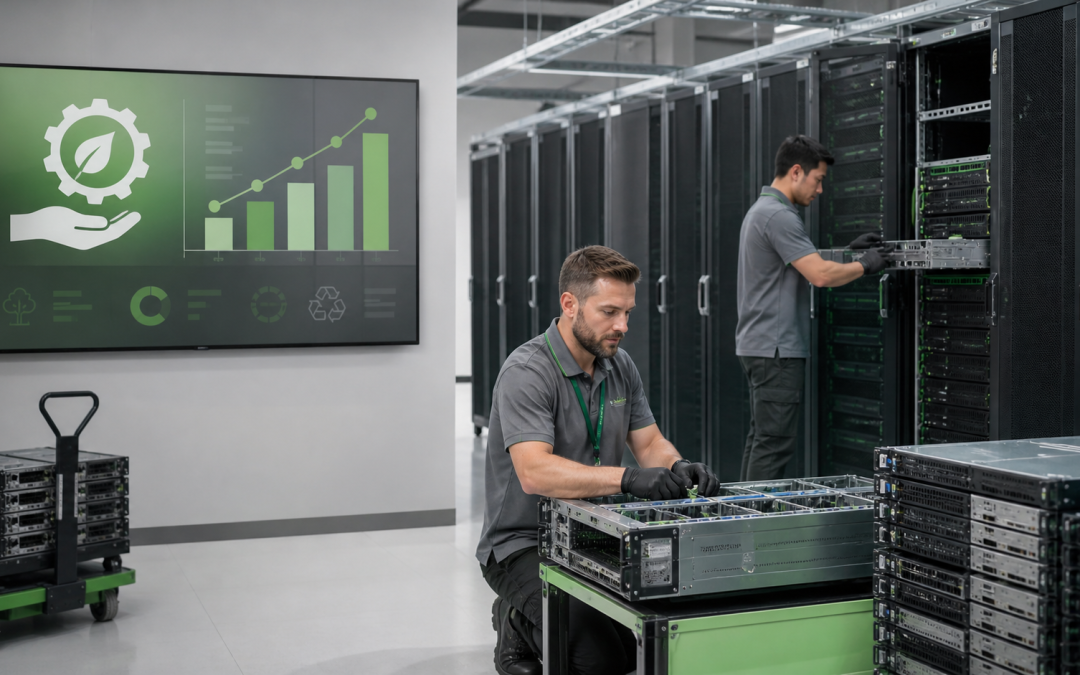
Data centre hardware refresh cycles have significant climate implications that are often underappreciated. Unlike end-user devices where manufacturing emissions dominate, data centre equipment presents a more complex picture where both the embodied carbon of new hardware and the energy efficiency gains from newer equipment must be weighed. Getting the timing right on data centre refreshes can mean the difference between reducing and increasing your organisation’s overall carbon footprint.
The Scale of Data Centre Hardware
Enterprise data centres contain equipment with substantially higher embodied carbon than end-user devices. A single rack-mounted server carries 1,000 to 4,000 kg of CO2e in embodied carbon depending on configuration. Storage arrays can carry 2,000 to 8,000 kg CO2e. Network core switches range from 500 to 2,000 kg CO2e. And uninterruptible power supplies add further embodied carbon to the infrastructure.
A medium-sized data centre might contain 50 to 200 servers, multiple storage arrays, and extensive networking equipment. The total embodied carbon of this hardware can easily reach hundreds of tonnes of CO2e, making a full refresh a significant carbon event.
The Efficiency Argument for Refresh
Unlike laptops, where the use phase is a small fraction of lifecycle emissions, data centre equipment runs 24/7 at high utilisation, meaning the use-phase energy consumption is substantial. A five-year-old server may consume 30 to 50 percent more electricity than a current-generation equivalent while delivering less computing power per watt.
This creates a genuine case for refresh on climate grounds. If a new server provides the same computing output with significantly less energy, the use-phase emission savings can outweigh the embodied carbon of the new equipment over its lifecycle. The crossover point, where the cumulative energy savings exceed the embodied carbon of the replacement, depends on the efficiency gap between old and new equipment, the utilisation rate of the server, the carbon intensity of the electricity supply, and the expected lifecycle of the new equipment.
Consolidation Opportunities
Hardware refresh is often an opportunity to consolidate workloads onto fewer, more powerful machines. Virtualisation and containerisation technologies allow organisations to run the same workloads on a fraction of the physical hardware. A refresh that replaces 20 older servers with 8 current-generation machines, while maintaining the same computing capacity, reduces both the embodied carbon per unit of computing and the ongoing energy consumption.
The climate benefit of consolidation is substantial because it reduces the total embodied carbon of the data centre (fewer physical machines), reduces total energy consumption (fewer machines to power and cool), reduces cooling requirements (less heat generated), and reduces the volume of equipment that needs to be processed at end of life.
Cloud Migration as an Alternative
For some organisations, the data centre refresh decision includes the option of migrating workloads to cloud infrastructure rather than purchasing new on-premises hardware. From a climate perspective, cloud providers typically operate at significantly higher utilisation rates than enterprise data centres, invest heavily in energy efficiency and renewable energy, achieve economies of scale in both hardware procurement and energy management, and retire and process hardware through established ITAD programmes.
Migrating to cloud infrastructure eliminates your embodied carbon from new hardware purchases and shifts the use-phase emissions to the cloud provider (who typically reports them in their own emissions inventory). However, the net climate benefit depends on the specific cloud provider’s energy sources and efficiency, and on how the decommissioned on-premises equipment is managed.
Managing the Retired Equipment
The climate impact of a data centre refresh does not end when new equipment is installed. How you manage the retired hardware significantly affects the total carbon equation. Refurbishment and remarketing is the best outcome for equipment that still has useful life. A three-year-old server that no longer meets your performance requirements may be perfectly adequate for a smaller organisation. Refurbishing and remarketing avoids the embodied carbon of a new server that the buyer would otherwise have purchased.
Component harvesting extracts reusable parts, such as memory modules, processors, drives, and power supplies, from equipment that cannot be remarketed as complete units. These components extend the life of other equipment, generating additional carbon avoidance.
Materials recycling recovers metals and other materials from equipment that cannot be refurbished or harvested, reducing the demand for primary resource extraction. Proper recycling through certified facilities ensures materials are recovered efficiently and hazardous substances are managed safely.
Timing Considerations
The optimal refresh timing from a climate perspective is not always the same as the optimal timing from a financial or performance perspective. A financially optimal refresh cycle (typically three to five years for servers) may retire equipment that still has significant useful life remaining. Extending server lifecycles by one to two years can be climate-positive if the efficiency gap does not justify earlier replacement.
Conversely, holding onto very old equipment past its efficient operating life can be climate-negative if it consumes significantly more energy than current alternatives. The decision should be based on a total lifecycle carbon assessment rather than either embodied carbon or operational efficiency alone.
For organisations managing data centre refreshes, working with an experienced ITAD provider ensures that retired equipment follows the highest-value disposition path, maximising the environmental benefit of the transition. For guidance on the broader lifecycle perspective, see our guide on the full IT asset lifecycle from procurement to disposal.
]]>EWV provides e-waste collection and recycling for Victorian businesses, responsibly processing electronic equipment through certified downstream partners. Book a collection to keep your e-waste out of landfill.