
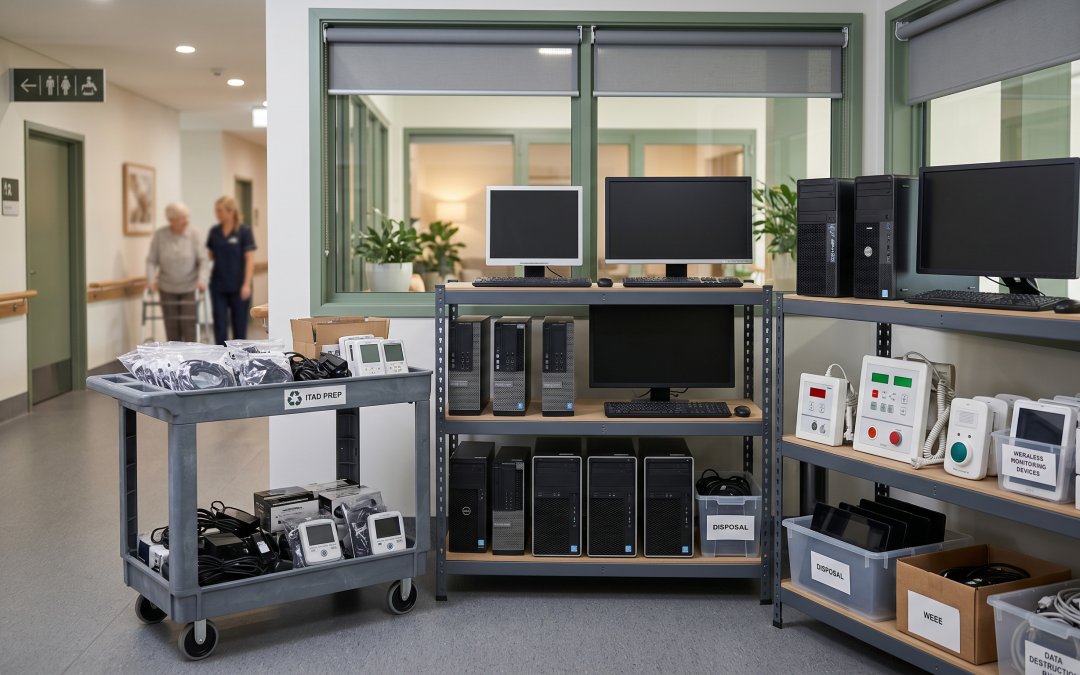
Aged care providers manage IT systems that store some of the most sensitive personal and health information in any sector. Resident records, care plans, medication management data, and family communications all flow through electronic systems that eventually reach end of life. Proper IT asset disposition protects vulnerable residents, meets regulatory obligations, and demonstrates the duty of care that is central to aged care.
The Aged Care IT Environment
Aged care facilities have become increasingly technology-dependent. Electronic medication management systems track every medication administered to every resident. Care management platforms document daily care activities, clinical observations, and incident reports. Nurse call systems log response times and resident requests. CCTV and access control systems monitor facility safety. Administrative systems manage finances, rostering, and compliance reporting.
Many providers also deploy resident-facing technology including Wi-Fi networks, shared tablets for video calls with family, and entertainment systems. While these devices may seem less sensitive, they can still store cached personal information, login credentials, and browsing history.
Regulatory Requirements
Aged care providers operate under multiple regulatory frameworks that affect IT disposal. The Privacy Act 1988 and Australian Privacy Principles impose general obligations around personal information handling and destruction. The Aged Care Act and associated quality standards require providers to demonstrate effective governance including information management.
The Aged Care Quality and Safety Commission assesses providers against the Aged Care Quality Standards, which include requirements around information management and governance. Standard 8 (Organisational governance) specifically requires effective systems for managing information. Demonstrable IT disposal practices support compliance with these standards.
Health information attracts additional protections under state health records legislation. In Victoria, the Health Records Act 2001 imposes specific requirements around the handling and destruction of health information that complement the federal Privacy Act.
The Royal Commission into Aged Care Quality and Safety brought increased scrutiny to governance practices in aged care, including information security. Providers that cannot demonstrate professional data management practices face reputational risk and potential regulatory action.
Data Destruction for Resident Information
Every device that has stored or processed resident information requires certified data destruction before disposal. This includes the obvious systems like care management servers and workstations, but also medication management hardware, nurse call system controllers, staff mobile devices used for care documentation, and any device connected to the resident records system.
Medication management systems are particularly sensitive. They contain detailed records of every medication administered to every resident, including controlled substances. Improper disposal of these systems could expose residents’ complete medication histories, which is both a privacy violation and a potential safeguarding concern.
Apply NIST 800-88 standards as a minimum for all data destruction. For systems containing the most sensitive clinical information, physical destruction provides the highest level of assurance. Ensure your ITAD provider understands aged care data sensitivity and applies appropriate destruction methods.
Record Retention Before Disposal
Aged care providers have specific record retention obligations that must be satisfied before equipment can enter the disposition pipeline. Clinical records typically need to be retained for seven years after the last entry, or seven years after the resident’s death in some jurisdictions. Financial records have their own retention requirements.
Before any equipment is disposed of, confirm with your records management team that all data has been migrated to current systems and that retention requirements are met. For systems being replaced, verify that data migration to the new platform is complete and accurate before the old system’s hardware enters the ITAD process.
Multi-Facility Operations
Many aged care providers operate multiple facilities across different locations. Each facility has its own IT infrastructure, equipment refresh cycles, and operational constraints. Coordination across facilities ensures consistent disposal practices and enables cost efficiencies through bulk processing.
Establish a provider-wide ITAD framework that sets standards for data destruction, documentation, and environmental compliance. Allow individual facilities flexibility in scheduling collections and staging equipment, but maintain central oversight of compliance and provider management.
Consider consolidating equipment from smaller facilities at a central location for batch processing. This reduces per-unit costs and simplifies the logistics of working with your ITAD provider.
Staff Training and Awareness
Aged care staff may not be familiar with IT disposal requirements. Care workers, nurses, and administrative staff all interact with technology daily but may not understand the importance of proper device handling at end of life. Simple training covering why old devices must not be taken home or given away, how to identify and report end-of-life equipment, the importance of not storing devices in unsecured areas, and who to contact when a device needs to be decommissioned helps ensure that equipment enters the formal disposition pipeline rather than being handled informally.
Budget Considerations
Aged care operates on tight margins, and ITAD is an additional cost that needs to be managed carefully. Several strategies help control costs. Batch processing reduces per-unit costs. Scheduling disposals to coincide with equipment refreshes avoids separate collection charges. Value recovery from newer equipment can offset disposal costs for older items. And choosing an ITAD provider that offers flexible service options for organisations with variable volumes helps match costs to actual needs.
Include ITAD costs in your technology refresh budget so they are planned and funded rather than coming as an unbudgeted surprise. Some providers offer fixed-price annual contracts that give budget certainty regardless of disposal volumes.
EWV handles IT asset disposition (ITAD) end-to-end for Victorian businesses — from collection and data destruction through to certified recycling or refurbishment for resale. Get in touch for a tailored ITAD quote.