
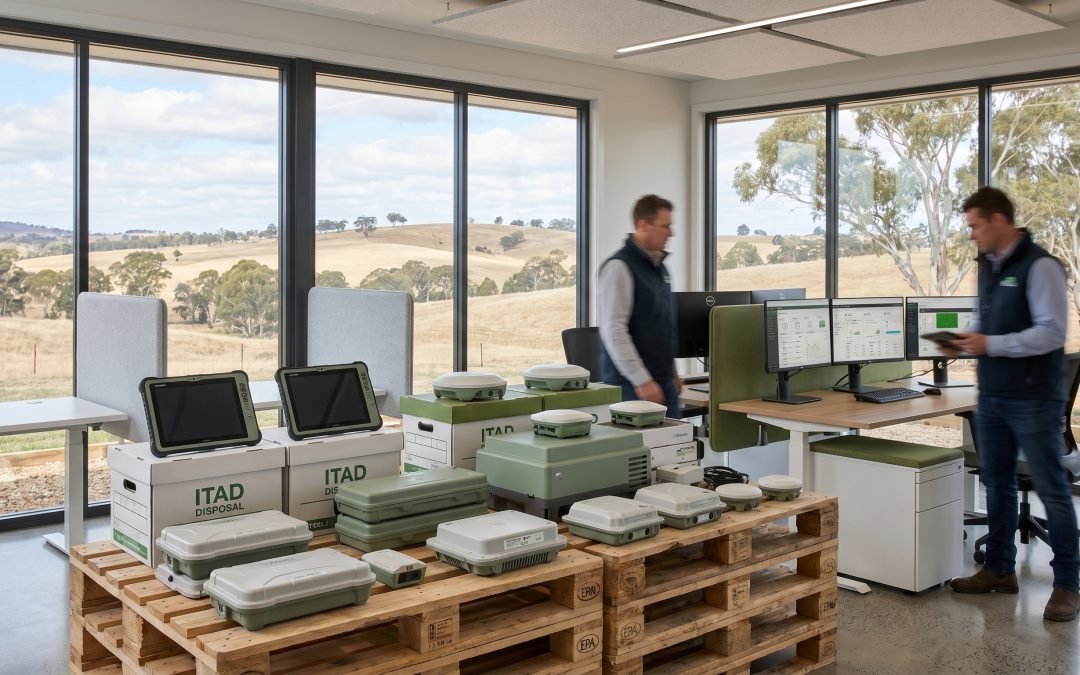
Agriculture might not be the first industry that comes to mind when thinking about IT asset disposition, but modern farming operations are surprisingly technology-intensive. Precision agriculture systems, GPS-guided equipment, weather monitoring stations, livestock management technology, and standard office IT all create a growing stream of electronic equipment that eventually needs proper disposal.
Technology in Modern Agriculture
Australian agriculture has embraced technology across virtually every operation. Precision agriculture uses GPS guidance, variable rate application systems, and yield mapping to optimise crop production. Livestock operations deploy electronic identification (EID) systems, remote water monitoring, and automated feeding systems. Weather stations, soil moisture sensors, and satellite imagery analysis support decision-making. And the farm office runs accounting, compliance, and communication systems on standard IT equipment.
Large agricultural operations may also use drone technology for crop monitoring, automated irrigation controllers, cold chain monitoring for produce storage and transport, and mobile devices for field data collection.
Data Sensitivity in Agriculture
Agricultural data is more sensitive than many operators realise. Yield data and soil mapping reveal the productive capacity of land, which has direct financial implications for land values, lease negotiations, and insurance. Livestock records include genetic information, health histories, and breeding data that represent significant investment. Financial data on farm management systems includes supplier relationships, pricing agreements, and production costs.
For agricultural businesses involved in research, the data sensitivity is higher still. Trial results, breeding program data, and agrochemical testing data can be commercially valuable and may be subject to confidentiality agreements with research partners.
Apply certified data destruction to all equipment that has stored farm business data. While the regulatory requirements for agricultural data are generally less prescriptive than for health or financial data, the commercial sensitivity is real and the Privacy Act applies to personal information held by farming businesses.
Remote Location Challenges
Many Australian agricultural operations are in regional or remote areas where ITAD services may not be readily available. The cost of having an ITAD provider travel to a remote property for a small volume of equipment can be prohibitive.
Several strategies help manage this challenge. Consolidation through local networks works well in farming communities. Coordinate with neighbouring properties, local agricultural cooperatives, or regional business networks to accumulate sufficient volumes for a cost-effective collection. Regional drop-off points at agricultural supply stores, council facilities, or regional business hubs can serve as consolidation points. Courier and freight services allow individual farms to ship small volumes of equipment to urban ITAD providers, though this requires proper packaging and tracking.
For larger agricultural enterprises with multiple properties, establish a schedule for consolidating equipment from satellite properties to a central location during regular supply runs or staff movements.
Harsh Environment Equipment
Agricultural IT equipment operates in conditions that significantly affect its condition at end of life. Dust, moisture, heat, and physical impact from field operations take their toll. GPS receivers and guidance systems mounted on machinery experience constant vibration. Field sensors are exposed to weather. Even office equipment in farm buildings may be subject to more dust and temperature variation than urban office equipment.
Set realistic expectations for value recovery from agricultural equipment. Standard office IT in good condition will perform similarly to any other environment. But field equipment and machinery-mounted technology will typically have lower resale value due to wear and condition. Material recovery through recycling may be the most appropriate disposition for heavily worn equipment.
Environmental Stewardship
Farmers are stewards of the land, and responsible e-waste disposal aligns with the environmental responsibility that is central to modern agriculture. Under Victoria’s e-waste landfill ban, all electronic equipment must be recycled through approved channels. Burying old equipment on the property, while perhaps tempting for its convenience, is both illegal and harmful to the land.
Document your e-waste disposal practices as part of your farm’s environmental management. If your operation participates in sustainability certification programs or supplies to customers with environmental requirements, demonstrable e-waste management supports your compliance.
EWV offers e-waste sustainability and ESG reporting to help Victorian businesses track, verify, and disclose their IT disposal outcomes. Contact our team to learn how we support your reporting obligations.