
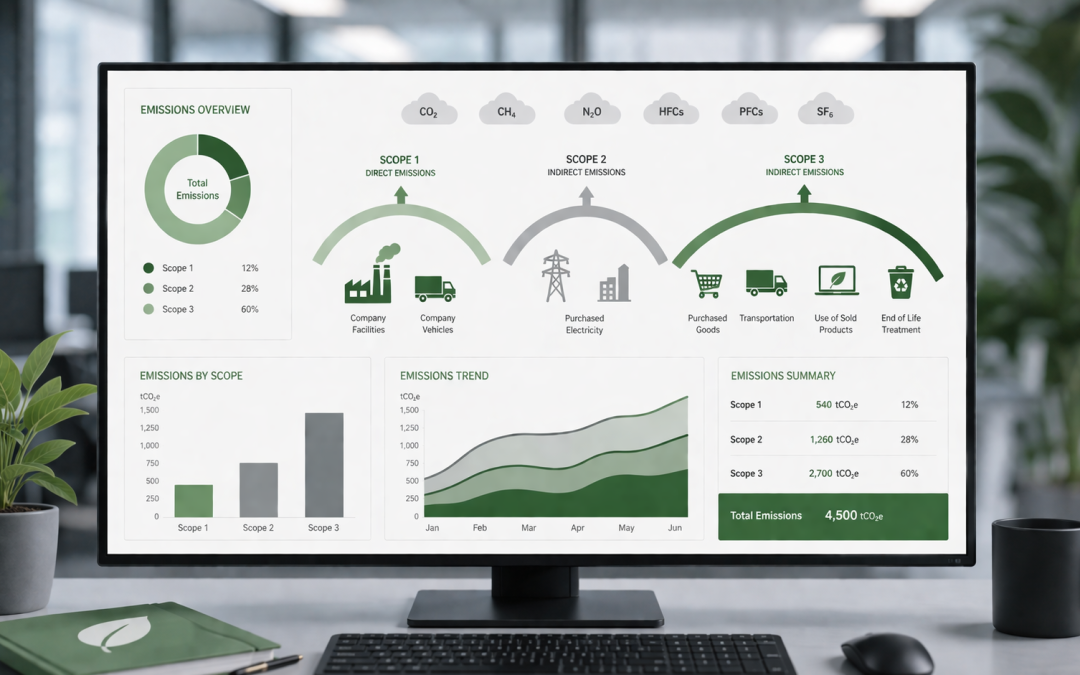
Carbon accounting for IT asset disposition involves systematically measuring, recording, and reporting the greenhouse gas emissions associated with retiring, processing, and managing end-of-life IT equipment. As mandatory climate reporting expands in Australia and stakeholder expectations for emissions transparency grow, having a robust carbon accounting methodology for your ITAD activities is becoming essential rather than optional.
What to Measure
A comprehensive carbon accounting approach for ITAD captures emissions and avoidances across the full disposition lifecycle. Transport emissions include the fuel consumed collecting equipment from your premises and delivering it to processing facilities. If your provider uses multiple facilities or consolidation points, emissions from inter-facility transfers should also be captured.
Processing emissions cover the energy used in data destruction (particularly for physical destruction methods like shredding), mechanical processing (shredding, separation, sorting), smelting and refining of recovered metals, and facility operations (lighting, heating, office functions).
Avoided emissions, sometimes called carbon avoidance or displacement, represent the emissions that would have been generated if the refurbished equipment had instead been replaced by new manufacturing, and if recycled materials had instead been produced from virgin resources. These avoided emissions are the positive side of the ITAD carbon ledger.
Scope 3 Categories
Under the Greenhouse Gas Protocol and related reporting frameworks, ITAD emissions fall primarily into Scope 3. Category 5 (Waste Generated in Operations) covers the emissions from transporting and processing your retired IT equipment. Category 1 (Purchased Goods and Services) is relevant if you purchase refurbished IT equipment, as the embodied carbon is lower than for new equipment. And Category 12 (End-of-Life Treatment of Sold Products) may be relevant if your organisation manufactures or sells IT equipment.
The avoided emissions from refurbishment and recycling are not typically reported within your Scope 3 totals (which only include actual emissions) but can be reported separately as avoided emissions or carbon benefits in your sustainability disclosures.
Emission Factors
Carbon accounting requires emission factors to convert activity data (such as kilometres driven, kilowatt-hours consumed, or tonnes of material processed) into CO2e figures. Key emission factors for ITAD include transport emission factors based on vehicle type, fuel type, and distance, available from the Australian National Greenhouse Accounts Factors. Electricity emission factors based on the grid mix where processing occurs, also published in the National Greenhouse Accounts Factors and varying by state. Processing emission factors for specific recycling activities, which may come from industry databases, lifecycle assessment studies, or your ITAD provider. And embodied carbon factors for new IT equipment, sourced from manufacturer environmental reports, lifecycle assessment databases, or industry averages.
The choice of emission factors significantly affects your results, so documenting which factors you use and why is essential for credibility and comparability.
Calculating Avoided Emissions
Calculating avoided emissions from ITAD requires establishing what would have happened without your refurbishment or recycling programme (the counterfactual scenario). For refurbished equipment, the standard assumption is that each refurbished device displaces the manufacture of one new device. The avoided emissions equal the embodied carbon of the new device minus the refurbishment processing emissions.
For recycled materials, the avoided emissions equal the emissions from producing the equivalent quantity of material from virgin sources minus the emissions from the recycling process. This calculation requires knowing the weight and type of materials recovered, which your ITAD provider should be able to supply.
Data Sources
Building your carbon accounting requires data from several sources. Your IT asset register provides the volumes and types of equipment disposed. Your ITAD provider supplies collection distances, processing methods, disposition outcomes (refurbished, recycled, destroyed), materials recovered, and in many cases pre-calculated CO2e figures. Equipment manufacturers provide embodied carbon data through environmental product declarations or sustainability reports. And government databases provide emission factors for transport, electricity, and materials processing.
Quality and Assurance
As climate reporting moves from voluntary to mandatory under ASRS, the assurance requirements for your emissions data are increasing. Your carbon accounting methodology needs to be documented and reproducible. Your data needs to be traceable to source records. Your assumptions need to be clearly stated and reasonable. And your calculations need to be verifiable by an external auditor.
Working with an ITAD provider that produces detailed, auditable environmental reports makes assurance significantly easier. Providers who can supply itemised data at the individual asset level, rather than just aggregated totals, give you the most robust foundation for assured carbon accounting.
Continuous Improvement
Carbon accounting methodology should improve over time as better data becomes available. In the early years of your programme, you may rely heavily on industry average emission factors and estimated data. As your data collection matures, you can progressively replace estimates with measured data, use provider-specific emission factors rather than industry averages, incorporate more granular activity data, and expand the boundary of your accounting to capture more of the disposition value chain.
For detailed guidance on CO2e avoidance reporting methodology, see our guide on CO2e avoidance reporting for ITAD. For the broader context of ESG reporting and e-waste, our comprehensive ESG reporting guide covers the Australian landscape.
]]>