
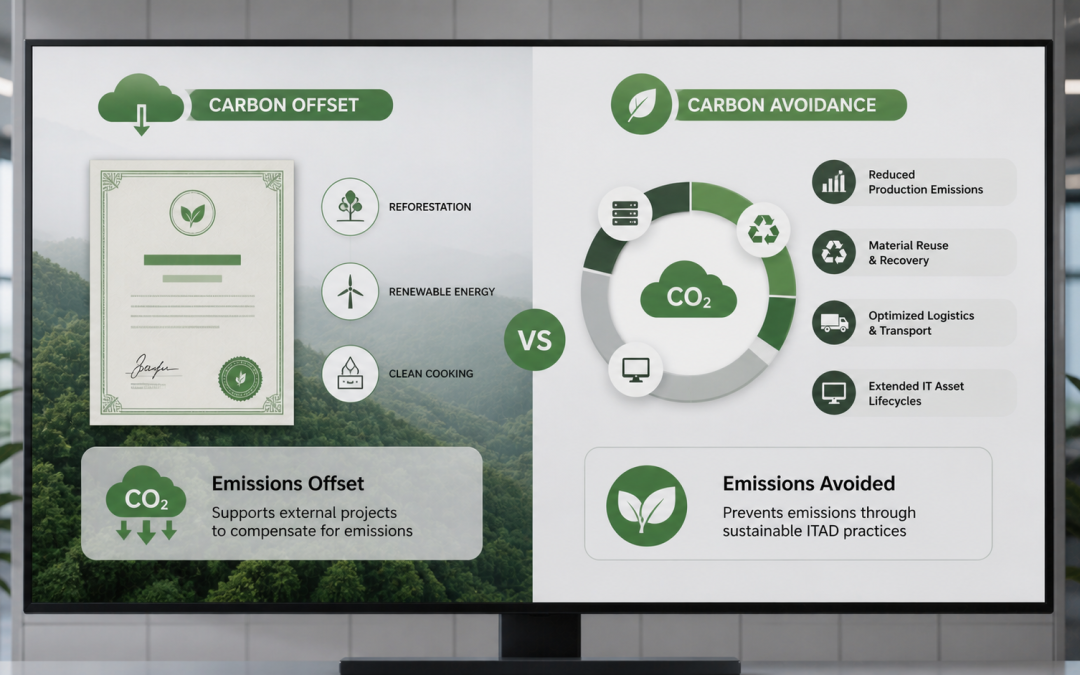
In the context of IT asset disposition, two terms are commonly used to describe carbon benefits: carbon offsets and carbon avoidance. While they both relate to reducing the net climate impact of your operations, they represent fundamentally different mechanisms and have very different credibility profiles. Understanding the distinction helps organisations communicate their ITAD programme’s climate benefits accurately and avoid the greenwashing risks that come with conflating the two.
What Carbon Avoidance Means in ITAD
Carbon avoidance, also called avoided emissions or emission displacement, occurs when your actions directly prevent emissions that would otherwise have been generated. In ITAD, the primary avoidance mechanism is refurbishment and reuse. When you refurbish a retired laptop and it re-enters productive use, it displaces the need for manufacturing a new device. The manufacturing emissions that would have been generated, approximately 300 to 400 kg CO2e for a typical laptop, are avoided.
Similarly, when materials are recovered through recycling and used in place of virgin materials, the emissions from primary extraction and processing are avoided. Recycling aluminium, for example, uses about 95 percent less energy than producing aluminium from bauxite ore.
Carbon avoidance is a direct, causal relationship. Your specific action (refurbishing this laptop, recycling this copper) directly prevents specific emissions (manufacturing a new laptop, mining and smelting new copper). The connection is traceable and quantifiable.
What Carbon Offsets Are
Carbon offsets are credits purchased from projects that reduce or remove greenhouse gas emissions elsewhere. When you buy a carbon offset, you are not reducing your own emissions; you are paying for someone else’s emission reduction or removal project. Common offset projects include renewable energy installations, forest conservation or reforestation, methane capture from landfills, and energy efficiency projects in developing countries.
Offsets are typically measured and traded in units of one tonne of CO2 equivalent. The theory is that a tonne of CO2 avoided or removed anywhere in the world has the same climate benefit as a tonne reduced at your own operations. In the ITAD context, an organisation might purchase offsets to compensate for the processing emissions from their e-waste management activities.
Why Avoidance Is Stronger Than Offsets
In the hierarchy of climate action, reducing and avoiding your own emissions is universally considered more credible and effective than purchasing offsets. Several reasons support this position.
Avoidance addresses the source. When you refurbish equipment instead of buying new, you eliminate emissions at the point where they would have been generated. Offsets leave the original emissions in place and attempt to balance them elsewhere. Avoidance has higher certainty. The emissions from manufacturing a new laptop are well-documented and predictable. The emission reductions from many offset projects are less certain, with concerns about additionality (would the project have happened anyway?), permanence (will the forest stay standing?), and measurement accuracy.
Net zero frameworks prioritise avoidance. The Science Based Targets initiative (SBTi) and other leading frameworks emphasise that organisations should prioritise reducing their own value chain emissions before using offsets for any residual emissions that cannot be eliminated. Offsets are a last resort, not a first response. And stakeholder credibility favours avoidance. Investors, customers, and ESG rating agencies generally view operational emission reductions as more credible than offset purchases. An ITAD programme that avoids 100 tonnes of CO2e through refurbishment is more impressive than purchasing 100 tonnes of offsets.
How to Report Each
Carbon avoidance and offsets should be reported differently in your sustainability disclosures. Avoided emissions from ITAD should be reported separately from your greenhouse gas inventory, clearly labelled as avoided emissions with the methodology and assumptions documented. They should not be subtracted from your Scope 1, 2, or 3 totals, as they represent a benefit beyond your inventory boundary rather than a reduction within it.
Carbon offsets, if purchased, should be reported with full transparency about the offset project type, certification standard, and registry. They should not be used to adjust your gross emissions figures. Under most frameworks, offsets can be reported as a separate line item showing your net position, but your gross emissions must still be disclosed.
The Role of Offsets in ITAD
For organisations with mature ITAD programmes, the role of offsets is limited. A well-managed programme already generates significant carbon avoidance through refurbishment and recycling. The residual emissions from ITAD processing (collection, transport, and facility energy) are relatively small compared to the avoidance generated.
If you choose to offset your ITAD processing emissions, ensure the offsets are from credible, independently verified projects. Look for certification under recognised standards like Gold Standard or Verra VCS. But recognise that the primary climate story from your ITAD programme is the avoidance, not the offsets.
Practical Recommendations
Focus your climate efforts on maximising avoidance through refurbishment and recycling rather than on purchasing offsets. Report your CO2e avoidance prominently alongside your gross emissions. Use high-quality offsets only for residual emissions that you cannot reduce through operational improvements. Be transparent about both avoidance and offsets in your reporting, clearly distinguishing between them. And avoid claiming “carbon neutral ITAD” based solely on offset purchases, as this can constitute greenwashing if your underlying processes are not genuinely optimised.
For detailed guidance on calculating and reporting CO2e avoidance from your ITAD programme, see our guide on CO2e avoidance reporting for ITAD. For the broader Scope 3 reporting context, our practical guide covers the full calculation methodology.
]]>