
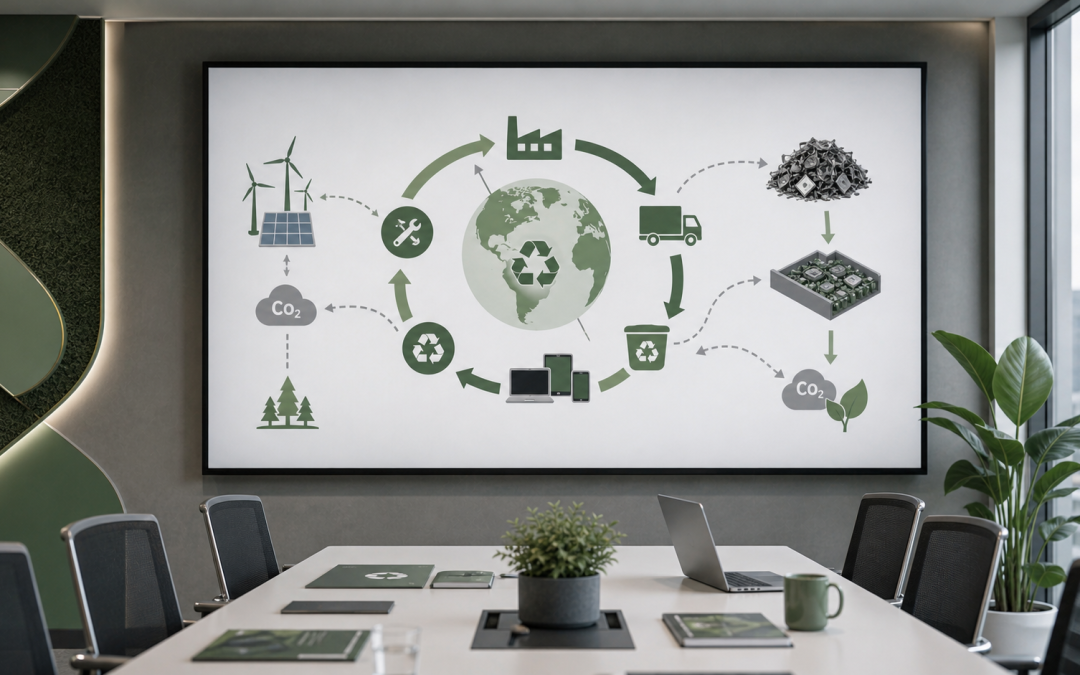
The circular carbon economy applies circular economy principles specifically to carbon management, focusing on how keeping products and materials in use for longer reduces the carbon emissions associated with extraction, manufacturing, and disposal. For electronics, where the majority of lifecycle carbon is generated during manufacturing, circular approaches deliver outsized carbon benefits compared to many other product categories. Understanding this connection helps organisations see their IT lifecycle management as a genuine climate strategy, not just a waste management exercise.
From Linear to Circular Carbon Flows
The traditional linear model for electronics, manufacture, use, dispose, generates a one-directional carbon flow. Carbon-intensive raw materials are extracted and processed, energy-intensive manufacturing transforms them into devices, and at end of life the embedded carbon value is largely lost through disposal or basic recycling.
A circular carbon approach aims to keep the embodied carbon locked in products and materials for as long as possible, reducing the frequency with which new carbon-intensive manufacturing is required. For IT equipment, this translates to extending the useful life of devices (keeping embodied carbon productive for longer), refurbishing and remarketing equipment (transferring embodied carbon to a new user rather than discarding it), recovering materials through recycling (retaining at least some of the embodied carbon value in recovered materials), and designing for longevity and recyclability (building circular carbon principles into the product from the start).
The Carbon Maths of Circular IT
The carbon arithmetic of circular IT is compelling. Consider a laptop with 350 kg of embodied CO2e and a traditional three-year lifecycle. In a linear model, the annualised embodied carbon is approximately 117 kg CO2e per year (350 divided by 3). If the lifecycle is extended to five years through refurbishment, the annualised embodied carbon drops to 70 kg CO2e per year, a 40 percent reduction.
If the laptop is then refurbished and used by a second user for another three years, the total useful life becomes eight years, and the annualised embodied carbon drops further to approximately 44 kg CO2e per year, a 62 percent reduction compared to the linear model.
At the end of its useful life, recycling recovers materials that carry their own embodied carbon from prior processing. Using these recycled materials in new manufacturing avoids the carbon that would have been generated by extracting and processing virgin resources.
Circular Strategies and Their Carbon Impact
Different circular strategies deliver different levels of carbon benefit. Maintenance and repair keeps equipment operational, extending the first life and avoiding any replacement manufacturing. This is the highest-carbon-benefit circular strategy because it requires minimal additional resources. Refurbishment restores equipment to a condition suitable for continued productive use, typically with data wiping, testing, minor component replacement, and cleaning. The carbon cost of refurbishment is typically 5 to 10 percent of new manufacturing.
Component harvesting extracts reusable parts from equipment that cannot be refurbished as a complete unit. These components extend the life of other equipment, generating carbon avoidance. Materials recycling recovers raw materials for reuse in manufacturing. While this retains less embodied carbon value than refurbishment (because energy must be invested in reprocessing), it still significantly outperforms manufacturing from virgin materials.
Enabling a Circular Carbon Economy for Electronics
Realising the full potential of circular carbon economy for electronics requires action at multiple levels. At the design level, manufacturers need to create products that are durable, repairable, upgradeable, and recyclable. Modular designs that allow component-level replacement extend useful life and facilitate refurbishment. At the procurement level, organisations need to choose equipment with longevity in mind, consider refurbished procurement, and factor lifecycle carbon into purchasing decisions.
At the management level, maintaining equipment well, implementing appropriate power management, and planning for lifecycle extension maximises the productive life of each device. At the disposition level, working with ITAD providers who prioritise refurbishment and remarketing over recycling ensures the highest-value circular pathway for retired equipment. And at the policy level, regulations that support extended producer responsibility, right to repair, and e-waste diversion from landfill create the framework for circular carbon outcomes.
Measuring Circular Carbon Performance
Organisations can track their circular carbon performance through several metrics. Average equipment lifecycle length indicates how long embodied carbon remains productive. Refurbishment rate shows what percentage of retired equipment re-enters productive use. CO2e avoidance from refurbishment quantifies the manufacturing emissions prevented by keeping equipment in use. Materials recovery rate indicates the effectiveness of recycling in retaining material value. And annualised embodied carbon per device tracks the carbon efficiency of your IT fleet over time.
For guidance on measuring and reporting these metrics, see our guide on CO2e avoidance reporting for ITAD. For a broader view of how circular economy principles apply to electronics, our guide on the circular economy for electronics in Australian businesses provides a comprehensive framework.
]]>EWV helps Victorian businesses manage e-waste and IT asset disposal compliantly and sustainably — including collection, certified data destruction, and recycling. Contact us for a free quote.