
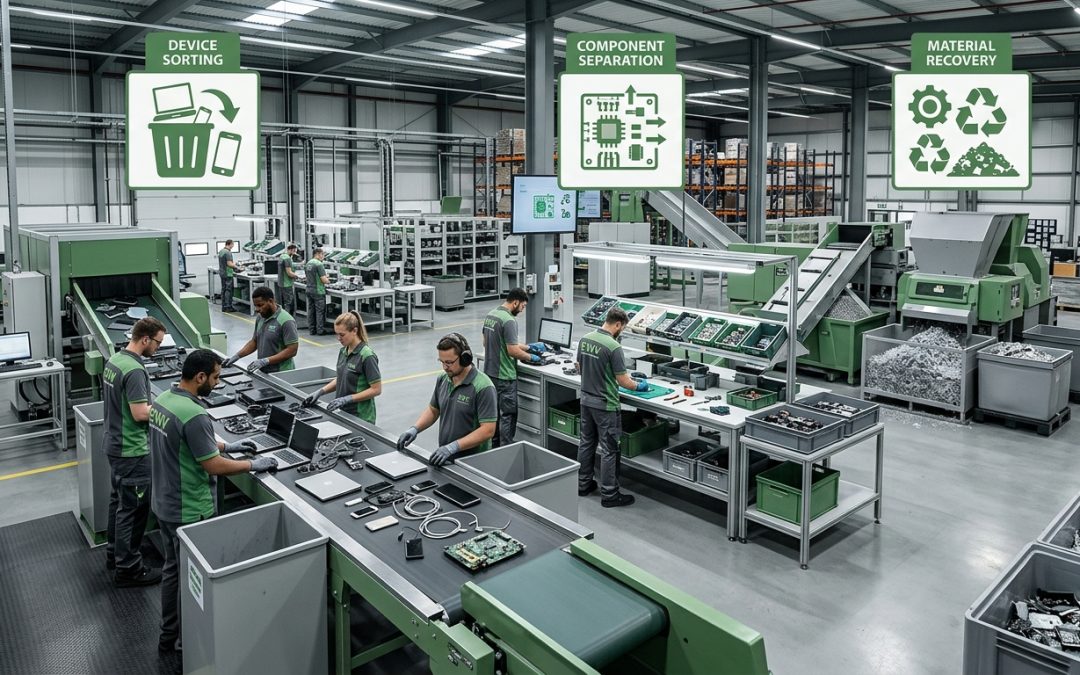
Behind the Scenes of E-Waste Recycling
You’ve done the right thing and dropped your old electronics at a recycling point. But what actually happens next? The journey from your old laptop to recovered copper, gold, and recycled plastic involves a sophisticated sequence of processes that most people never see. Understanding how an e-waste recycling facility operates helps explain why proper recycling matters and why it’s different from tossing things in the general waste.
Receiving and Sorting
When e-waste arrives at a processing facility, the first step is intake and initial sorting. Staff assess incoming material and separate it into broad categories: computers and IT equipment, TVs and monitors, large appliances, small appliances, batteries, and cables. This initial sort determines which processing line each item enters.
Items with potential resale value are set aside for testing. A recent-model laptop in good condition might be diverted to refurbishment rather than recycling. This hierarchy, reuse before recycling, is fundamental to responsible e-waste processing.
Hazardous components are identified early. CRT monitors are separated because of their lead-containing glass. Devices with visible battery swelling are flagged for careful handling. Items containing mercury (older flat-panel backlights) are noted for special processing.
Manual Disassembly
Many items go through manual disassembly before mechanical processing. Trained technicians take devices apart by hand, separating components into distinct material streams:
Batteries are removed first. This is a safety-critical step because batteries that enter mechanical shredding can catch fire. Technicians extract lithium-ion batteries, button cells, and other battery types and direct them to specialised battery recycling.
Hard drives and storage media are separated for data destruction processing. Depending on the facility’s capabilities and the client’s requirements, these may be wiped using NIST 800-88 compliant software or physically shredded for data security.
Circuit boards are removed and sorted by grade. High-grade boards (from computers, phones, and servers) contain more precious metals and go to specialist refining. Lower-grade boards from simple appliances have less precious metal content and may be processed differently.
Cables are cut and bundled for copper recovery. The copper content in cables makes them one of the more economically valuable material streams in e-waste.
Plastic housings are separated by type where possible. Different plastic polymers need to go to different recycling streams for effective processing.
Mechanical Processing
After manual disassembly removes hazardous and high-value components, remaining material often goes through mechanical processing:
Shredding reduces material to small, relatively uniform pieces. Industrial shredders can process entire devices, breaking them into fragments typically 20-50mm in size. This step liberates materials from each other, making subsequent separation more effective.
Magnetic separation pulls ferrous metals (iron and steel) from the shredded stream using powerful magnets. Steel from chassis, screws, and structural components is collected for steel recycling.
Eddy current separation uses alternating magnetic fields to repel non-ferrous metals (aluminium, copper, brass) from the material stream. These metals fly off the conveyor in a different direction from non-metallic materials, achieving clean separation.
Density separation uses air classification or liquid float-sink processes to separate materials by weight. Heavier materials sink while lighter plastics float, enabling further material stream purification.
Optical sorting uses cameras and sensors to identify and separate specific material types. Near-infrared spectroscopy can distinguish between different plastic polymers, while X-ray fluorescence identifies specific metal compositions.
Downstream Processing
The separated material streams leave the e-waste facility and enter specialist processing operations:
Precious metals refining. Circuit boards and other precious-metal-bearing materials go to smelters and refineries that extract gold, silver, palladium, and platinum. A single tonne of mobile phone circuit boards can yield 300-350 grams of gold, roughly 30-80 times the concentration found in gold ore.
Copper smelting. Copper-rich materials including cables, heat sinks, and motor windings go to copper recyclers. Recycled copper is virtually identical in quality to virgin copper and requires about 85% less energy to produce.
Steel and aluminium recycling. These metals enter conventional metal recycling streams where they’re melted and reformed into new products. Both metals can be recycled indefinitely without quality loss.
Plastic recycling. Sorted plastic streams go to plastic recyclers for cleaning, pelletising, and reuse in manufacturing. The quality of recycled plastic depends heavily on how well it was sorted, which is why proper separation at the e-waste facility matters.
Hazardous material treatment. Lead-containing glass from CRTs, mercury from lamps, and other hazardous fractions go to licensed treatment facilities for safe processing or encapsulation.
What Recovery Rates Look Like
A well-run e-waste facility achieves impressive material recovery rates. Typical figures for a mixed e-waste stream are approximately 95-98% recovery by weight, meaning only 2-5% of incoming material ends up as non-recyclable residue (typically mixed fines, contaminated dust, and composite materials that can’t be economically separated).
Individual material recovery rates vary: ferrous metals achieve near-100% recovery, non-ferrous metals 95%+, precious metals 95%+ from high-grade boards, glass 90%+, and plastics 70-90% depending on polymer type and contamination level.
Why This Matters
Every device that reaches a proper e-waste facility has its materials returned to the manufacturing supply chain, reducing the need for mining, refining, and processing virgin materials. The environmental savings are substantial: recycling metals uses a fraction of the energy required for primary production, avoids the habitat destruction and water contamination associated with mining, and keeps hazardous materials out of landfill.
The next time you drop off your old electronics for recycling, you can be confident that within a well-run facility, virtually everything in that device will find a second life as raw material for new products. It’s a sophisticated industrial process that turns yesterday’s technology into tomorrow’s resources.
EWV helps Victorian businesses manage e-waste and IT asset disposal compliantly and sustainably — including collection, certified data destruction, and recycling. Contact us for a free quote.