
Hospital IT departments operate in one of the most regulated and data-sensitive environments of any industry. Patient health information, clinical systems, medical devices, and the sheer volume of IT equipment in a modern hospital create unique challenges for IT asset disposition. Getting it wrong can result in serious regulatory penalties, compromise patient privacy, and damage the trust that is fundamental to healthcare.
The Healthcare ITAD Landscape
Modern hospitals are technology-intensive environments. Beyond standard office IT, hospitals deploy clinical workstations, patient monitoring systems, diagnostic imaging equipment, pharmacy dispensing systems, nurse call systems, and an increasingly connected ecosystem of medical IoT devices. Each of these systems stores or processes patient data, and each requires proper disposition at end of life.
The scale can be significant. A mid-sized hospital might have several thousand IT devices, from bedside terminals and mobile workstations on wheels to servers running electronic medical records (EMR) systems. Refresh cycles in healthcare tend to be longer than in corporate environments due to budget constraints and the complexity of clinical system integration, which means equipment often reaches end of life in waves that need careful planning.
Health Information Privacy Requirements
Healthcare organisations are subject to overlapping privacy requirements that make data destruction particularly critical. The Privacy Act 1988 covers personal information generally. State-based health records legislation, such as the Health Records Act 2001 in Victoria, imposes additional requirements specific to health information. The My Health Records Act 2012 governs information in the national digital health record system.
Health information is classified as sensitive information under the Privacy Act, which means it receives a higher level of protection than general personal information. The penalties for mishandling health information are severe, and the reputational damage to a hospital that suffers a disposal-related data breach can be catastrophic.
Patient records include some of the most sensitive information imaginable: diagnoses, treatment histories, mental health records, genetic information, and substance use records. Every device that has stored or processed this information must undergo certified data destruction before disposal.
Medical Device ITAD Challenges
Medical devices present unique disposition challenges that standard ITAD processes may not adequately address. Many medical devices contain embedded storage that is not easily accessible for standard data destruction methods. Some devices have proprietary operating systems that require manufacturer-specific sanitisation procedures. Devices classified as therapeutic goods may have regulatory requirements around their disposal or decommissioning.
Diagnostic imaging equipment, such as MRI machines, CT scanners, and ultrasound systems, contains large volumes of patient data in proprietary formats. Sanitising these systems often requires specialist knowledge and, in some cases, vendor involvement. Build relationships with your equipment vendors to understand their recommended decommissioning procedures and ensure data destruction is part of the process.
Point-of-care devices, patient monitors, and infusion pumps are increasingly connected and store patient identification data, treatment parameters, and usage logs. Include these devices in your ITAD scope even if they are not traditionally classified as IT equipment.
Clinical System Decommissioning
When clinical systems are replaced or upgraded, the servers, workstations, and storage that supported them need proper disposition. This is particularly important when migrating between EMR systems or consolidating clinical applications, because the old infrastructure may contain comprehensive patient records spanning years or decades.
Plan clinical system decommissioning carefully. Work with your clinical informatics team to identify all data stores associated with the system being retired. Ensure that data migration to the replacement system is complete and verified before the old infrastructure enters the disposition pipeline. Maintain the ability to restore the old system from backup for a defined period after migration, in case data issues are discovered.
Once the retention period has passed and the old system is confirmed as no longer needed, proceed with certified data destruction of all associated media. Document the entire process, including the data migration verification, the retention period, and the final destruction.
Chain of Custody in a Hospital Setting
Hospitals present particular chain of custody challenges. Equipment is distributed across wards, clinics, operating theatres, and administration areas. Staff work around the clock in shifts. Patient care takes priority over IT operations, which means equipment collection must be planned around clinical workflows.
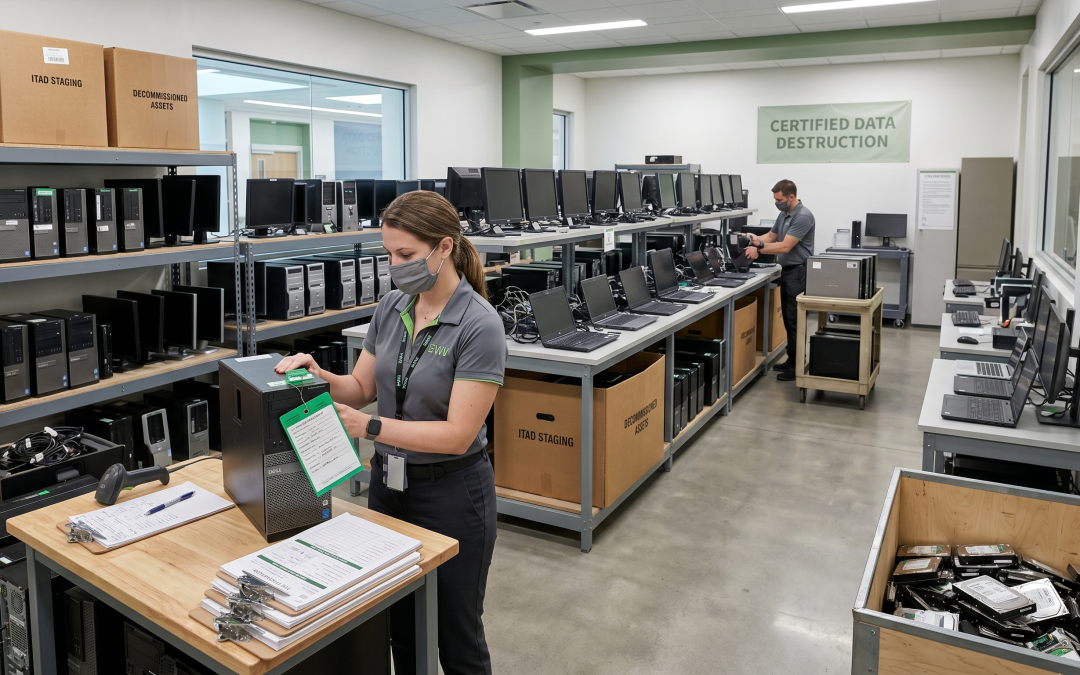
Establish a clear process for decommissioning equipment that includes IT disabling the device in your asset management system, removing the device from the clinical network, a preliminary data wipe via your endpoint management tools, physical collection and transport to a secure staging area, logging the device into the staging area inventory, and maintaining the staging area under controlled access until ITAD provider collection.
The staging area should be in a secure, non-clinical space. Do not stage equipment in corridors, utility rooms, or areas accessible to patients or visitors. Hospitals are busy environments, and equipment left in unsecured areas can easily go missing.
Regulatory Compliance Documentation
Healthcare organisations face particularly stringent audit requirements. Your ITAD documentation must withstand scrutiny from multiple sources, including hospital accreditation bodies, state health department auditors, privacy regulators, and potentially coronial enquiries or legal proceedings.
For each disposal event, maintain certificates of data destruction linked to individual device serial numbers, chain of custody records covering the full journey from ward to final disposition, environmental compliance documentation, asset register updates reflecting the disposition, and sign-off from the relevant clinical department head or information custodian.
Retain these records for a minimum of seven years, or longer if your state’s health records retention requirements specify a longer period. Some health record retention requirements extend to 25 years or more for certain record types, and the associated destruction documentation should be retained for the same period.
Working with Procurement and Clinical Engineering
Hospital ITAD requires collaboration across several departments. Procurement manages vendor relationships and contracts. Clinical engineering manages medical devices. Biomedical engineering handles device safety and regulatory compliance. Information services manages data and systems. Facilities manages logistics and space.
Establish a cross-functional ITAD working group that meets regularly to coordinate disposal activities, address emerging issues, and plan for major refresh or decommissioning projects. This coordination prevents equipment from falling through the cracks between departmental responsibilities.
EWV handles IT asset disposition (ITAD) end-to-end for Victorian businesses — from collection and data destruction through to certified recycling or refurbishment for resale. Get in touch for a tailored ITAD quote.