
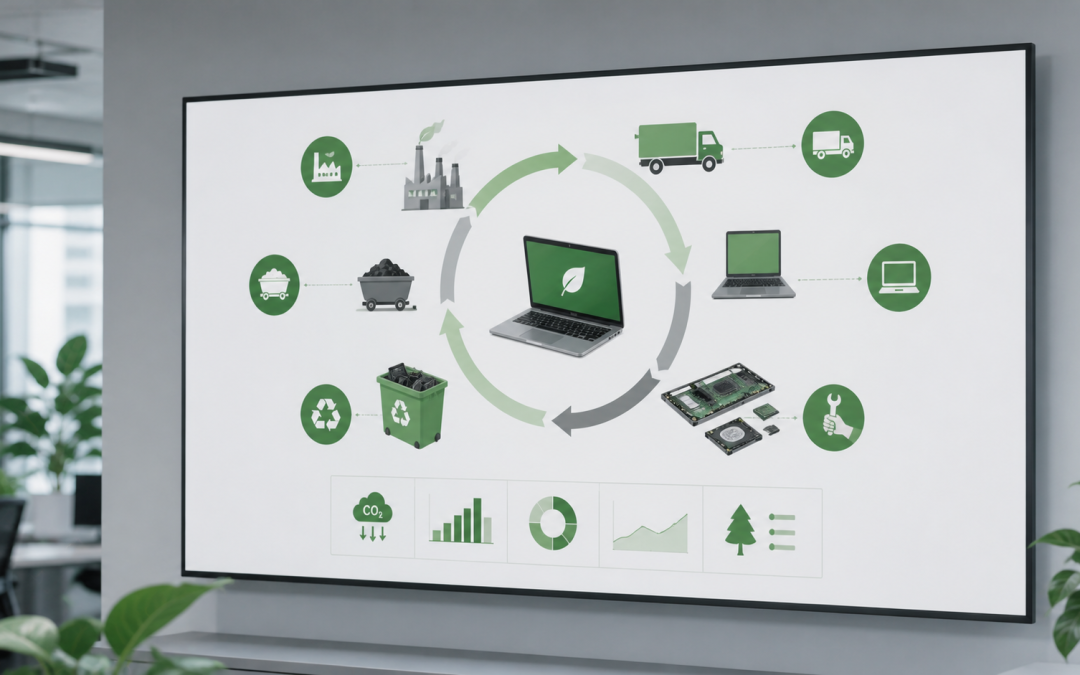
Life cycle assessment (LCA) is a methodology for evaluating the environmental impacts of a product across its entire lifecycle, from raw material extraction through manufacturing, use, and end-of-life management. For IT equipment, LCA provides the most complete picture of environmental impact and is the foundation for informed decisions about procurement, lifecycle management, and disposition. Understanding LCA results for common IT equipment helps organisations prioritise their sustainability efforts where they will have the most impact.
What LCA Measures
A comprehensive LCA evaluates impacts across multiple environmental categories. Global warming potential (GWP) measures the greenhouse gas emissions associated with each lifecycle stage, expressed in kg CO2 equivalent. This is the most commonly reported LCA metric for IT equipment. Resource depletion measures the consumption of finite natural resources including metals, minerals, and fossil fuels. Water consumption tracks freshwater use across the lifecycle. Acidification measures emissions that contribute to acid rain, primarily from sulphur dioxide and nitrogen oxides. Eutrophication measures nutrient loading in water systems, which can cause algal blooms and oxygen depletion. Human toxicity evaluates the potential health impacts from toxic substance releases. And ecotoxicity assesses impacts on ecosystems from toxic emissions.
While GWP gets the most attention, a complete LCA considers all these categories to avoid shifting problems from one environmental dimension to another.
Laptop LCA
For a typical business-grade laptop, LCA results consistently show that manufacturing dominates the environmental profile. Manufacturing accounts for 75 to 85 percent of lifecycle GWP, generating 300 to 400 kg CO2e through component production (particularly semiconductors), assembly, and upstream supply chain activities. The use phase accounts for 15 to 25 percent of lifecycle GWP, generating 50 to 100 kg CO2e from electricity consumption over a typical four-year corporate lifecycle. End of life typically accounts for less than 5 percent of lifecycle GWP if properly recycled, and can generate net environmental benefits if the equipment is refurbished.
The resource depletion impact follows a similar pattern, with manufacturing consuming the vast majority of natural resources. The use phase primarily depletes energy resources (fossil fuels used in electricity generation), while end-of-life recycling can partially offset resource depletion by recovering materials for reuse.
Desktop Computer LCA
Desktop computers have a broadly similar LCA profile to laptops, with manufacturing dominating. However, desktops tend to consume more electricity during the use phase because they lack the power-saving optimisations of battery-powered devices and often run continuously during business hours without the sleep states that laptops enter when their lids are closed.
Manufacturing GWP for a typical desktop is 300 to 500 kg CO2e. Use-phase GWP over a four-year lifecycle can range from 150 to 400 kg CO2e depending on the system’s power consumption and usage patterns. The higher use-phase impact means operational energy efficiency matters more for desktops than for laptops in relative terms.
Server LCA
Servers have substantially larger lifecycle impacts than end-user devices due to their more powerful components and continuous operation. Manufacturing GWP for a rack-mounted server ranges from 1,000 to 4,000 kg CO2e depending on configuration. Use-phase GWP can be enormous, potentially 5,000 to 20,000 kg CO2e over a typical five-year lifecycle, because servers run 24/7 at high utilisation and their electricity consumption is substantial.
Unlike laptops and desktops where manufacturing dominates, servers often have a more balanced or use-phase-dominated LCA profile. This means that for servers, both energy efficiency during operation and manufacturing impact at procurement matter significantly.
Monitor LCA
Display monitors have manufacturing impacts of 200 to 400 kg CO2e depending on size and technology (LCD vs OLED). Use-phase impacts are modest because modern displays are relatively energy efficient, typically generating 50 to 150 kg CO2e over a five-year lifecycle. As monitor sizes increase and higher resolution displays become standard, both manufacturing and use-phase impacts are trending upward.
Networking Equipment LCA
Enterprise networking equipment, including switches, routers, and access points, has received less LCA attention than end-user devices, but the impacts can be significant for organisations with extensive network infrastructure. Manufacturing impacts range from 100 to 800 kg CO2e per device depending on size and complexity. Use-phase impacts can be substantial for core network equipment that operates continuously and handles high data throughput.
Using LCA Data in Decision-Making
LCA data supports better decisions at multiple points in the IT lifecycle. At procurement, comparing LCA data across products helps identify lower-impact options. Some manufacturers publish environmental product declarations (EPDs) that provide standardised LCA results. During the use phase, LCA data helps quantify the benefits of energy management and efficiency improvements. At end of life, LCA data helps quantify the environmental benefits of refurbishment versus recycling versus disposal, supporting decisions about disposition methods. And in reporting, LCA-based emission factors provide the most credible foundation for sustainability disclosures.
Limitations of LCA
While LCA is the gold standard for environmental assessment, it has limitations that organisations should understand. Data quality varies. Manufacturer-specific LCA data is preferable but not always available, and industry averages may not accurately represent your specific equipment. System boundaries differ between studies, making direct comparisons difficult unless studies use the same scope and methodology. And LCA results represent a snapshot, so they may not reflect the most current manufacturing processes or energy mixes.
Despite these limitations, LCA provides the most comprehensive and scientifically robust basis for understanding and managing the environmental impact of your IT equipment. For guidance on applying LCA insights to your sustainability reporting, see our guide on measuring the environmental impact of IT disposal.
]]>