
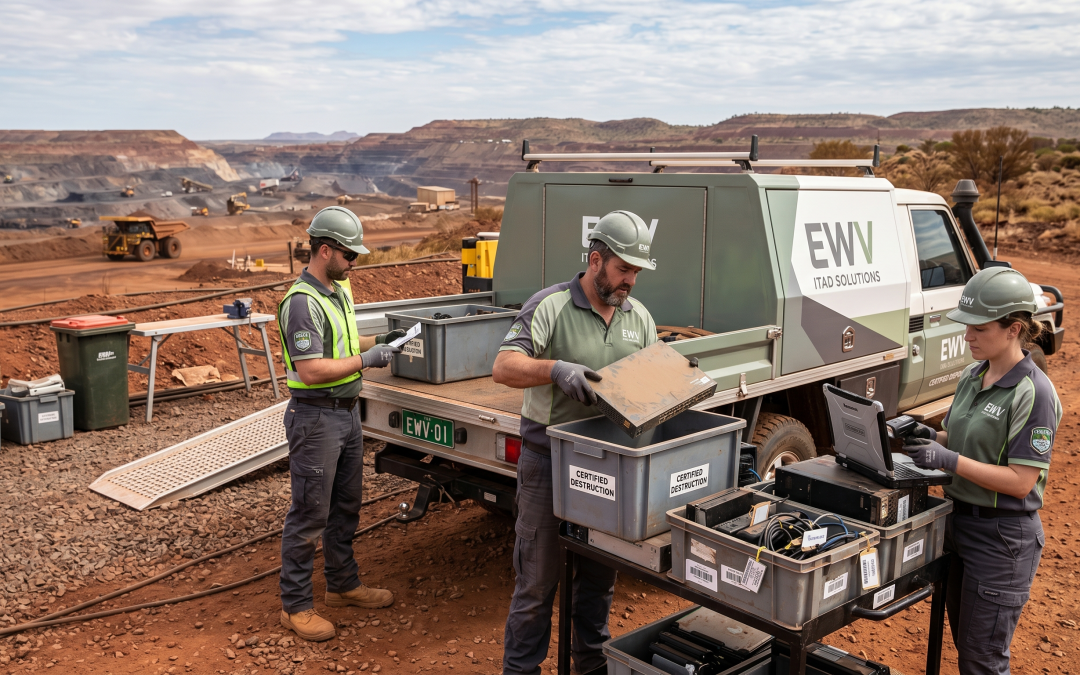
Mining operations and remote industrial sites present some of the most challenging IT asset disposition scenarios in any industry. Equipment operates in harsh environments, sites may be hundreds of kilometres from the nearest city, logistics are complex and expensive, and the combination of sensitive operational data and remote locations creates unique security risks.
The Remote Site Challenge
Australia’s mining sector operates across some of the most remote locations on the continent. From the Pilbara and Kimberley in Western Australia to Central Queensland’s coal fields and the Northern Territory’s mineral deposits, mining IT equipment is deployed in conditions that mainstream ITAD processes were never designed for.
The tyranny of distance affects every aspect of ITAD. Collection costs are substantially higher when a truck needs to travel hundreds of kilometres to reach a site. Equipment condition is often poor due to dust, heat, vibration, and humidity. Staff turnover on remote sites means devices change hands frequently, making asset tracking more difficult. And the operational focus of mining sites means IT disposal is rarely a priority for site management.
Equipment Types in Mining Operations
Mining sites use a diverse range of IT equipment beyond standard office hardware. Control room workstations manage real-time operational data including production volumes, equipment status, and safety monitoring. Fleet management systems contain GPS tracking data, operational patterns, and maintenance records. Communication systems including two-way radios, satellite phones, and mobile devices contain call logs and messaging data.
Rugged devices used by geologists, surveyors, and environmental officers contain exploration data that may be commercially sensitive. SCADA and industrial control systems manage critical infrastructure and contain configuration data that could be exploited if it fell into the wrong hands. CCTV and access control systems record personnel movements across the site.
Each of these equipment types requires appropriate data destruction before disposal, but the methods and logistics differ significantly from standard office ITAD.
Logistics and Collection Strategies
The cost of individual collections from remote sites can be prohibitive. A dedicated ITAD collection run to a single remote mine site might cost thousands of dollars in transport alone, which may exceed the value of the equipment being collected. Several strategies help manage these costs.
Consolidated collections batch multiple sites in a region into a single collection run. If your company operates several sites within a region, coordinate disposals so the ITAD provider can service multiple locations in one trip. This dramatically reduces per-site logistics costs.
Backloading uses existing freight movements to move IT equipment. Mining operations have regular freight movements between sites and major centres. Adding pallets of decommissioned IT equipment to an outbound truck that would otherwise return empty is far cheaper than arranging dedicated transport.
Hub-and-spoke staging consolidates equipment from multiple remote sites at a regional hub, such as a regional office or port facility, where the ITAD provider can collect it more cost-effectively. Site staff package and freight equipment to the hub as part of regular supply chain movements.
Fly-in processing brings the ITAD provider to the site for major decommissioning events, such as mine closures or major equipment upgrades. This can be more cost-effective than shipping large volumes of equipment out, particularly for bulky items like server racks and networking cabinets.
Equipment Condition and Value Recovery
Mining equipment typically arrives at the ITAD provider in worse condition than office equipment. Dust ingress, heat damage, physical impacts, and corrosion all reduce both functionality and cosmetic appearance. This affects value recovery, but does not eliminate it.
Laptops and tablets from mining sites may have damaged screens or cases but functional internals that retain value for component harvesting. Servers and networking equipment from climate-controlled server rooms may be in better condition than end-user devices. Specialised equipment like GPS units and communication devices may have strong secondary markets regardless of cosmetic condition.
Set realistic expectations for value recovery from mining equipment. The returns will generally be lower than for office equipment, but the focus should be on proper data destruction and environmental compliance rather than maximising resale revenue.
Security Considerations for Mining Data
Mining data has unique sensitivity considerations. Resource estimates, exploration results, and production data can affect share prices and are subject to continuous disclosure obligations under ASX listing rules. Leaking this information through improperly disposed equipment could trigger insider trading concerns and regulatory action.
Operational data including site layouts, security procedures, blast patterns, and access control configurations could pose safety and security risks if accessed by unauthorised parties. Environmental monitoring data could be commercially sensitive in the context of regulatory compliance and community relations.
Apply strict data destruction standards to all mining site equipment. Physical destruction is often the most practical option for remote sites because it provides the highest assurance level and eliminates the risk of data recovery from equipment that may change hands multiple times during the logistics process.
Mine Closure and Major Decommissioning
Mine closure events create large-scale ITAD requirements that need project-level planning. When a mine closes, all IT infrastructure needs to be decommissioned, including the server room, communications systems, control room equipment, and end-user devices across the entire site.
Plan ITAD as a formal workstream within the mine closure project. Allocate budget, assign responsibility, establish timelines, and coordinate with other closure activities. The ITAD workstream should begin well before the site closes, with asset registers verified, data destruction requirements confirmed, and logistics planned.
Consider whether on-site destruction is more practical for closure events. Mobile shredding units can be deployed to the site to destroy media on location, eliminating the need to transport data-bearing equipment over long distances. The shredded material can then be shipped for recycling as part of the broader site cleanup.
Environmental Compliance in Remote Areas
Victoria’s e-waste landfill ban and similar regulations in other states apply regardless of how remote the site is. Burying old IT equipment on site, a practice that was common in the past, is both illegal and environmentally harmful.
Mining companies face heightened scrutiny on environmental practices from regulators, communities, and investors. Demonstrating proper e-waste management is part of the broader environmental responsibility that mining companies must uphold. Document your e-waste disposal practices and include them in your site environmental management plan.
EWV handles IT asset disposition (ITAD) end-to-end for Victorian businesses — from collection and data destruction through to certified recycling or refurbishment for resale. Get in touch for a tailored ITAD quote.