
When IT Equipment Contains Refrigerants
Most people do not associate IT equipment with refrigerants, but a surprising range of electronic products relies on active cooling systems that contain gases regulated under environmental legislation. From data centre precision cooling units through to the small refrigerator in the office kitchen, refrigerant-containing equipment is more common in IT and business environments than many people realise. When this equipment reaches end of life, the refrigerant must be recovered before the equipment can be recycled.
Refrigerants are gases used in cooling systems to transfer heat. In a sealed cooling circuit, the refrigerant absorbs heat from one location (such as a server room) and releases it elsewhere (typically outside the building). The environmental concern with many refrigerants is that they are potent greenhouse gases. Some refrigerants, particularly older types, also deplete the ozone layer. Releasing these gases into the atmosphere during equipment disposal has significant environmental consequences.
IT Equipment That Contains Refrigerants
The most obvious refrigerant-containing equipment in a business environment is air conditioning and precision cooling systems. Data centres and server rooms rely on dedicated cooling units to maintain the temperature and humidity levels that IT equipment requires. These precision cooling units, also known as computer room air conditioning (CRAC) or computer room air handlers (CRAH), contain refrigerants that must be recovered when the units are decommissioned.
- Data centre precision cooling units (CRAC/CRAH systems)
- Server room split system air conditioners
- In-row and rack-mounted cooling units
- Portable or spot cooling units used for temporary IT installations
- Water-cooled server systems with integrated refrigeration circuits
- Office refrigerators and bar fridges in break rooms and server rooms
- Vending machines and water coolers
- Dehumidifiers used in equipment storage areas
In-row cooling units positioned between server racks in data centres are another common source. These units bring cooling directly to the heat source, improving efficiency in high-density server environments. Like standalone CRAC units, they contain refrigerant circuits that need professional handling at end of life.
Even office-level cooling associated with IT rooms qualifies. Many businesses have dedicated split system air conditioners for their server rooms or communications rooms that are separate from the building’s main HVAC system. These units are part of the IT infrastructure and may be decommissioned as part of IT projects rather than building maintenance programs.
Less obviously, office refrigerators, bar fridges, water coolers, and vending machines all contain refrigerants. While these are not strictly IT equipment, they are commonly found in office environments and are often included in office clearouts and relocations alongside IT assets.
Why Refrigerant Recovery Matters
The refrigerants used in cooling equipment are significant greenhouse gases. Their global warming potential (GWP) is measured relative to carbon dioxide, and many common refrigerants have GWP values hundreds or thousands of times greater than CO2.
For example, R-410A, commonly used in modern air conditioning systems, has a GWP of approximately 2,088, meaning one kilogram of R-410A released into the atmosphere has the same warming effect as approximately 2,088 kilograms of CO2. Older refrigerants like R-22 (HCFC-22), still found in some legacy cooling equipment, have both high GWP and ozone-depleting potential.
A single precision cooling unit in a data centre may contain several kilograms of refrigerant. Releasing this quantity directly into the atmosphere is equivalent to emitting tonnes of CO2. Proper recovery ensures that the refrigerant is either recycled for reuse, reclaimed to virgin quality, or destroyed in a controlled manner, preventing its release as a greenhouse gas.
For businesses tracking their carbon footprint, refrigerant emissions are a reportable Scope 1 emission under most greenhouse gas accounting frameworks. Uncontrolled release of refrigerants during equipment disposal could represent a significant and avoidable spike in reported emissions. Our guide on Scope 3 emissions and IT equipment provides broader context on emissions from IT operations.
Legal Requirements for Refrigerant Handling
Australian law is clear on refrigerant handling. The Ozone Protection and Synthetic Greenhouse Gas Management Act 1989 and associated regulations make it illegal to knowingly vent refrigerants into the atmosphere. This applies to all refrigerant types, including newer synthetic gases that do not deplete the ozone layer but are potent greenhouse gases.
Only licensed technicians are authorised to handle refrigerants in Australia. The Australian Refrigeration Council (ARC) administers the licensing system, and any work involving the installation, maintenance, or decommissioning of refrigerant-containing equipment must be performed by or supervised by a person holding the appropriate ARC licence.
This means that when refrigerant-containing equipment is being disposed of, a licensed refrigeration technician must recover the refrigerant before the equipment can be dismantled or recycled. This requirement applies regardless of the size of the equipment, from a large data centre cooling plant down to a small bar fridge.
Penalties for illegally venting refrigerants can be substantial, and businesses that knowingly allow refrigerant release during equipment disposal can face both financial penalties and reputational consequences.
The Recovery Process
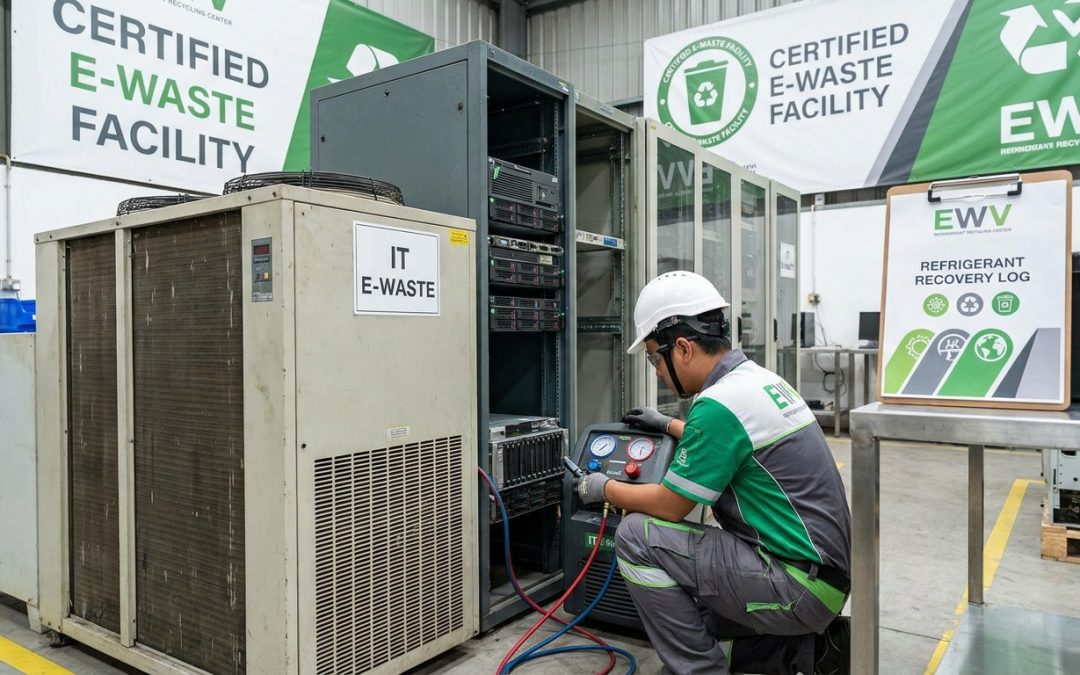
Refrigerant recovery is a straightforward process when performed by qualified technicians. The technician connects recovery equipment to the cooling system’s service ports and transfers the refrigerant from the equipment into certified recovery cylinders. The process is designed to capture as close to 100% of the refrigerant as possible.
Once recovered, the refrigerant is either recycled (cleaned and reused in similar equipment), reclaimed (reprocessed to meet virgin quality standards for use in any application), or destroyed (thermally decomposed in approved facilities if the refrigerant type is being phased out or is unsuitable for recycling).
The technician provides a record of recovery documenting the type and quantity of refrigerant recovered, which the equipment owner should retain for compliance and emissions reporting purposes. This documentation is particularly important for businesses reporting under the National Greenhouse and Energy Reporting (NGER) scheme or preparing sustainability reports.
Integration with IT Equipment Disposal
When decommissioning a server room, data centre, or office that includes cooling equipment, refrigerant recovery should be one of the first steps in the disposal process. The cooling system should be decommissioned and refrigerant recovered before the room is cleared and IT equipment removed.
If you are working with an ITAD provider for IT equipment disposal, confirm whether their service scope includes coordination of refrigerant recovery for associated cooling equipment. Some ITAD providers handle this as part of their service, while others focus exclusively on IT assets and expect the client to arrange cooling equipment disposal separately.
For businesses undertaking data centre or server room decommissioning, a clear project plan that sequences refrigerant recovery, data destruction, IT equipment removal, and cooling equipment disposal ensures nothing is missed and all regulatory requirements are met. Our guide on choosing an ITAD provider covers the scope of services to evaluate.
The Bigger Picture
Refrigerant management in IT equipment disposal is a relatively small but important piece of the overall e-waste puzzle. It sits at the intersection of e-waste regulation, greenhouse gas management, and ozone protection legislation. Getting it right requires coordination between IT teams, facility management, licensed refrigeration technicians, and waste management providers.
For businesses committed to managing their environmental impact, proper refrigerant recovery during equipment disposal is a tangible action with measurable results. The tonnes of CO2 equivalent avoided by recovering refrigerant rather than venting it can be quantified and reported as part of the business’s sustainability metrics. For more on integrating e-waste management into environmental reporting, see our guide on measuring the environmental impact of IT disposal.
EWV helps Victorian businesses manage e-waste and IT asset disposal compliantly and sustainably — including collection, certified data destruction, and recycling. Contact us for a free quote.