
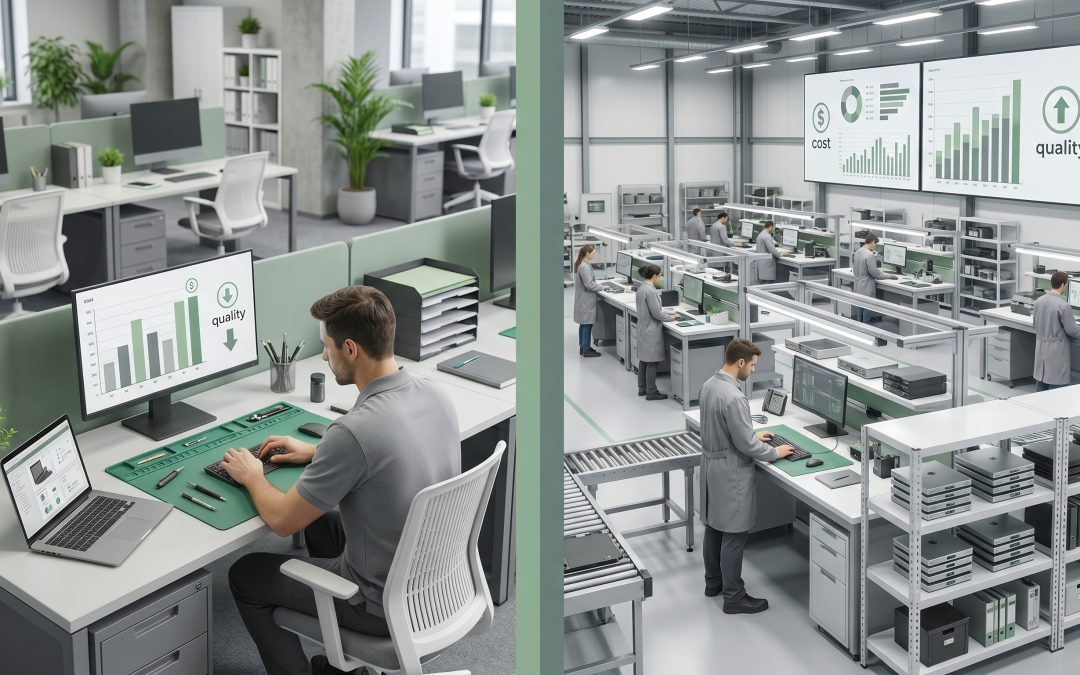
Refurbishing IT equipment for reuse rather than recycling delivers better environmental and financial outcomes. But should your organisation handle refurbishment internally or outsource it to a specialist? The answer depends on your volumes, technical capability, and strategic objectives.
In-House Refurbishment
In-house refurbishment means your own staff test, repair, upgrade, and redeploy equipment within the organisation or prepare it for external sale. This approach gives you direct control over quality, timing, and the decision about which equipment is worth refurbishing.
When it makes sense: You have skilled IT staff with spare capacity. You want to redeploy equipment internally, for example moving executive laptops to less demanding roles. You process relatively small volumes where the overhead of outsourcing exceeds the cost of doing it yourself. Or you have specialised equipment that requires internal expertise to properly test and configure.
Challenges: It requires dedicated workspace, test equipment, and spare parts inventory. Your staff may not have the expertise in cosmetic restoration, certified data destruction, or secondary market pricing. Scaling is difficult when volumes spike during major refreshes. And there is an opportunity cost: your IT staff could be working on higher-value projects.
Outsourced Refurbishment
Outsourcing to a specialist ITAD provider means sending equipment to a facility designed for high-volume refurbishment. The provider handles testing, repair, data destruction, cosmetic restoration, and remarketing.
When it makes sense: You process volumes that justify the logistics of sending equipment to an external facility. You want access to professional-grade testing, refurbishment, and remarketing capabilities. You do not have internal staff with refurbishment expertise or spare capacity. Or you want to capture the best possible resale value through a provider with established secondary market channels.
Challenges: Equipment must be transported off-site, introducing logistics costs and chain of custody requirements. You have less direct control over quality and timing. The provider takes a margin on the refurbishment and remarketing, reducing your net revenue. And the provider may not handle very small volumes cost-effectively.
The Hybrid Approach
Many organisations handle basic internal redeployment themselves, performing simple tasks like reimaging and battery replacement for equipment that will be reused within the organisation. Equipment destined for external remarketing goes to the ITAD provider for professional refurbishment and sale. This hybrid captures the benefits of both approaches.
EWV handles IT asset disposition (ITAD) end-to-end for Victorian businesses — from collection and data destruction through to certified recycling or refurbishment for resale. Get in touch for a tailored ITAD quote.