
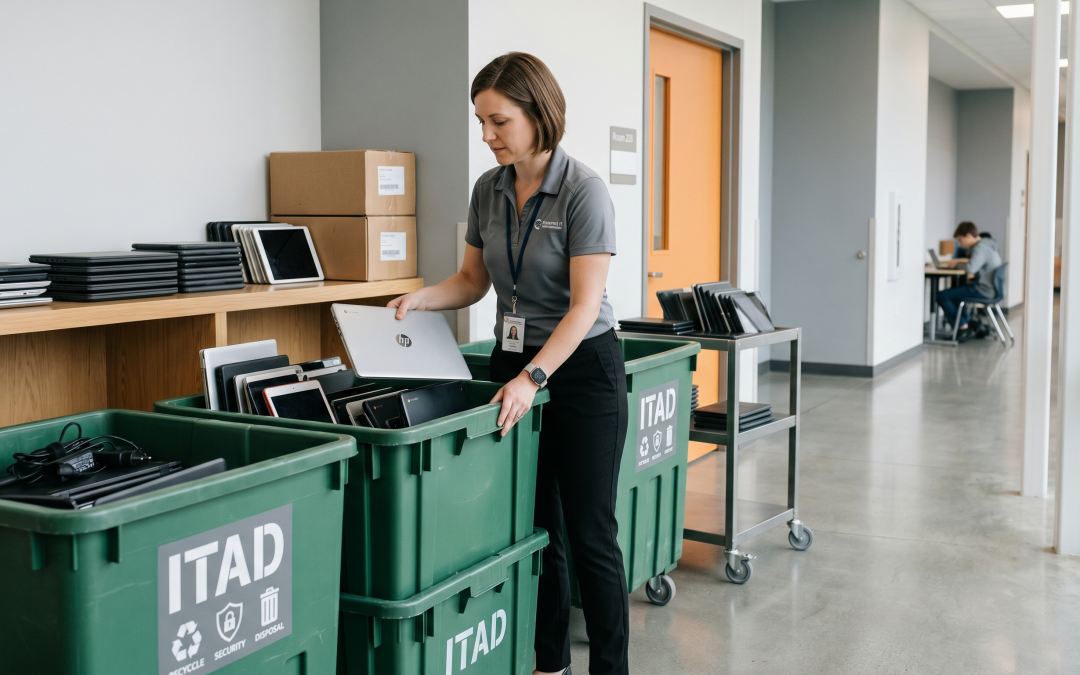
School IT coordinators face a unique set of challenges when it comes to IT asset disposition. Tight budgets, large fleets of student devices, data privacy obligations for minors, and the pressure to be environmentally responsible all converge to make disposal planning essential. Whether you are managing a single primary school or coordinating across a multi-campus secondary college, a structured approach to ITAD will save you time, reduce risk, and potentially recover funds for new equipment.
The School IT Disposal Challenge
Schools are some of the most device-intensive organisations per capita. One-to-one laptop programs, shared computer labs, teacher devices, interactive whiteboards, and administrative systems all create a steady stream of end-of-life equipment. A secondary school with 1,000 students running a one-to-one program might be cycling 200 to 300 devices per year, and that is before accounting for breakages and early retirements.
Unlike corporate environments, schools operate on fixed budgets with limited flexibility. Every dollar spent on disposal is a dollar that cannot be spent on new equipment or educational resources. This makes cost management and value recovery particularly important.
Data Privacy for Student Devices
Student devices contain personal information about minors, which carries heightened privacy obligations. The Privacy Act and state-level health and education records legislation impose strict requirements around the handling and destruction of information about children.
Before any device leaves the school, all personal data must be securely destroyed. This includes student work files, browser history, cached login credentials, email data, and any cloud service tokens. A simple factory reset is not sufficient because data may remain recoverable. Certified data destruction to a recognised standard like NIST 800-88 is the appropriate approach.
If your school uses a mobile device management (MDM) system, use it to remotely wipe devices before they are collected for disposal. However, treat the MDM wipe as a first step, not the final one. Your ITAD provider should perform a secondary verified wipe or physical destruction as part of their processing.
Budget-Friendly Disposal Strategies
Schools need to balance proper disposal with budget constraints. Several strategies can help manage costs.
Batch processing reduces per-unit costs. Rather than disposing of devices individually throughout the year, accumulate them and process in batches. Most ITAD providers offer volume discounts, and the logistics of a single collection are cheaper than multiple small pickups.
Value recovery can offset or even exceed disposal costs. Student laptops that are three to four years old and still functional can have meaningful resale value. Your ITAD provider can refurbish and resell these devices, with the proceeds offsetting the cost of data destruction and processing. For schools with newer, well-maintained fleets, value recovery can turn ITAD from a cost into a revenue source.
Donation programs may be appropriate for devices that have limited resale value but are still functional. Donating to community organisations, families in need, or partner schools in developing countries is a positive outcome, but ensure data destruction is completed before donation, and check whether your school or department has specific policies about equipment donation.
Sector-specific programs exist in some states and territories. Check with your education department whether there are centrally coordinated disposal programs that offer preferential rates or streamlined processes for schools.
Managing the Device Lifecycle
Good ITAD outcomes start with good lifecycle management. Plan your refresh cycles so that devices are replaced before they become too old to recover meaningful value. A four-year cycle for student laptops is common and balances useful life against residual value and maintenance costs.
Maintain a current asset register that tracks every device from procurement to disposal. Include the serial number, purchase date, assigned student or classroom, and condition notes. This register is your foundation for disposal planning and compliance documentation.
Implement a clear process for handling devices when students leave or move between year levels. Devices should be collected, inspected, and either redeployed or added to the disposal queue. Devices that go missing are both a financial loss and a potential data risk.
Working with Your ITAD Provider
Choose an ITAD provider that understands the education sector. Schools have specific needs including flexible scheduling around term dates, sensitivity to budget constraints, experience with high-volume device processing, and understanding of education-specific data privacy requirements.
Schedule collections during term breaks when devices can be collected and processed without disrupting teaching. Plan ahead so that devices are decommissioned, wiped via MDM, and staged in a secure area before the collection date. This preparation makes the collection process faster and more efficient.
Request detailed reporting from your provider, including per-device data destruction certificates, environmental compliance documentation, and value recovery statements. These reports support your compliance obligations and demonstrate responsible asset management to your school leadership and parent community.
Environmental Responsibility
Schools have a particular responsibility to model environmental best practice. Students learn from what the school does, not just what it teaches. A visible, well-communicated e-waste program reinforces sustainability education and demonstrates that the school practises what it preaches.
Under Victoria’s e-waste landfill ban, electronic waste cannot be sent to landfill. Ensure all your end-of-life equipment is directed to certified recyclers. Consider involving students in the process, for example by running e-waste awareness campaigns or incorporating the school’s recycling data into sustainability curriculum.
Compliance Documentation
Maintain a complete file for each disposal event that includes the list of devices disposed of with serial numbers, certificates of data destruction, collection and chain of custody records, environmental compliance documentation, and any financial records related to value recovery or disposal costs.
These records should be retained for a minimum of seven years and be accessible for audits by your school leadership, education department, or privacy regulators. Good record-keeping protects the school and demonstrates professional asset management.
EWV handles IT asset disposition (ITAD) end-to-end for Victorian businesses — from collection and data destruction through to certified recycling or refurbishment for resale. Get in touch for a tailored ITAD quote.