
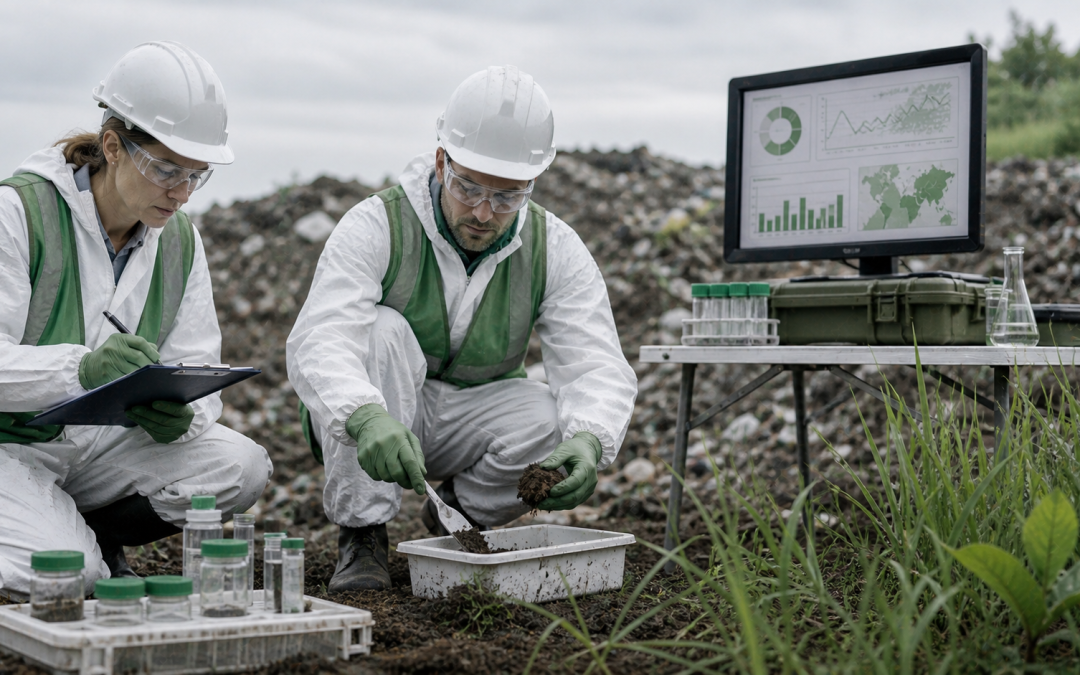
When electronic waste contaminates soil through landfill leaching, illegal dumping, or informal processing, the resulting heavy metal and chemical contamination requires remediation that is technically challenging, extremely expensive, and often only partially effective. Understanding the realities of soil remediation from e-waste contamination underscores why prevention through proper e-waste management is far preferable to cleanup after the damage is done.
Types of Soil Contamination from E-Waste
E-waste creates several categories of soil contamination. Heavy metal contamination is the most common and persistent. Lead, mercury, cadmium, chromium, copper, zinc, and arsenic from various electronic components accumulate in soil at concentrations that can be hundreds or thousands of times above natural background levels at heavily impacted sites.
Organic pollutant contamination includes brominated flame retardants (PBDEs, HBCD), polychlorinated biphenyls (PCBs from older equipment), dioxins and furans (from burning), polycyclic aromatic hydrocarbons (PAHs from incomplete combustion), and phthalates and other plasticisers from degrading plastics.
Mixed contamination is the most common scenario, where both heavy metals and organic pollutants are present simultaneously, often making remediation more complex because different contaminant types may require different treatment approaches.
Remediation Technologies
Several technologies are used to remediate soil contaminated by e-waste, each with strengths and limitations. Excavation and disposal is the most straightforward approach, involving physically removing contaminated soil and transporting it to a licensed hazardous waste facility. It is effective at removing contamination from the site but simply moves the problem elsewhere, is very expensive for large volumes, and generates significant transport emissions.
Soil washing uses water or chemical solutions to dissolve or separate contaminants from soil particles. It can be effective for certain heavy metals and some organic compounds but generates contaminated wastewater that requires treatment, may not remove all contaminant types, and works best on sandy or gravelly soils rather than clay-rich soils.
Chemical stabilisation involves adding materials that bind heavy metals into less soluble forms, reducing their mobility and bioavailability. The contaminants remain in the soil but are less likely to leach into groundwater or be taken up by plants. This is cost-effective for large areas but does not remove contaminants, requires long-term monitoring, and may not be permanent if soil chemistry changes over time.
Phytoremediation uses plants that accumulate heavy metals in their tissues to gradually extract contaminants from soil. Certain plant species, called hyperaccumulators, can take up high concentrations of specific metals. This approach is low cost and minimally disruptive but extremely slow (requiring years to decades for meaningful remediation), limited to the root zone depth, and only effective for specific contaminants that certain plants can accumulate.
Challenges Specific to E-Waste Contamination
E-waste soil contamination presents several remediation challenges. Multiple contaminant types require multiple treatment approaches. A site with both heavy metals and organic pollutants may need sequential treatments or combined approaches, increasing complexity and cost. Heavy metal persistence means that, unlike organic pollutants that can potentially be biodegraded, heavy metals do not break down. They can only be removed, stabilised, or dispersed, none of which fully eliminates the contamination.
Depth of contamination at landfill sites can extend metres below the surface, well beyond the reach of many remediation technologies. Deep contamination may require extensive excavation or be left in place with containment measures. And ongoing sources like active landfills may continue to generate contamination even as remediation attempts are made, requiring source control before remediation can be effective.
The Australian Context
Australia has contaminated sites associated with e-waste from historical landfilling of electronics, industrial sites where electronics were manufactured or processed, and locations where illegal dumping has occurred. State and territory contaminated land registers identify known contaminated sites, and environmental protection authorities oversee remediation activities.
Victoria’s e-waste landfill ban, effective since 1 July 2019, prevents new e-waste contamination from landfilling but does not address historical contamination from decades of e-waste disposal in landfill. Many legacy sites will require monitoring and potentially remediation for years to come.
Prevention Over Remediation
The overwhelming lesson from soil remediation experience is that prevention is orders of magnitude more effective and economical than cleanup. Ensuring e-waste is processed through certified facilities with proper environmental controls prevents the contamination that would later require expensive, imperfect remediation.
For organisations, this means ensuring all retired IT equipment goes through certified ITAD providers, never allowing e-waste to enter general waste streams that might end up in landfill, verifying that downstream processors operate under appropriate environmental management systems, and supporting regulatory frameworks that prevent e-waste from reaching the environment.
For information on how proper e-waste management prevents environmental contamination, see our complete guide to e-waste recycling in Australia. For a broader view of the environmental costs of improper disposal, our guide on the true environmental cost of electronic waste provides comprehensive coverage.
]]>