
Transportation is a necessary part of every ITAD programme, moving retired equipment from your premises to processing facilities and onward to remarketing channels or downstream recyclers. While transport emissions are typically a small fraction of the total lifecycle carbon footprint of IT equipment, they are within your influence and can be optimised. Understanding where transport emissions come from and how to reduce them contributes to a more comprehensive approach to IT lifecycle carbon management.
Where Transport Emissions Occur
Transport emissions in the ITAD chain arise at several points. Collection involves picking up equipment from your premises and delivering it to the ITAD provider’s facility. This is usually the most significant transport stage because it involves individual site visits, often with partially loaded vehicles. Inter-facility transfers occur when equipment moves between different processing locations, for example from a collection hub to a data destruction facility or from a refurbishment centre to a remarketing warehouse.
Downstream transport covers the movement of processed materials, such as shredded metals going to smelters or refurbished equipment being shipped to buyers. If materials are exported for processing or remarketing, international shipping emissions can be substantial. Returns and redistribution involve refurbished equipment being delivered to its next user, which may be domestic or international.
Calculating Transport Emissions
Transport emissions are calculated using the weight of equipment transported, the distance travelled, the type of vehicle used, and the applicable emission factor. The Australian National Greenhouse Accounts Factors provide emission factors for different vehicle types, typically expressed in kg CO2e per tonne-kilometre.
For a typical ITAD collection using a medium rigid truck (the common type for IT equipment pickups), the emission factor is approximately 0.15 to 0.25 kg CO2e per tonne-kilometre. A collection trip of 50 km carrying 500 kg of equipment would generate approximately 3.75 to 6.25 kg CO2e, a modest amount compared to the embodied carbon in the equipment itself.
However, if your organisation has multiple sites across a large geographic area, or if your equipment is shipped interstate or internationally for processing, transport emissions can accumulate to more meaningful levels.
Collection Logistics Optimisation
Collection logistics offer the most direct opportunity to reduce transport emissions. Scheduled collections on a regular cadence (monthly or quarterly) allow your ITAD provider to plan efficient routes and ensure vehicles are well loaded. This contrasts with ad-hoc collections where a truck may travel a significant distance for a small number of items.
For multi-site organisations, consolidating equipment from several smaller sites to a central location for a single collection reduces the total kilometres driven and improves vehicle utilisation. The trade-off is the internal effort required to move equipment between sites, but for organisations with regular inter-site logistics, adding IT equipment to existing transport arrangements can be efficient.
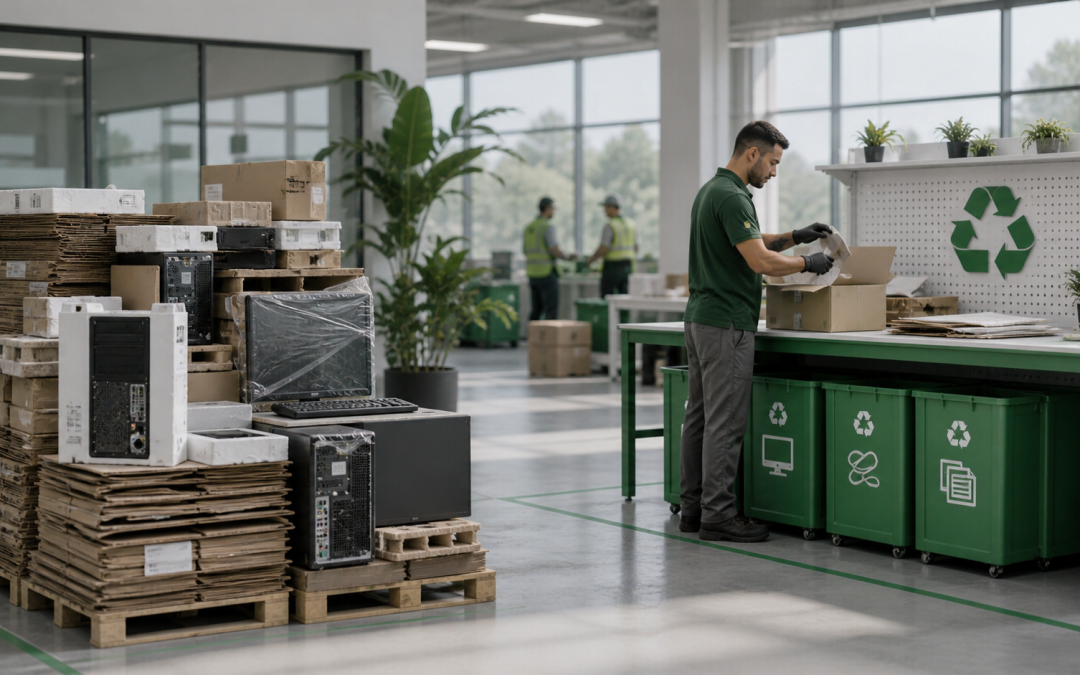
Pallet collection, where you consolidate equipment onto pallets for efficient loading, reduces on-site handling time and allows faster turnaround at each pickup location, meaning the vehicle can cover more collections per trip.
Vehicle and Fuel Considerations
The type of vehicle used for collection affects per-kilometre emissions. Larger vehicles have higher absolute emissions but may have lower per-tonne emissions when fully loaded. Electric and hybrid vehicles produce lower tailpipe emissions, and some ITAD providers are beginning to incorporate electric vehicles into their collection fleets, particularly for urban routes where range limitations are less of a constraint.
For longer-distance transport, such as interstate movements or delivery to regional facilities, vehicle efficiency and fuel type have a proportionally larger impact because the distances involved amplify any per-kilometre emission differences.
Domestic vs International Processing
One of the most significant transport emission variables is whether your equipment is processed domestically or exported. Shipping equipment to overseas processing facilities, whether for recycling or remarketing, adds substantial transport emissions from trucking to port, container handling and port operations, ocean freight (which, while relatively efficient per tonne-kilometre, involves enormous distances), and local transport at the destination.
Choosing an ITAD provider that processes equipment domestically within Australia eliminates these international transport emissions entirely. It also provides better visibility into the processing chain, stronger regulatory protections, and a simpler audit trail.
Reporting Transport Emissions
Transport emissions from ITAD fall into your Scope 3 reporting under Category 5 (Waste Generated in Operations) if the transport is arranged by your ITAD provider. If you use your own vehicles for any part of the transport, those emissions would be Scope 1 (for company-owned vehicles) or Scope 3 Category 4 (for third-party transport you arrange).
Ask your ITAD provider for transport-specific emission data as part of their environmental reporting. The key data points are total distance travelled for your collections, vehicle types used, and the resulting CO2e emissions. Some providers include transport emissions in their overall processing emission figures, while others report them separately.
For guidance on how transport emissions fit into your broader ITAD carbon accounting, see our guide on CO2e avoidance reporting for ITAD. For the overall context of Scope 3 emissions from IT equipment, our practical guide covers the full calculation framework.
]]>