
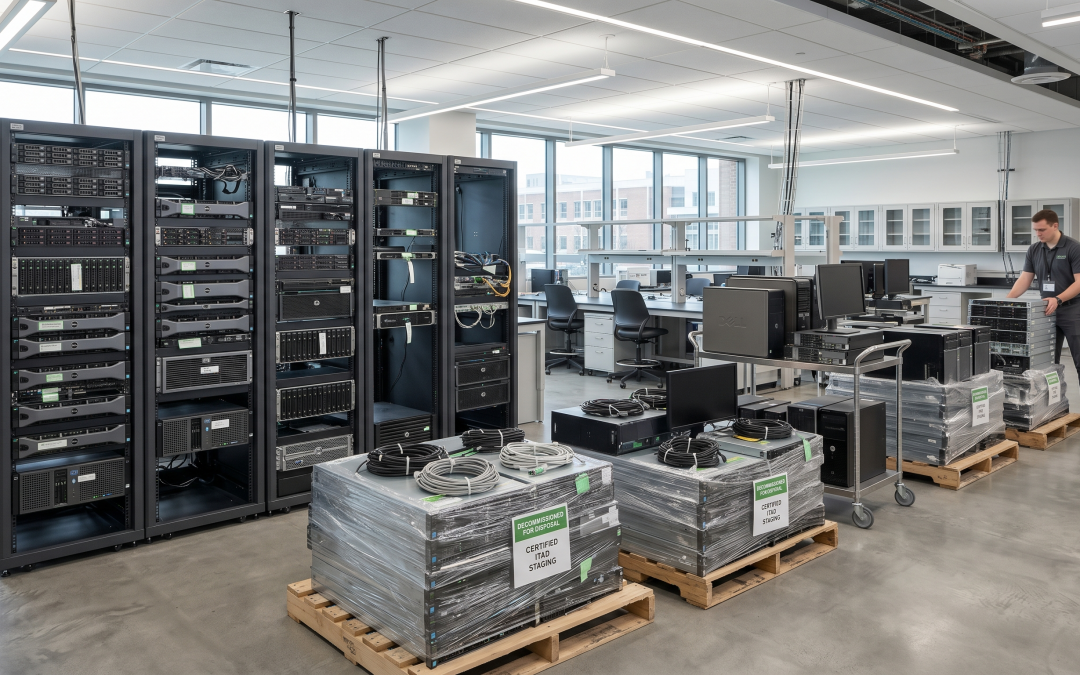
Universities present one of the most complex IT asset disposition challenges of any sector. The combination of vast, distributed IT estates, sensitive research data, student and staff personal information, decentralised governance, and tight budgets creates a disposal environment that requires careful coordination across faculties, departments, and central IT.
The University IT Landscape
A large Australian university might manage tens of thousands of IT devices across multiple campuses. The standard fleet includes staff laptops and desktops, student lab computers, lecture theatre and classroom technology, and administrative systems. But universities also deploy specialised research equipment including high-performance computing clusters, laboratory instrumentation with embedded computing, data acquisition systems, specialised imaging and analysis workstations, and research-specific servers and storage.
This diversity means a university’s ITAD program must handle everything from commodity laptops to highly specialised research equipment that may have no secondary market and requires specialist disposal knowledge.
Research Data Sensitivity
Research data is often the most sensitive information on a university’s IT systems. This data can include unpublished research findings that represent years of work and millions of dollars in funding, clinical trial data subject to health privacy legislation and ethics committee requirements, commercial research conducted under industry partnership agreements with strict IP protections, defence and security-related research subject to government controls, and personal data collected from research participants who consented to specific uses.
The improper disposal of equipment containing research data can have severe consequences. Unpublished findings could be compromised, affecting publication priority and funding outcomes. Clinical trial data breaches could trigger regulatory action and harm research participants. IP leakage could breach commercial partnership agreements and result in legal liability.
Apply rigorous data destruction standards to all research equipment. For equipment that has processed the most sensitive research data, physical destruction is the appropriate method. For standard research workstations, certified software sanitisation provides adequate assurance.
Decentralised Governance Challenge
Universities are notoriously decentralised. Individual faculties, schools, and research centres often manage their own IT equipment with varying levels of oversight from central IT. This decentralisation creates several ITAD challenges.
Equipment purchased through research grants may not appear in the central asset register. Departments may dispose of equipment informally without going through a formal ITAD process. Research labs may retain old equipment long past its useful life because nobody takes responsibility for its disposal. And different parts of the university may apply inconsistent data destruction standards.
Address these challenges through a university-wide ITAD policy that applies to all faculties and departments, regardless of how equipment was funded or who manages it. The policy should mandate central oversight of all disposals, require data destruction certification for every device, and establish clear responsibilities for departmental IT staff and researchers.
Student Lab Equipment
Student computer labs generate regular disposal volumes as equipment is refreshed on three to five year cycles. Lab computers may contain student work files, cached credentials, and browsing history from thousands of users. While the data per device is less sensitive than a researcher’s workstation, the aggregate volume across a large lab refresh can be significant.
Standard certified sanitisation is appropriate for lab equipment. The relatively recent vintage and uniform specification of lab computers also means they typically have good resale value, making lab refreshes a good opportunity for value recovery that can partially fund the new equipment.
Coordinate lab disposals with the academic calendar. Process lab refreshes during semester breaks when labs are not in use. Plan ahead so that new equipment is installed and tested before the start of the next teaching period.
High-Performance Computing and Data Centre Equipment
University data centres and HPC facilities house some of the most valuable and sensitive IT infrastructure on campus. When these systems are decommissioned, the volumes can be substantial, and the equipment may include servers, storage arrays, networking equipment, and specialised accelerators like GPU clusters.
HPC and data centre decommissioning should be treated as a project with dedicated planning, budget, and oversight. Identify all data stores associated with the systems being retired. Ensure that research data is migrated or archived according to retention requirements before hardware enters the disposition pipeline. Coordinate with researchers who may have data on the systems to ensure nothing is lost.
University data centre equipment can have strong resale value, particularly servers and storage arrays that are still within their useful life from a commercial perspective. Work with your ITAD provider to maximise value recovery, and consider whether any equipment can be redeployed to other university research groups before it enters the external disposition pipeline.
Grant-Funded Equipment
Equipment purchased through research grants may have specific conditions attached to its disposal. Some funding bodies require that equipment is returned or transferred to other institutions at the end of the grant period. Others require that disposal proceeds are returned to the funding pool. And some grants specify particular data handling requirements at the end of the research project.
Check the conditions of the relevant grant before disposing of any grant-funded equipment. Work with your research office to understand the obligations and ensure compliance. Document the disposal of grant-funded equipment thoroughly, as funding bodies may audit equipment disposals as part of their grant acquittal process.
Environmental Responsibility and Teaching
Universities have a dual role in e-waste management. They are both generators of e-waste and educators of the next generation. A visible, well-managed e-waste program supports the university’s sustainability commitments and provides a practical example for students studying environmental science, sustainability, engineering, and related fields.
Under Victoria’s e-waste landfill ban, all electronic waste must be recycled through approved channels. Document your e-waste volumes, recycling outcomes, and environmental metrics, and share these results through the university’s sustainability reporting.
EWV handles IT asset disposition (ITAD) end-to-end for Victorian businesses — from collection and data destruction through to certified recycling or refurbishment for resale. Get in touch for a tailored ITAD quote.