
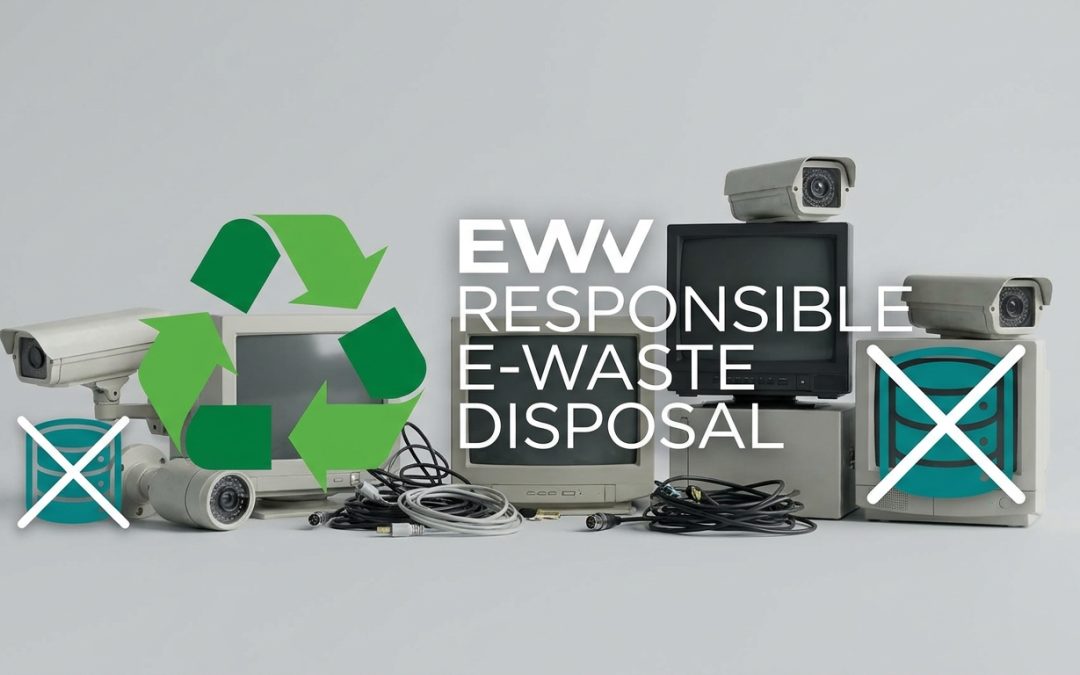
Security camera and CCTV systems are replaced regularly as technology improves, businesses renovate, and older analogue systems give way to modern IP cameras. Disposing of these systems involves unique considerations around video footage privacy, data storage, and the mix of equipment that makes up a complete surveillance installation.
Components of a CCTV System
A complete security camera system includes several types of equipment that all need proper handling during disposal.
Cameras (IP cameras, analogue cameras, PTZ cameras, dome cameras) contain image sensors, lenses, infrared LED arrays for night vision, circuit boards, weatherproof housings (for outdoor models), and sometimes microSD card storage and built-in microphones. Some modern IP cameras also contain AI processing chips for on-device analytics like person detection and facial recognition.
Network Video Recorders (NVRs) and Digital Video Recorders (DVRs) are the central storage and management devices. These contain one or more hard drives (often multiple terabytes), processors, RAM, network interfaces, and firmware that stores system configuration. The hard drives are the primary data security concern.
Switches and networking equipment (PoE switches for IP camera systems) supply power and data connectivity to cameras. These store network configurations as described in our guide to recycling networking equipment.
Cabling includes coaxial cable (for analogue systems) and Cat5e/Cat6 Ethernet cable (for IP systems), plus power cabling.
The Data Problem: Video Footage
NVRs and DVRs contain hard drives that store weeks to months of continuous video footage, depending on the number of cameras, resolution settings, and storage capacity. This footage contains images of identifiable people, which makes it personal information under Australian privacy law.
Before disposing of NVR/DVR equipment, the hard drives must be either wiped to NIST 800-88 standards (if the drives are going to be reused) or physically destroyed (if the drives are being retired). Simply deleting the recordings or formatting the drive is not sufficient for compliance purposes.
Individual cameras that have onboard storage (microSD cards) also contain footage that needs to be cleared. Remove any SD cards and either wipe or destroy them.
Configuration Data
Beyond the video footage, CCTV systems store configuration data that could be a security concern. NVRs/DVRs store user accounts and passwords for system access, network configuration including IP addresses, camera positioning data (pan, tilt, zoom presets), motion detection zones and alert configurations, and remote access credentials (for viewing cameras from outside the network).
IP cameras individually store Wi-Fi or network credentials, RTSP stream credentials, ONVIF access credentials, and firmware that may contain security certificates.
Perform a factory reset on every device (NVR/DVR, each camera, network switches) before disposal to clear this configuration data.
Recycling the Equipment
Cameras
Security cameras contain circuit boards, image sensors (CCD or CMOS), infrared LEDs, lenses, aluminium or plastic housings, and copper wiring. Outdoor cameras often have weatherproof aluminium or die-cast housings that have good metal recycling value. The circuit boards contain the standard precious metals found in all electronics.
NVRs and DVRs
These devices are essentially small computers and should be recycled the same way. The hard drives are the most valuable and most sensitive components. The chassis, power supply, and circuit boards all contain recyclable materials.
Cabling
Coaxial cable from analogue systems contains copper (or copper-clad steel) centre conductor and copper braided shield, making it worth recycling. Ethernet cable from IP systems contains four pairs of copper conductors. For large installations, the cabling can represent significant copper weight. See our guide to recycling cables and wiring for more detail.
Where to Recycle
Professional e-waste recyclers and ITAD providers are the recommended option for CCTV system disposal, particularly for the NVR/DVR units that contain data-bearing hard drives. They can provide certified data destruction for the storage devices and handle the hardware recycling.
Council e-waste drop-off points accept individual cameras and small DVRs at transfer stations.
Resale: Enterprise-grade IP cameras from brands like Axis, Hikvision, and Dahua can have reasonable resale value if they are relatively recent models. NVRs with current-generation features may also be resaleable. Factory reset everything and remove hard drives before selling.
Upgrading from Analogue to IP
Many businesses and homeowners are currently upgrading from analogue CCTV to modern IP camera systems. This transition generates a complete system’s worth of e-waste: analogue cameras, a DVR, coaxial cabling, BNC connectors, and power supplies. Plan the disposal of the old system as part of your upgrade project and coordinate with your installer to ensure the old equipment is recycled rather than dumped.
The coaxial cabling from an analogue system is worth recovering for its copper content, particularly in larger installations where hundreds of metres of cable may be involved.
For the complete picture on IT equipment disposal including security systems, see our guide to building an IT asset disposal policy.
EWV helps Victorian businesses manage e-waste and IT asset disposal compliantly and sustainably — including collection, certified data destruction, and recycling. Contact us for a free quote.