
Technology in Early Childhood Education
Childcare centres and early learning services have become increasingly technology-dependent over the past decade. What was once an industry that ran largely on paper has embraced digital systems for almost every aspect of operations. From electronic sign-in kiosks at the front door to tablets used for documenting children’s learning journeys, technology is now woven into the daily routine of early childhood education settings across Australia.
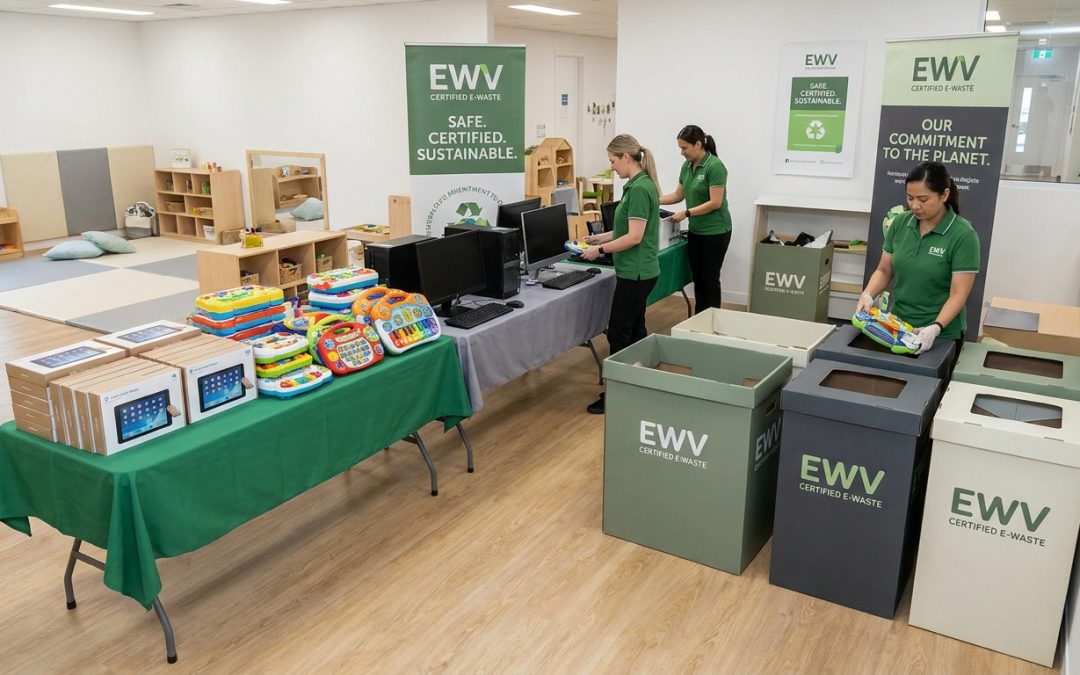
A typical childcare centre will have computers for administration and programming, tablets for educators, electronic sign-in/sign-out systems, security cameras, intercom systems, and networking equipment. Larger centres and those operated by corporate groups may also have servers, point-of-sale systems for fee payments, and dedicated devices for the Child Care Subsidy (CCS) system. When any of this equipment needs replacing, it becomes e-waste that requires proper handling.
The childcare sector’s relatively tight operating margins mean that technology refreshes do not always happen on optimal schedules. Equipment is often used until it fails rather than being replaced proactively, which can result in older devices accumulating in storage rooms while staff figure out what to do with them.
The Exceptional Sensitivity of Childcare Data
Of all the industries that generate e-waste, childcare centres may handle some of the most sensitive personal information there is. The data on childcare centre devices relates primarily to children, and the legal and ethical obligations around protecting children’s information are among the strictest in any sector.
Consider what a childcare centre’s computer system typically stores: children’s full names, dates of birth, addresses, medical conditions, allergy information, immunisation records, developmental assessments, learning stories with photographs, and custody arrangements. Family information includes parents’ names, workplaces, income details (for subsidy assessments), emergency contacts, and sometimes court orders or intervention documentation for vulnerable families.
- Children’s personal details, medical conditions, and allergy information
- Immunisation records and developmental assessments
- Photographs and videos of children (learning documentation)
- Family income details and Child Care Subsidy records
- Custody arrangements, court orders, and family violence orders
- Staff Working with Children Check details
- Incident reports including injury records
- Parent payment records and financial information
Photographs and videos of children represent a particularly sensitive category. Educators routinely photograph children as part of their learning documentation, and these images are stored on tablets, computers, and sometimes cloud-synced devices. The thought of these images ending up on an improperly disposed device is deeply concerning from both a privacy and child safety perspective.
The Privacy Act 1988, along with state-level child information sharing legislation and the National Quality Framework, all impose obligations on childcare providers to protect the information they hold about children and families. Secure disposal of devices containing this data is not optional. Our guide to preventing data breaches through proper IT disposal explains why professional data destruction matters.
Regulatory Framework for Childcare E-Waste
Childcare services in Australia operate under the National Quality Framework (NQF), which includes the Education and Care Services National Law and National Regulations. While the NQF does not specifically address e-waste disposal, it does require services to maintain secure records management practices and protect the privacy of children and families. Proper disposal of devices containing records is an extension of these obligations.
The Child Care Subsidy system requires services to transmit sensitive family information to the Department of Education. Devices that have been used to process CCS data, including session reports, enrolment records, and subsidy calculations, contain financial and personal information that is subject to both Privacy Act protections and specific CCS record-keeping requirements.
Victorian childcare centres must also comply with the state’s e-waste landfill ban. Every electronic device, from a broken tablet to a decommissioned security camera, must be recycled through appropriate channels. For an overview of the regulatory landscape, see our article on e-waste laws and regulations across Australia.
Electronic Sign-In Systems and Kiosks
Most modern childcare centres use electronic sign-in and sign-out systems, either as standalone kiosks or tablet-based applications. These systems record who is dropping off and picking up each child, the times of attendance, and sometimes capture digital signatures or photographs of authorised collectors. Some systems integrate with the CCS platform to submit attendance data directly.
When these systems are replaced, the devices may contain cached attendance records, authorised collector details, and potentially photographs of parents and family members. Even if the primary data is stored in the cloud, local devices often retain cached information that needs to be properly wiped before disposal.
Standalone kiosk units are essentially computers in custom housings and should be treated as standard IT equipment for disposal purposes. The data they contain, particularly information about children’s daily attendance patterns and who collects them, is sensitive from a child safety perspective.
Security Cameras and Monitoring
Childcare centres typically operate security camera systems both for child safety monitoring and general security. These systems include cameras, recording devices (DVRs or NVRs), and sometimes dedicated monitors. The recording devices store footage that captures children, families, and staff throughout the day.
When security camera systems are upgraded, the recording devices must be securely wiped or physically destroyed before disposal. Footage of children is extremely sensitive, and the possibility of this footage being recovered from improperly disposed equipment represents a serious child safety risk. This is one area where the precautionary principle should always apply. If there is any doubt about whether data has been fully removed, physical destruction of the storage media is the safest option.
Educator Tablets and Learning Documentation
Many childcare centres provide tablets to educators for documenting children’s learning and development. These tablets capture photographs, videos, written observations, and developmental checklists throughout the day. The tablets may sync to cloud-based platforms, but they also typically store images and data locally.
When tablets are replaced due to damage, age, or software compatibility issues, all locally stored content needs to be removed before disposal. A factory reset may not be sufficient to remove all traces of stored photographs and cached data. Professional data sanitisation ensures that images of children cannot be recovered from retired devices.
For centres that allow educators to use personal devices for work documentation, clear policies about data removal when staff leave are equally important. While this is not strictly an e-waste issue, it is part of the broader data lifecycle management that supports secure disposal practices.
Practical Steps for Childcare Centres
Childcare centres can protect the children and families they serve by taking a deliberate approach to e-waste disposal. Here are the key steps:
First, maintain a list of all electronic devices in the centre, including who uses them and what data they contain. This does not need to be complicated. A simple spreadsheet tracking device type, location, and data sensitivity is sufficient for most centres.
Second, when devices are being replaced, ensure all data has been backed up or migrated before the old device is collected for disposal. This is particularly important for learning documentation photographs and attendance records that may be needed for compliance purposes.
Third, use a certified ITAD provider for all device disposal rather than attempting in-house data removal. Given the sensitivity of children’s information, professional data destruction with a certificate provides the highest level of assurance and creates a compliance record. See our guide on choosing an ITAD provider for what to look for in a disposal partner.
The children and families who trust childcare centres with some of their most personal information deserve to know that their data will be protected not just during the time it is actively used, but right through to the point where the devices that held it are securely and responsibly disposed of.
EWV helps Victorian businesses manage e-waste and IT asset disposal compliantly and sustainably — including collection, certified data destruction, and recycling. Contact us for a free quote.