
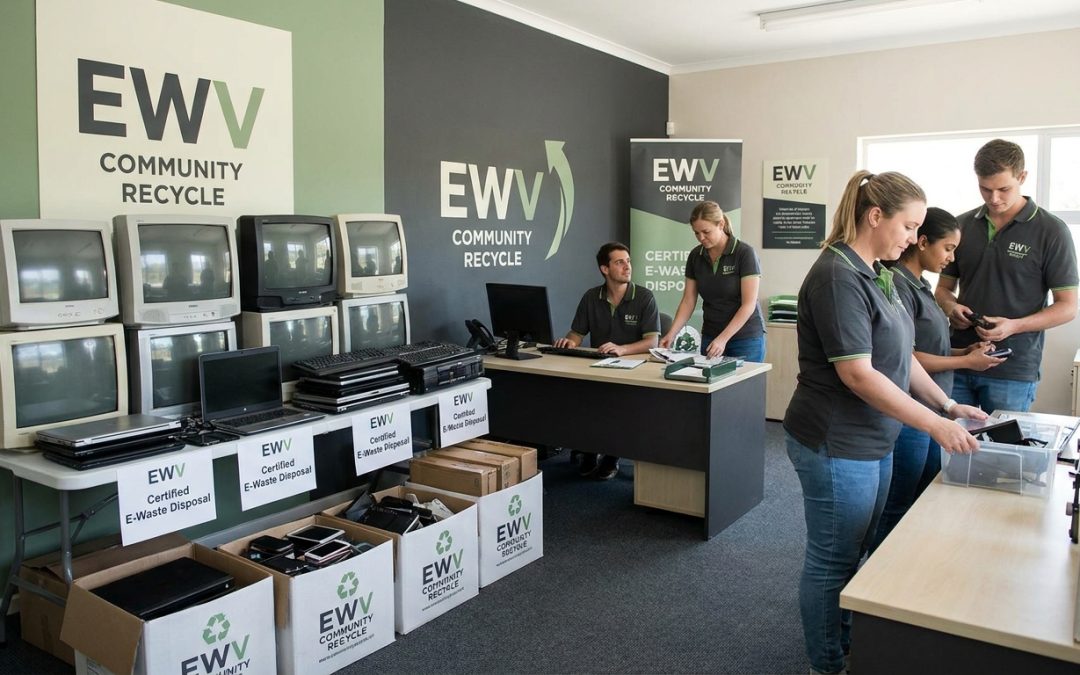
The E-Waste Challenge for Not-for-Profits
Community organisations and not-for-profit (NFP) organisations play a vital role in Australian society, but they often operate with limited budgets and lean IT resources. When computers age out, printers break down, or donated equipment reaches the end of its useful life, many NFPs are unsure how to dispose of it responsibly without adding to their already stretched budgets.
The reality is that NFPs accumulate e-waste just like any other organisation. Office computers, laptops, printers, phones, networking equipment, and donated devices all eventually need replacing. Many NFPs also manage community-facing technology like public access computers, digital signage, event equipment, and client management systems. The difference is that NFPs rarely have dedicated IT staff or disposal budgets, leaving e-waste management as an afterthought.
The result is all too common: cupboards and storage rooms filled with old computers, boxes of cables nobody knows what to do with, and outdated equipment sitting in corners because disposing of it properly seems too complicated or expensive. This guide explores practical, budget-conscious approaches to e-waste disposal that work for organisations operating on tight margins.
Data Security Matters for NFPs Too
One misconception in the NFP sector is that data security during disposal is mainly a concern for large corporations or government agencies. In reality, many community organisations handle highly sensitive personal information that requires careful protection throughout its lifecycle, including at disposal.
Consider what a typical community service organisation stores on its computers: client case files, referral records, mental health assessments, family violence documentation, housing application details, financial counselling records, and disability support plans. For organisations working with vulnerable populations, this information is extraordinarily sensitive. A data breach from improperly disposed equipment could put already vulnerable people at further risk.
- Community health and mental health services
- Family violence and crisis support organisations
- Disability support providers
- Housing and homelessness services
- Financial counselling and emergency relief providers
- Youth services and child protection organisations
- Refugee and migrant support services
- Drug and alcohol treatment services
Even NFPs that do not work with vulnerable clients still handle donor information, volunteer records, membership databases, and financial data that is protected under the Privacy Act 1988. Organisations with annual revenue over $3 million are directly covered by the Act, but many smaller NFPs also fall within its scope if they provide health services or are contracted by government to deliver services.
Professional data destruction is important regardless of the organisation’s size. For more on the standards involved, see our guide to data destruction for Australian businesses.
Free and Low-Cost Disposal Options
The good news for NFPs is that responsible e-waste disposal does not have to be expensive. Several options exist that can keep costs minimal:
Council e-waste drop-off points are available in many municipalities across Victoria and other states. These accept household and small business quantities of e-waste at no charge. For NFPs disposing of a few computers or a box of old equipment, this is often the simplest option. Check with your local council for locations and accepted items.
ITAD providers that offer equipment refurbishment and resale may collect equipment at no cost or even provide a return to the organisation if the equipment has residual value. Laptops and desktops that are only a few years old can often be refurbished and resold, with the proceeds offsetting or eliminating disposal costs. Even when equipment has no resale value, some providers offer free collection for sufficient volumes because they recover value from material recycling.
Manufacturer take-back programs are available from some major technology brands. Dell, HP, and Apple all operate recycling programs that accept their branded equipment. These can be a good option for NFPs that have standardised on a particular brand.
For organisations working with an IT managed service provider (MSP), disposal services may be included in or added to the existing service agreement. Many MSPs can arrange certified disposal as part of their equipment lifecycle management services.
Donated Equipment: When Good Intentions Create Problems
NFPs frequently receive donated computers and equipment from businesses, government agencies, and individuals. While these donations can be valuable, they also create e-waste challenges. Donated equipment is often older, meaning it has a shorter remaining useful life before it becomes e-waste itself. Some donated equipment arrives already obsolete, unsuitable for the organisation’s needs, and essentially becomes the NFP’s disposal problem.
Before accepting donated equipment, NFPs should assess whether the devices are actually usable for their intended purpose. A five-year-old laptop donated by a corporate partner may still work, but if it cannot run current software or meet minimum security requirements, it will become e-waste quickly. Establishing clear criteria for accepting donations helps prevent the organisation from becoming an informal e-waste collection point.
When donated equipment does reach end of life, the same disposal obligations apply as for any other equipment. The fact that it was received for free does not exempt it from e-waste regulations or data security requirements. Any data the organisation has stored on donated devices needs proper destruction before disposal.
Building a Simple E-Waste Process
NFPs do not need complex policies or expensive systems to manage their e-waste. A simple, practical process that everyone in the organisation understands is far more effective than a detailed policy document that sits in a drawer.
Start by designating a single collection point for retired equipment. Rather than letting old devices accumulate in individual offices or storage areas, have one clearly identified location where all end-of-life equipment goes. This makes it easier to track volumes and arrange disposal efficiently.
Establish a regular disposal schedule, even if it is just once or twice a year. Batching disposal is more efficient and cost-effective than handling individual items. Coordinate with your chosen disposal provider to arrange collection or drop-off at regular intervals.
- Designate one collection point for all retired equipment
- Keep a basic list of what goes into the collection point (device type, date)
- Arrange disposal at least annually, or when the collection reaches a full pallet
- Ensure data destruction is included for any device that has stored client or organisational data
- Keep certificates of disposal and data destruction in your compliance files
- Brief staff on where to put old equipment (not in general waste)
Compliance for Victorian NFPs
Victoria’s e-waste landfill ban applies equally to NFPs. No electronic equipment can go into general waste or landfill, regardless of the organisation’s size or sector. This includes everything from large items like computers and monitors down to small items like old phones, cables, keyboards, and mice.
NFPs that receive government funding may also have contractual obligations around data management and asset disposal. Funding agreements, particularly those from state and federal human services departments, often include clauses requiring the secure handling of client information throughout its lifecycle. Demonstrating proper disposal practices through certificates from certified providers supports compliance with these requirements.
For organisations accredited under the Human Services Standards or other quality frameworks, information management including disposal is typically addressed in the standards. Having a documented e-waste process, even a simple one, supports accreditation compliance. Our overview of Australian e-waste regulations provides broader context.
Making It Work on a Tight Budget
The key message for NFPs is that responsible e-waste disposal is achievable on any budget. Council drop-off points cost nothing. ITAD providers may collect for free or at minimal cost. The main investment required is organisational: someone needs to take responsibility for collecting and coordinating disposal, and staff need to know that old equipment goes to the collection point rather than the bin.
For NFPs looking to build a more structured approach to managing all their IT assets, not just the e-waste phase, our guide on building an IT asset disposal policy can be scaled to suit organisations of any size and budget. The principles are the same whether you are a large health service or a small community group running from a single office.
EWV helps Victorian businesses manage e-waste and IT asset disposal compliantly and sustainably — including collection, certified data destruction, and recycling. Contact us for a free quote.