
Technology in Places of Worship
Churches, mosques, temples, synagogues, and other religious organisations have embraced technology in ways that would have seemed unlikely a generation ago. Live-streamed services, projection systems, sound equipment, computers for administration, and digital communication platforms are now standard in congregations of all sizes. This technology serves the community well, but when it reaches end of life, religious organisations face the same e-waste disposal questions as any other organisation.
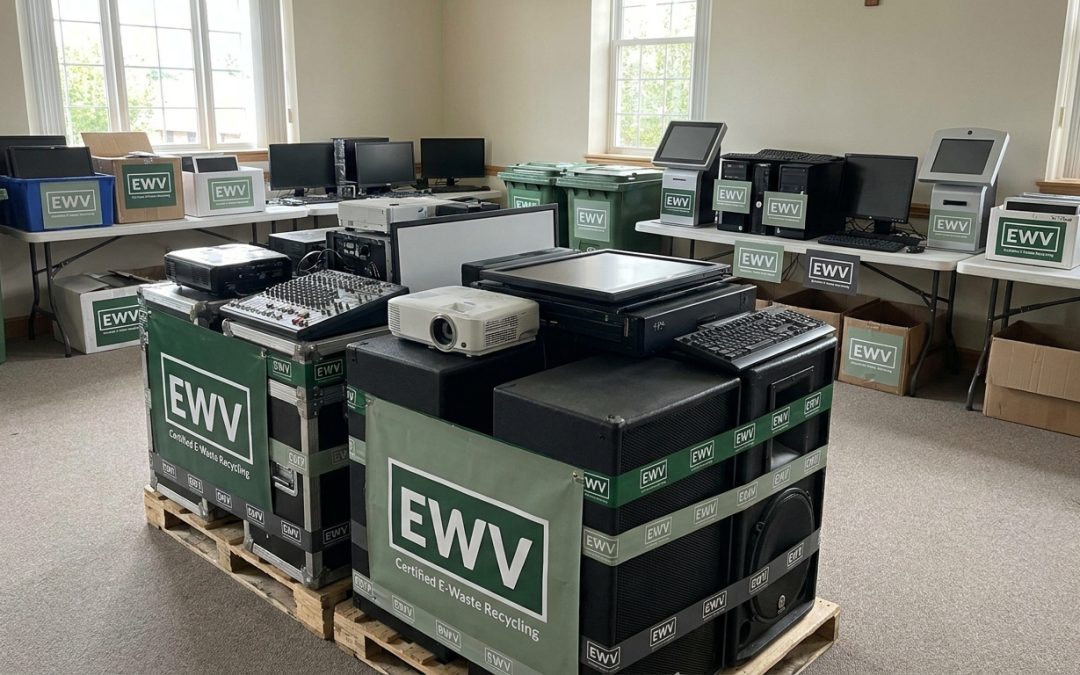
The range of electronic equipment in a typical religious organisation is broader than many people assume. Office computers and printers handle administration, accounting, and communication. Sound systems including mixers, amplifiers, speakers, and wireless microphones support worship services. Projection and display systems show lyrics, announcements, and multimedia content. Camera and streaming equipment enables online participation. And increasingly, building management systems control lighting, heating, cooling, and security across what can be substantial property portfolios.
Many religious organisations also operate ancillary services like community halls, schools, aged care facilities, counselling services, and charity operations, each generating their own e-waste streams. A large parish or denomination with multiple sites can accumulate significant volumes of electronic equipment over time.
Data Sensitivity in Religious Organisations
Religious organisations handle personal information that can be deeply sensitive. Membership databases contain names, addresses, family details, and giving histories. Pastoral care records may document personal crises, relationship difficulties, mental health concerns, and other highly confidential matters shared in trust. Counselling services operated by religious organisations handle data that is effectively clinical in nature.
- Membership records with personal and family details
- Giving and tithing histories (financial information)
- Pastoral care and counselling records
- Volunteer screening records including Working with Children Checks
- Community service client records (food bank, emergency relief, etc.)
- Employment records for staff
- Safeguarding and incident records
- Banking and financial management data
Giving records are particularly sensitive because they reveal both financial capacity and religious affiliation, two categories of personal information that individuals may not want disclosed. A data breach from an improperly disposed computer could expose who gives what to which religious organisation, information that many people consider deeply private.
Religious organisations that provide community services like food banks, emergency relief, or counselling handle client information that may include details about financial hardship, family circumstances, or personal crises. This data deserves the same protection as information held by any other community service provider.
The Privacy Act 1988 applies to religious organisations with annual revenue over $3 million, and also to smaller organisations if they provide health services or hold health information. Even where the Act does not technically apply, the ethical obligation to protect information shared in confidence is a fundamental part of pastoral and community care. Our guide to data breach prevention covers why secure disposal matters.
Audio-Visual Equipment as E-Waste
One of the largest categories of e-waste in religious organisations is audio-visual (AV) equipment. Sound systems, projectors, displays, cameras, and streaming equipment are essential for modern worship but have finite lifespans and get replaced regularly as technology advances.
Sound systems include mixing consoles (increasingly digital), power amplifiers, speakers, wireless microphone systems with receivers, and in-ear monitoring equipment. Digital mixing consoles contain computer processors and storage that may hold configuration data, recording files, and network settings.
Projectors and large displays are common in worship spaces. Projectors contain lamps with mercury content that requires special handling during recycling. LED displays contain circuit boards and power supplies. Media servers or dedicated computers running presentation software store service content and potentially network credentials.
Live streaming and recording equipment has become standard since the pandemic accelerated the adoption of online services. Cameras, capture cards, encoding computers, and associated networking equipment all become e-waste when upgraded. Recording devices may contain stored footage of services and events.
Managing Equipment Across Multiple Sites
Many religious denominations operate multiple properties including worship spaces, halls, offices, schools, aged care homes, and service centres. The technology deployed across these sites is often managed in a decentralised way, with individual sites making their own purchasing and disposal decisions. This can lead to inconsistent practices, with some sites disposing of equipment responsibly and others letting it accumulate or, worse, putting it in general waste.
Denominations and larger organisations benefit from establishing centralised guidance on e-waste disposal that all sites can follow. This might include an approved list of disposal providers, a simple procedure for collecting and routing equipment, and templates for tracking what has been disposed of and how. Even loose coordination is better than leaving each site to figure it out independently.
For organisations with significant property portfolios, working with a single ITAD provider across all sites simplifies logistics, ensures consistent data destruction standards, and provides centralised reporting. Our guide on choosing an ITAD provider can help with the selection process.
Budget-Friendly Disposal Approaches
Religious organisations, like NFPs generally, often operate on limited budgets that do not include line items for e-waste disposal. The good news is that several affordable options exist.
Council e-waste collection services are available in many municipalities at no charge. For small quantities of equipment, this is often the simplest and most cost-effective option. Many councils also hold periodic collection events that accept larger volumes.
Equipment that is still functional may have resale or donation value. ITAD providers can assess which items are suitable for refurbishment and remarketing, potentially generating a return that offsets disposal costs for the remaining equipment. Some organisations donate working equipment to other community groups, though this should be done only after proper data destruction.
Denominational partnerships can reduce costs through volume. If a denomination coordinates disposal across 20 or 30 sites, the combined volume may qualify for free collection or better rates than individual sites would achieve on their own.
Safeguarding and Record-Keeping
In the current environment, religious organisations have heightened obligations around safeguarding, particularly the protection of children and vulnerable adults. The Royal Commission into Institutional Responses to Child Sexual Abuse and subsequent reforms have placed significant emphasis on record keeping, information management, and accountability within religious institutions.
Devices that have been used to store safeguarding records, incident reports, complaints data, or related correspondence need to be handled with particular care during disposal. Records may need to be retained for extended periods under state and territory record-keeping requirements. Before hardware is disposed of, organisations must ensure that all required records have been properly archived and are accessible independent of the devices being retired.
Once retention requirements are satisfied, the hardware must be securely sanitised to prevent inappropriate access to sensitive safeguarding information. Certificates of data destruction provide evidence of proper handling that supports the organisation’s compliance with record-keeping and information security obligations.
Practical Steps for Religious Organisations
Managing e-waste responsibly is consistent with the values that religious organisations embody: care for the environment, care for community, and responsible stewardship of resources. Here are straightforward steps any organisation can take:
Keep track of electronic equipment across all sites. When equipment is being replaced, route it to a designated collection point rather than letting it accumulate in storage rooms. Arrange regular disposal through council services, an ITAD provider, or a coordinated denominational program. Ensure data destruction is addressed for any device that has stored personal information, giving records, or pastoral care data. And keep simple records of what was disposed of and how, filed with your compliance documentation.
For Victorian organisations, remember that the e-waste landfill ban means all electronic equipment must be recycled, not placed in general waste. For a broader view of the regulatory framework, see our overview of e-waste laws and regulations across Australia.
EWV helps Victorian businesses manage e-waste and IT asset disposal compliantly and sustainably — including collection, certified data destruction, and recycling. Contact us for a free quote.