
What Is Product Stewardship?
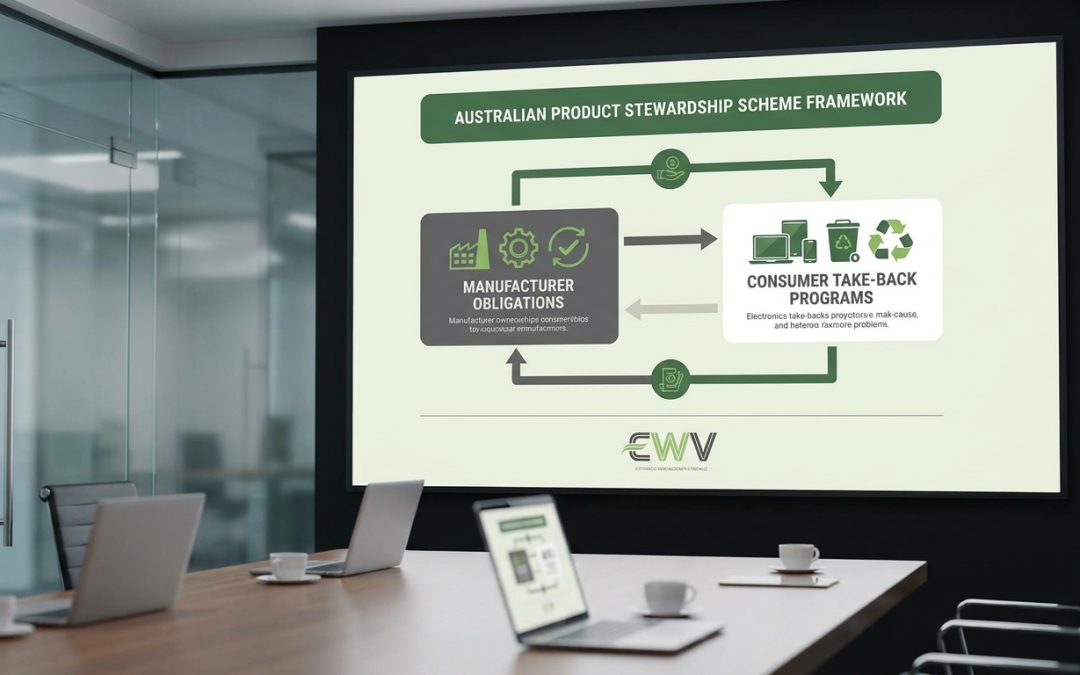
Product stewardship is the principle that everyone involved in the lifecycle of a product, from manufacturers and importers through to retailers, consumers, and recyclers, shares responsibility for managing that product’s environmental impact, including at end of life. In the context of electronic waste, product stewardship means that the companies that design, manufacture, and sell electronic products bear a degree of responsibility for what happens to those products when consumers and businesses are finished with them.
This represents a fundamental shift from the traditional model where the burden of disposal falls entirely on the end user. Under product stewardship frameworks, manufacturers contribute to the cost of collection and recycling, either directly by running take-back programs or indirectly by funding recycling infrastructure through levies or fees. The logic is straightforward: those who profit from selling products should share in the cost of managing them responsibly at end of life.
Australia has embraced product stewardship through a combination of voluntary, co-regulatory, and mandatory schemes that cover various product categories. For electronic waste specifically, the most significant scheme is the National Television and Computer Recycling Scheme (NTCRS), but the product stewardship landscape is broader than this single program.
The Product Stewardship Act 2011
The legal foundation for product stewardship in Australia is the Product Stewardship Act 2011, administered by the federal Department of Climate Change, Energy, the Environment and Water. This Act provides the framework for establishing product stewardship arrangements across three tiers of obligation.
- Voluntary: industry-led schemes that are accredited by the government but not mandatory. Participants commit to meeting outcomes but are not legally required to join.
- Co-regulatory: industry manages the scheme but participation is mandatory for liable parties (manufacturers and importers above certain thresholds). The NTCRS operates under this model.
- Mandatory: the government can mandate specific requirements for products that pose significant environmental risk. This tier provides a backstop if voluntary and co-regulatory approaches are insufficient.
The Act allows the government to declare products as subject to product stewardship obligations and to approve or mandate the schemes that manage them. The flexibility of the three-tier approach is intended to allow the most appropriate level of regulation for different product categories and market conditions.
The NTCRS: Australia’s Main E-Waste Stewardship Scheme
The National Television and Computer Recycling Scheme (NTCRS) is the most significant product stewardship scheme for electronic waste in Australia. Launched in 2012, it operates as a co-regulatory scheme, meaning that participation is mandatory for manufacturers and importers of televisions, computers, printers, and computer peripherals who exceed specified import thresholds.
Under the NTCRS, liable manufacturers and importers must fund the collection and recycling of a specified proportion of the products they place on the Australian market. They do this by joining an approved co-regulatory arrangement, which organises collection services and contracts with recyclers on behalf of its members.
For consumers and businesses, the NTCRS provides free recycling services for covered products. Collection points operate under various brand names across Australia, and the scheme has processed hundreds of thousands of tonnes of e-waste since its inception. The products covered include televisions (all types), computers (desktops, laptops, tablets), computer monitors, printers (including multifunction devices), and computer peripherals (keyboards, mice, hard drives, and similar items).
For a comprehensive look at how e-waste recycling works in Australia, see our complete guide to e-waste recycling.
What the NTCRS Does Not Cover
While the NTCRS is significant, it covers only a subset of the total e-waste stream. Many categories of electronic waste fall outside the scheme, including mobile phones (covered by a separate voluntary program), household appliances, power tools, audio equipment, gaming consoles, cables and chargers, lighting (covered by a separate scheme), and batteries (also covered by separate programs).
This means that for a large portion of the e-waste generated in Australia, there is no mandatory producer-funded recycling scheme. The cost and responsibility for recycling these items falls on consumers, businesses, and local governments. This gap in coverage is one of the key issues in the ongoing policy discussion about product stewardship in Australia.
For businesses generating diverse e-waste that includes both NTCRS-covered and non-covered items, working with an ITAD provider or commercial recycler who handles all categories simplifies the disposal process. See our guide on choosing an ITAD provider for what to look for.
Other E-Waste Related Stewardship Programs
Several other product stewardship programs in Australia address specific categories of electronic and electrical waste.
MobileMuster is the mobile phone industry’s product stewardship program, operated by the Australian Mobile Telecommunications Association (AMTA). It provides free collection and recycling of mobile phones, tablets, and accessories through drop-off points at retail stores and other locations. The program is voluntary but has strong industry participation.
B-cycle (formerly the Battery Stewardship Scheme) is a stewardship program for batteries, funded by a levy on battery imports. It supports the collection and recycling of household batteries through retail and council collection points. Given the growing volume of lithium batteries in consumer electronics, this program addresses an increasingly important waste stream.
FluoroCycle addresses mercury-containing lighting products including fluorescent tubes and compact fluorescent lamps. While not exclusively e-waste, these lighting products contain electronic components and hazardous mercury that requires specialist recycling.
Extended Producer Responsibility: The Global Trend
Australia’s product stewardship framework sits within a global trend toward extended producer responsibility (EPR) for electronic products. The European Union’s WEEE (Waste Electrical and Electronic Equipment) Directive is the most comprehensive example, requiring manufacturers to fund the collection and recycling of virtually all categories of electronic waste.
Compared to the EU approach, Australia’s framework is more limited in scope. The EU scheme covers all categories of electrical and electronic equipment, while Australia’s mandatory coverage extends only to televisions, computers, and printers. Several other countries including Japan, South Korea, and Canada have also implemented comprehensive EPR schemes for electronics that go beyond Australia’s current coverage.
There is ongoing discussion in Australian policy circles about expanding product stewardship obligations to cover a broader range of electronic products. The rapid growth of IoT devices, the increasing complexity of consumer electronics, and the emerging challenge of solar panel and EV battery disposal are all driving consideration of expanded schemes.
How Product Stewardship Affects Businesses
Product stewardship has several practical implications for businesses, depending on their role in the electronics lifecycle.
Manufacturers and importers of covered products have direct obligations under co-regulatory schemes. They must register with an approved arrangement, report on the products they place on the market, and contribute funding based on their market share. Non-compliance can result in penalties under the Product Stewardship Act.
Retailers may participate in collection programs, either voluntarily or as part of scheme arrangements. Offering in-store collection for old devices can be both a customer service and an environmental contribution.
Businesses disposing of e-waste can take advantage of free recycling services funded by product stewardship schemes for covered product categories. For NTCRS-covered items, this means free recycling is available regardless of the volume. However, businesses with data security requirements should note that product stewardship recycling services do not typically include certified data destruction. Businesses needing data destruction certificates should use an ITAD provider, even if the recycling itself would be free through a stewardship scheme.
For understanding data destruction requirements, see our guide to data destruction for Australian businesses.
The Future of E-Waste Product Stewardship
Product stewardship for electronic waste in Australia is evolving. Policy reviews, industry consultations, and growing environmental awareness are all driving discussion about expanding the scope and effectiveness of existing schemes.
Key areas of development include potential expansion of mandatory schemes to cover additional product categories, reforms to the NTCRS to improve its effectiveness and coverage, development of stewardship approaches for emerging waste streams like solar panels and EV batteries, and exploration of circular economy principles that go beyond recycling to include design for durability, repairability, and material recovery.
For businesses, staying informed about product stewardship developments is important for both compliance and strategic planning. Changes to stewardship obligations can affect product costs, disposal options, and competitive dynamics. Our overview of e-waste laws and regulations across Australia provides the broader regulatory context, and our article on the circular economy for electronics explores where product stewardship fits within the broader sustainability picture.
EWV helps Victorian businesses manage e-waste and IT asset disposal compliantly and sustainably — including collection, certified data destruction, and recycling. Contact us for a free quote.