
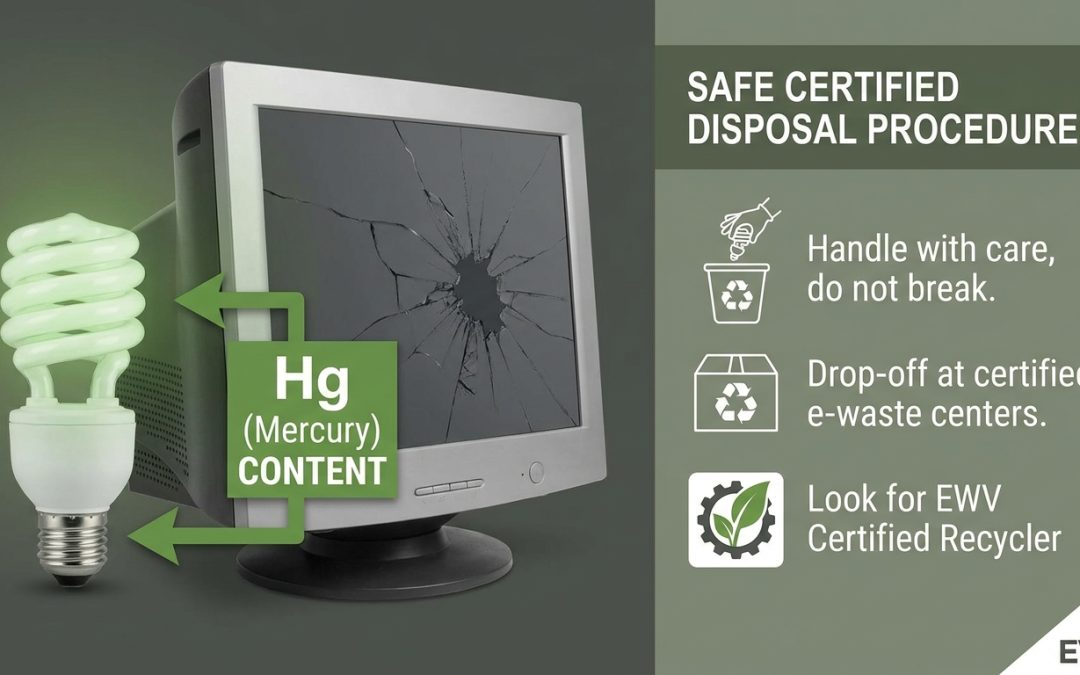
Where Mercury Hides in Electronics and Lighting
Mercury is one of the most toxic substances found in everyday products, and it turns up in electronic waste more often than most people realise. While the shift to LED technology has significantly reduced mercury use in new products, the legacy stock of mercury-containing devices still in use and awaiting disposal across Australia remains substantial. Understanding where mercury is found and why it requires careful handling is essential for anyone managing e-waste.
The two main categories of mercury-containing waste in the electronics and lighting space are fluorescent lighting products and older LCD screens. Each uses mercury for different purposes, but both require the same fundamental approach to disposal: keep the mercury contained and ensure it is processed through facilities equipped to handle it safely.
Mercury in Fluorescent Lighting
Fluorescent tubes and compact fluorescent lamps (CFLs) are the most common mercury-containing products in both commercial and residential settings. Every fluorescent light, whether it is a 1.2-metre tube in an office ceiling or a spiral CFL in a desk lamp, contains a small amount of mercury vapour that is essential to its operation.
The mercury inside a fluorescent lamp enables the production of ultraviolet light, which then excites the phosphor coating on the inside of the glass tube to produce visible light. Without mercury, the fluorescent process does not work. The amount of mercury in a single lamp is small, typically 3 to 5 milligrams in a modern CFL and 5 to 10 milligrams in a standard fluorescent tube. Older lamps may contain significantly more.
- Fluorescent tubes (all lengths and types)
- Compact fluorescent lamps (CFLs/energy-saving bulbs)
- High-intensity discharge (HID) lamps (used in industrial and outdoor lighting)
- Metal halide lamps
- Mercury vapour lamps
- Some UV germicidal lamps
- Neon signs (some types contain mercury)
While individual amounts are small, the cumulative volume is significant. Australia uses hundreds of millions of fluorescent lamps, and as they reach end of life, the total mercury content in the waste stream adds up. A single commercial building relamping project can generate hundreds of spent fluorescent tubes, each containing mercury that needs proper handling.
Mercury in LCD Screens
Older LCD (liquid crystal display) screens used cold cathode fluorescent lamp (CCFL) backlights that contain mercury. These backlights illuminate the LCD panel from behind, and like their full-sized counterparts, they use mercury vapour to generate light. The CCFLs in a typical laptop screen or computer monitor contain small amounts of mercury, but across millions of devices, the quantities are meaningful.
CCFL backlighting was standard in LCD screens from the early 2000s through to approximately 2012, when LED backlighting became dominant. This means that LCD monitors, laptop screens, and televisions manufactured during this period likely contain mercury in their backlights. Products manufactured after the transition to LED backlighting generally do not contain mercury in their display components.
For businesses disposing of old monitors and laptops, this timeline matters. Equipment purchased before approximately 2012 is more likely to contain mercury, and proper disposal through e-waste recycling channels ensures the mercury is handled safely. Our complete guide to e-waste recycling covers the full disposal process.
Health Risks of Mercury Exposure
Mercury is a potent neurotoxin that poses serious health risks even at low levels of exposure. The health effects depend on the form of mercury, the route of exposure, and the duration and level of exposure.
Elemental mercury vapour, the form found in fluorescent lamps and CCFL backlights, is primarily an inhalation hazard. When a lamp breaks, mercury vapour is released into the surrounding air. Acute exposure to high concentrations can cause respiratory distress, chest pain, and lung damage. Chronic exposure to lower levels can cause tremors, mood changes, memory problems, and kidney damage.
In the environment, mercury released from improperly disposed products can undergo transformation by bacteria into methylmercury, which is the most toxic form. Methylmercury accumulates in aquatic food chains, reaching its highest concentrations in predatory fish. Human exposure to methylmercury primarily occurs through consumption of contaminated fish, and the effects include neurological damage, particularly to developing foetuses and young children.
This environmental pathway is why keeping mercury out of landfill is so important. Mercury released from broken lamps in landfill can leach into soil and waterways, entering the broader environment where it persists and accumulates over time.
What to Do When a Fluorescent Lamp Breaks
If a fluorescent tube or CFL breaks, take the following steps to minimise mercury exposure:
Ventilate the area immediately. Open windows and doors to allow mercury vapour to disperse. Leave the room for at least 15 minutes before beginning cleanup. Turn off any heating or air conditioning systems that recirculate air.
Do not vacuum the broken lamp. Vacuuming can spread mercury vapour and fine particles. Instead, use stiff cardboard or a piece of card to carefully scoop up large fragments. Use sticky tape to pick up smaller pieces and powder. Place all debris in a sealed glass jar or double-sealed plastic bag.
Wipe the area with a damp cloth or paper towel, then place the cloth in the sealed container with the broken lamp debris. Dispose of the sealed container through your council’s hazardous waste or e-waste collection, not in general waste.
For larger spills involving multiple broken lamps (such as during a commercial relamping project), specialist mercury spill cleanup procedures may be required. Contact EPA Victoria or your waste management provider for guidance on managing larger quantities.
Safe Storage and Transport
Intact fluorescent tubes and CFLs should be stored carefully to prevent breakage before they are taken for recycling. Keep tubes in their original cardboard sleeves or boxes where possible. Store them upright or in purpose-designed storage containers. Do not stack heavy items on top of stored lamps.
For businesses generating significant quantities of spent lamps, dedicated lamp storage containers are available from waste management suppliers. These are typically drum-shaped containers that hold fluorescent tubes vertically and include padding to prevent breakage during transport.
Transport lamps to recycling facilities with care to prevent breakage in transit. Secure them so they cannot roll, slide, or be crushed by other items. If a lamp breaks during transport, treat it as a small mercury spill and clean up as described above.
Recycling Mercury-Containing Products
Proper recycling of mercury-containing lamps and screens involves specialist processing that safely captures and contains the mercury. Licensed recycling facilities use controlled crushing or thermal processing methods that recover the mercury for recycling or safe disposal, while also recovering glass, aluminium end caps, and phosphor powder.
In Victoria, mercury-containing lamps can be disposed of through council e-waste and hazardous waste collection points. The FluoroCycle program also provides resources for finding collection points for spent fluorescent lighting. Some lighting suppliers and electrical wholesalers offer take-back services for spent lamps.
For businesses, particularly those in commercial property management, office fit-out, or facility management, establishing a regular lamp collection arrangement with a licensed recycler is the most efficient approach. Many waste management companies offer scheduled lamp collection as part of their service portfolio.
LCD monitors and laptops containing CCFL backlights should be disposed of through standard e-waste recycling channels or ITAD providers. The mercury-containing backlights are separated during the recycling process and directed to appropriate processing. For guidance on choosing a disposal provider, see our article on selecting an ITAD provider in Australia.
The Transition to Mercury-Free Technology
The good news is that mercury use in both lighting and display technology is declining rapidly. LED lighting, which contains no mercury, has become the dominant technology for both residential and commercial applications. LED backlighting has replaced CCFL in virtually all new screens and monitors.
However, the transition will take time to work through the installed base. Commercial buildings with large fluorescent lighting installations may continue to generate spent fluorescent tubes for years as they gradually transition to LED. The stock of older LCD screens in offices, homes, and storage is substantial. Responsible disposal of these legacy products remains important even as the volume of new mercury-containing products entering the market diminishes.
For the broader picture of hazardous materials in electronic waste, see our article on the true environmental cost of electronic waste.
EWV helps Victorian businesses manage e-waste and IT asset disposal compliantly and sustainably — including collection, certified data destruction, and recycling. Contact us for a free quote.