
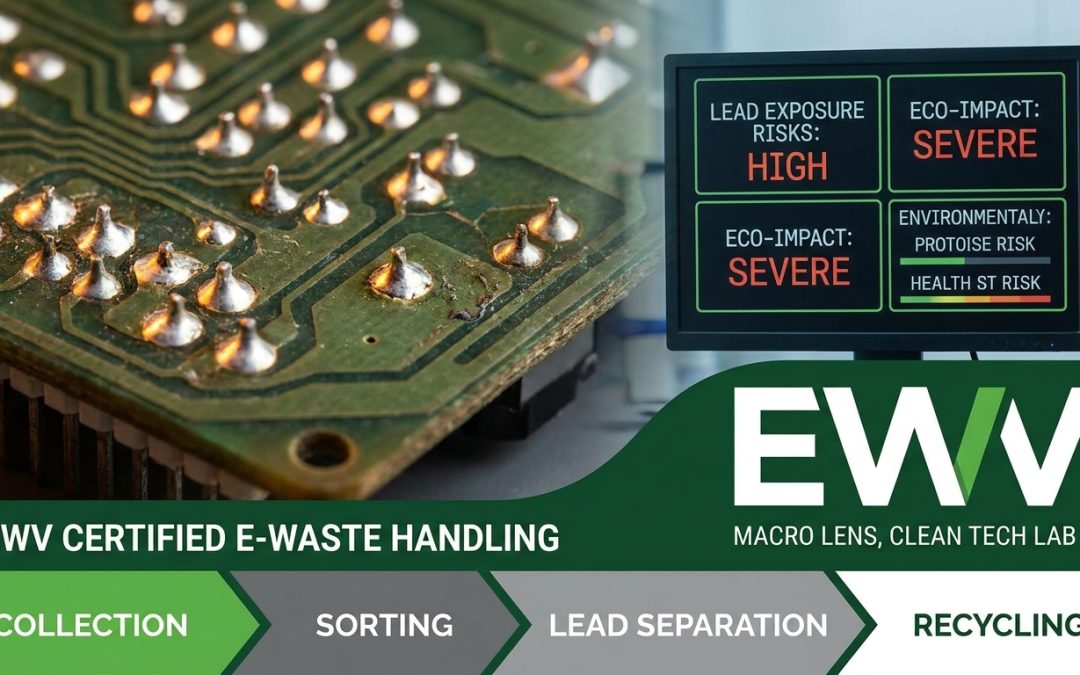
Lead Solder: The Invisible Hazard in Every Circuit Board
Every piece of electronic equipment contains circuit boards, and most circuit boards contain lead. It is one of the most widespread hazardous materials in the e-waste stream, yet it receives less attention than more dramatic hazards like lithium battery fires. The lead in electronic circuit boards comes primarily from tin-lead solder, the metallic alloy that joins electronic components to the board. This solder has been the standard in electronics manufacturing for decades, and it is present in virtually every electronic product ever made.
A typical desktop computer contains multiple circuit boards: the motherboard, graphics card, sound card, network card, and various other expansion cards and controller boards. Each of these boards has hundreds or thousands of solder joints, every one of which contains lead. The total lead content in a single computer may range from 1 to 6 grams, depending on the age and complexity of the machine. While this sounds small, multiply it by the billions of electronic devices manufactured globally each year, and the cumulative volume of lead in the electronics waste stream is enormous.
Why Lead Was Used in Electronics
Lead has been used in electronic solder for good technical reasons. Tin-lead solder (typically a 60/40 or 63/37 tin-to-lead ratio) has properties that made it ideal for electronics manufacturing: it melts at a relatively low temperature, flows smoothly into joints, creates strong and reliable connections, and is easy to work with in both manual and automated assembly processes.
Lead also provides excellent fatigue resistance in solder joints. Electronic devices experience thermal cycling, vibrating between hot and cold as they are turned on and off. Lead in solder helps joints withstand this cycling without cracking, which contributes to product reliability. The electronics industry’s long experience with tin-lead solder meant that manufacturing processes, quality standards, and reliability data were all optimised around this material.
- Solder joints: the primary source, present on virtually every circuit board
- CRT glass: lead oxide used as radiation shielding (2-4 kg per CRT monitor)
- Lead-acid batteries: in UPS systems, emergency lighting, and older equipment
- PVC cable insulation: lead compounds used as stabilisers in some cables
- Ceramic components: some capacitors and piezoelectric elements contain lead
The Move to Lead-Free Solder
Recognising the environmental and health risks of lead in electronics, the European Union introduced the Restriction of Hazardous Substances (RoHS) Directive in 2006, which restricted the use of lead and several other hazardous substances in electrical and electronic equipment sold in the EU. This drove a global shift toward lead-free solder, typically based on tin-silver-copper (SAC) alloys.
While the RoHS Directive does not directly apply in Australia, the global nature of electronics manufacturing means that most products sold in Australia since the mid-2000s are manufactured to RoHS standards, particularly products from major international brands. However, there are important exceptions: military and aerospace electronics, medical devices, some industrial equipment, and products from manufacturers not targeting the EU market may still use leaded solder.
This means the e-waste stream contains a mix of leaded and lead-free products. Older equipment manufactured before 2006 almost certainly contains leaded solder. Newer equipment is more likely to be lead-free, but this cannot be assumed without checking. From a waste management perspective, all circuit boards should be treated as potentially containing lead and handled accordingly.
Health Effects of Lead Exposure
Lead is a cumulative toxin that affects virtually every system in the body. Unlike many substances, there is no known safe level of lead exposure. Even very low levels can cause measurable health effects, particularly in children.
In children, lead exposure can cause developmental delays, learning difficulties, reduced IQ, behavioural problems, hearing loss, and speech delays. Children are more vulnerable than adults because their growing bodies absorb lead more readily and their developing brains are more susceptible to damage. The effects of childhood lead exposure can be permanent.
In adults, lead exposure can cause high blood pressure, kidney damage, reproductive problems (including reduced fertility and increased risk of miscarriage), neurological effects including memory loss and difficulty concentrating, and anaemia. Chronic occupational exposure to lead is associated with increased risk of cardiovascular disease.
The primary routes of lead exposure from e-waste are ingestion and inhalation. Lead dust generated during the dismantling or processing of circuit boards can be inhaled or can settle on surfaces where it is transferred to hands and then ingested. In informal or uncontrolled recycling operations, workers may be exposed to significant lead levels. In landfill environments, lead leaches from circuit boards into soil and groundwater, creating potential exposure pathways for surrounding communities.
Environmental Impact of Lead from Circuit Boards
When circuit boards end up in landfill, the lead in solder joints is gradually released into the environment. The acidic conditions in landfill accelerate the leaching process, with lead dissolving into leachate, the liquid that percolates through the waste mass. This leachate can contaminate groundwater if the landfill’s liner system is imperfect or as it degrades over time.
Lead in soil and water is persistent. It does not break down or dissipate. Once lead contaminates an area, it remains there essentially permanently unless actively remediated. Lead-contaminated soil can be ingested by children playing in affected areas, taken up by plants, and washed into waterways during rain events.
The contamination risk from a single circuit board in a well-managed landfill is small. But e-waste is not generated in ones and twos. Millions of circuit boards enter the waste stream every year, and the cumulative impact of lead leaching from this volume of electronic waste over decades is a serious environmental concern. This is one of the key reasons that Victoria banned e-waste from landfill in 2019.
For the broader environmental picture, see our article on the true environmental cost of electronic waste.
How Circuit Board Recycling Works
Licensed e-waste recyclers process circuit boards through controlled methods that recover valuable materials while managing hazardous substances including lead. The typical process involves several stages.
First, circuit boards are separated from other device components during the initial dismantling phase. Batteries, screens, and other hazardous components are removed for separate processing. The bare circuit boards are then processed to recover metals.
Metal recovery from circuit boards can involve mechanical processing (shredding and separation using density, magnetic, and electrostatic techniques) or pyrometallurgical processing (smelting in specialised furnaces). Some facilities use a combination of both. During smelting, lead is captured and recovered as a separate metal stream rather than being released into the environment.
The valuable metals recovered from circuit boards include gold, silver, palladium, copper, and tin, along with lead and other base metals. A tonne of circuit boards typically contains more gold than a tonne of gold ore, making circuit board recycling both environmentally and economically important. The recovered lead is sent to lead recyclers who process it for reuse in new products.
Proper Handling and Disposal
For businesses and households disposing of electronic equipment, the practical message is straightforward: recycle all electronic equipment through proper channels. You do not need to identify which devices contain leaded solder and which do not. Treat all circuit boards as potentially containing lead and ensure they go through e-waste recycling rather than general waste.
If you are handling large quantities of loose circuit boards, for example during an office clearout or equipment decommissioning, take basic precautions: avoid creating dust by not breaking or crushing boards, wash hands after handling, and store boards in sealed containers for transport to recycling.
For businesses managing IT asset disposal, working with a certified ITAD provider ensures that circuit boards and all other components are processed through appropriate recycling channels. The provider handles the logistics and processing, and provides documentation of proper disposal. See our guide on choosing an ITAD provider for selection criteria.
Victoria’s e-waste landfill ban exists specifically to keep hazardous materials like lead out of the environment. Recycling your electronics through proper channels is the simplest and most effective way to ensure the lead in circuit boards is recovered safely rather than contaminating soil and water. For the full regulatory context, see our overview of e-waste laws and regulations across Australia.
EWV helps Victorian businesses manage e-waste and IT asset disposal compliantly and sustainably — including collection, certified data destruction, and recycling. Contact us for a free quote.