
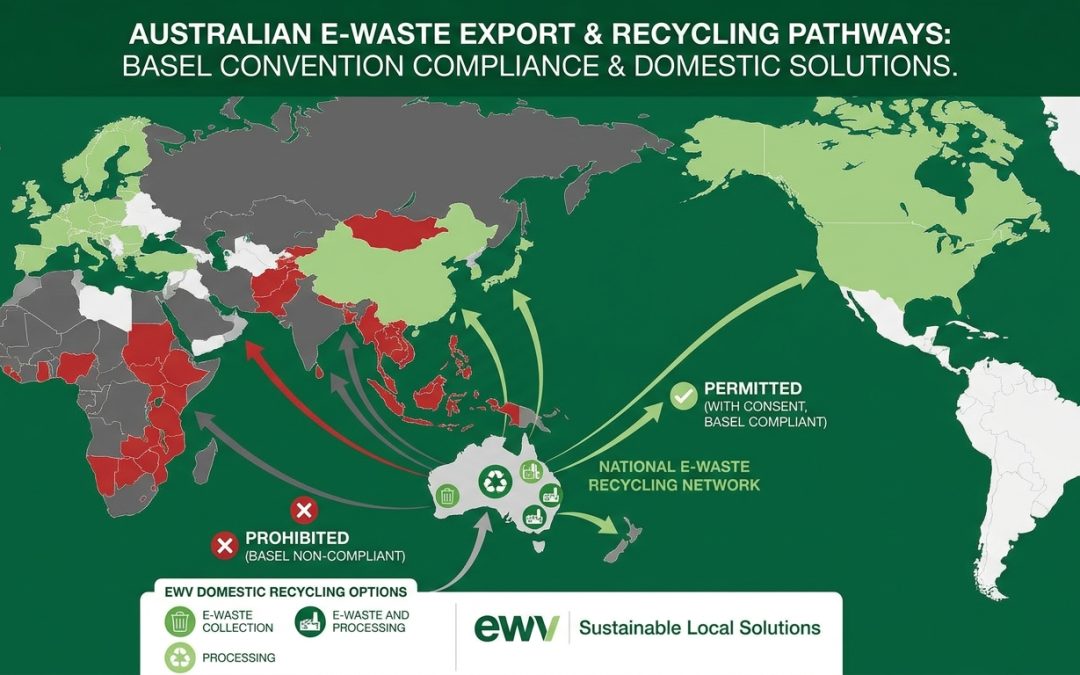
Australia’s Restrictions on E-Waste Exports
For decades, wealthy nations exported their electronic waste problems to developing countries in Asia and Africa, where cheap labour and lax environmental regulations made e-waste processing cheaper, though far more dangerous for workers and the environment. Australia was part of this global flow. However, significant changes in both international agreements and Australian domestic law have dramatically restricted the export of e-waste from Australia, requiring more of it to be processed domestically.
Understanding Australia’s e-waste export laws matters for businesses and recyclers because the rules determine where e-waste can legally be sent for processing and what documentation and approvals are required. Getting it wrong can result in serious penalties under both Australian and international law.
The Recycling and Waste Reduction Act 2020
The most significant recent change to Australian e-waste export law came with the Recycling and Waste Reduction Act 2020, which implemented a phased ban on the export of certain waste materials, including unprocessed e-waste. This legislation was a key outcome of the 2019 agreement by the Council of Australian Governments (COAG) to ban the export of waste plastic, paper, glass, and tyres.
For e-waste specifically, the Act prohibits the export of unprocessed or minimally processed electronic waste unless specific conditions are met. The intent is to ensure that e-waste generated in Australia is processed domestically to a standard where the exported product is a genuine resource (like refined metals) rather than unprocessed waste being shipped offshore for someone else to deal with.
- Unprocessed e-waste cannot be exported for disposal or basic processing
- Export of e-waste for recycling requires permits and must meet specific conditions
- The Basel Convention regulates transboundary movement of hazardous waste including e-waste
- Working functional equipment may be exported as second-hand goods (not waste)
- Processed materials (refined metals, clean plastics) can be exported as commodities
The Basel Convention
Underpinning Australia’s domestic export controls is the Basel Convention on the Control of Transboundary Movements of Hazardous Wastes and their Disposal. Australia is a party to this international treaty, which regulates the movement of hazardous waste between countries. Electronic waste falls within the Convention’s scope because it contains hazardous substances including lead, mercury, cadmium, and brominated flame retardants.
Under the Basel Convention, the export of hazardous waste from developed to developing countries is restricted. Specifically, the Basel Ban Amendment prohibits the export of hazardous waste from OECD countries to non-OECD countries. Australia’s implementation of the Convention means that e-waste classified as hazardous waste cannot be exported to non-OECD countries without meeting strict conditions.
Even between OECD countries, the Convention requires a system of prior informed consent (PIC). Before hazardous waste can be exported, the exporting country must notify the importing country and receive written consent. The importing country must confirm that it has adequate facilities to process the waste in an environmentally sound manner.
For a deeper exploration of the Basel Convention’s impact on e-waste, see our dedicated article on e-waste laws and regulations across Australia.
What Can and Cannot Be Exported
The distinction between what can and cannot be exported centres on the degree of processing and whether the material is classified as waste or as a commodity.
Unprocessed e-waste, whole devices, loose circuit boards, mixed electronic scrap, and other forms of unprocessed electronic waste generally cannot be exported under current regulations. This includes shipping containers of old computers, monitors, or other electronic equipment to offshore destinations for processing.
Processed materials that have been recovered from e-waste through domestic recycling, such as refined copper, gold concentrate, clean steel, and sorted plastics, can typically be exported as commodities. The key is that these materials have been processed in Australia to a point where they are genuine inputs for manufacturing rather than waste requiring further hazardous processing.
Working second-hand equipment intended for reuse occupies a grey area. Functional electronics that have been tested, refurbished, and are genuinely suitable for continued use can be exported as second-hand goods rather than waste. However, this exemption has been subject to abuse globally, with non-functional e-waste labelled as “second-hand goods” to circumvent export restrictions. Australian authorities scrutinise exports of used electronics to ensure they are genuinely functional.
The Reuse vs. Waste Distinction
One of the most debated aspects of e-waste export law is the line between legitimate reuse and disguised waste dumping. ITAD providers and refurbishers regularly export working, tested equipment to overseas markets where it has genuine second-life value. A three-year-old laptop that an Australian business has finished with may be perfectly suitable for a school in Southeast Asia or a small business in the Pacific region.
The test is whether the equipment is genuinely functional and suitable for its intended purpose. Regulators look at factors including whether the equipment has been tested and certified as working, whether it comes with appropriate accessories (power supplies, cables), whether there is a genuine market for the equipment in the destination country, and whether the equipment is of a type and age that makes reuse plausible.
Shipping containers of untested, mixed-condition equipment to developing countries under the guise of “reuse” or “charitable donation” is likely to be treated as illegal waste export, regardless of how it is labelled. A significant percentage of “donated” equipment that arrives in developing countries is found to be non-functional and ends up being processed in informal recycling operations with minimal environmental or worker protection.
Penalties for Illegal E-Waste Export
The penalties for illegally exporting hazardous waste, including e-waste, from Australia are severe. The Recycling and Waste Reduction Act 2020 and the Hazardous Waste (Regulation of Exports and Imports) Act 1989 both provide for significant penalties.
Criminal penalties can include substantial fines and imprisonment for individuals and corporations found to have knowingly exported waste in contravention of the legislation. Civil penalties and enforcement orders may also apply. The Australian Border Force and the Department of Climate Change, Energy, the Environment and Water monitor waste exports and investigate suspected breaches.
International consequences can also follow. Australia’s reputation as a responsible party to the Basel Convention depends on effective enforcement of export controls. Cases of illegal waste export attract international attention and can affect Australia’s standing in international environmental negotiations.
Implications for Businesses
For most businesses disposing of e-waste, the export restrictions are managed by the recycling or ITAD provider rather than the business itself. However, it is worth understanding the regulatory landscape for several reasons.
When selecting a disposal provider, ask about their processing arrangements. Where is the e-waste physically processed? Is it handled domestically or exported? If exported, under what conditions and to which destinations? A reputable provider will be transparent about their processing chain and able to demonstrate compliance with export regulations.
If your business is involved in remarketing or donating used equipment internationally, ensure that the equipment is genuinely functional, properly tested, and documented. Sham donations of non-functional equipment can expose your organisation to legal risk and reputational damage.
For businesses reporting on their environmental performance, understanding the end-to-end processing chain for their e-waste ensures that sustainability claims about recycling and responsible disposal are accurate and defensible. Our guide on measuring the environmental impact of IT disposal covers this reporting dimension.
The Direction of Policy
The trend in Australian and international policy is clearly toward greater domestic processing of e-waste and tighter controls on waste exports. This is driving investment in Australian recycling infrastructure and creating new opportunities for domestic e-waste processing capacity.
For businesses generating e-waste, this trend reinforces the importance of working with established, licensed domestic processors who have the infrastructure and capabilities to handle e-waste in compliance with current and evolving regulations. Our guide on choosing an ITAD provider in Australia helps with evaluating potential partners.
EWV helps Victorian businesses manage e-waste and IT asset disposal compliantly and sustainably — including collection, certified data destruction, and recycling. Contact us for a free quote.