
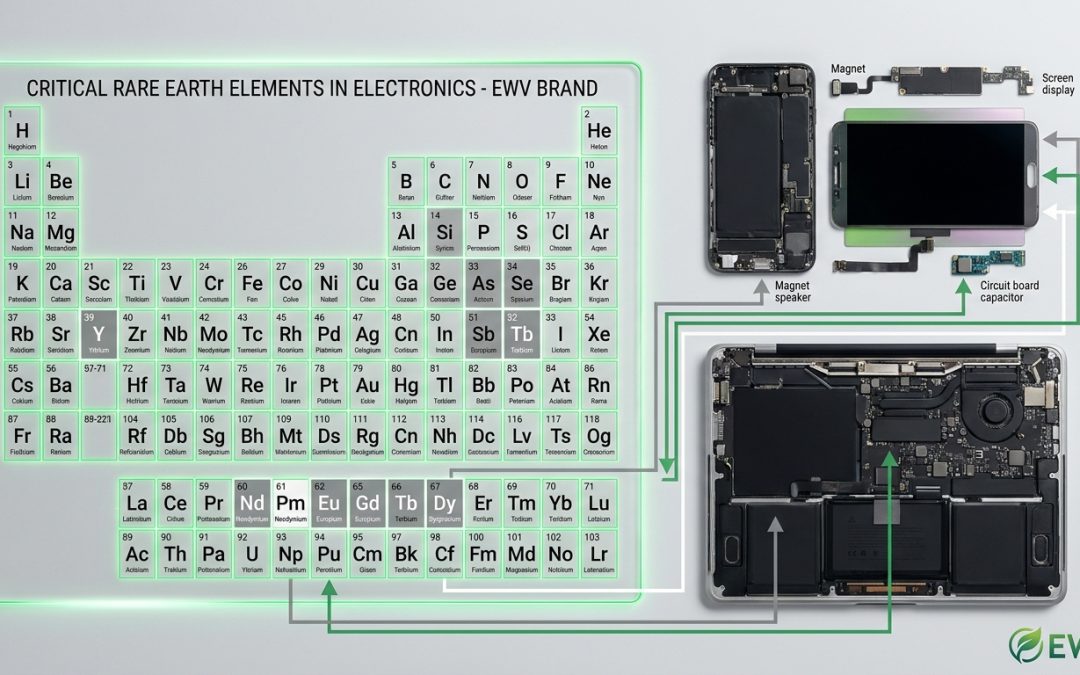
What Are Rare Earth Elements?
Rare earth elements (REEs) are a group of 17 metallic elements that have become indispensable to modern technology. Despite their name, most rare earth elements are not actually rare in the earth’s crust. What makes them “rare” is that they are seldom found in concentrations high enough to make extraction economically viable, and the mining and refining process is complex, energy-intensive, and environmentally challenging.
These elements have unique magnetic, luminescent, and electrochemical properties that make them essential components in a wide range of electronic products. Every smartphone, computer, electric vehicle, and wind turbine contains rare earth elements in some form. Understanding where they are in your old electronics, and why recovering them matters, adds another dimension to the case for responsible e-waste recycling.
Where Rare Earths Hide in Your Devices
Rare earth elements are used throughout electronic products, though often in small quantities that make them easy to overlook. Here is where you will find them in common devices.
Magnets are the largest single application. Neodymium-iron-boron (NdFeB) magnets are the most powerful permanent magnets available, and they are found in hard disk drives (the spinning motors and read/write actuators), smartphone vibration motors, speaker drivers in phones, headphones, and computers, and electric motor assemblies in various devices. A single hard disk drive contains approximately 10 to 20 grams of neodymium magnet material.
- Neodymium (Nd): permanent magnets in hard drives, speakers, vibration motors
- Dysprosium (Dy): added to NdFeB magnets to improve high-temperature performance
- Praseodymium (Pr): used alongside neodymium in high-strength magnets
- Terbium (Tb): green phosphor in some displays, magneto-optical recording
- Europium (Eu): red phosphor in older displays and fluorescent lighting
- Yttrium (Y): phosphors in displays and LEDs, ceramic components
- Lanthanum (La): camera and optical lens elements, battery electrodes
- Cerium (Ce): glass polishing compounds, catalytic converters
- Gadolinium (Gd): MRI contrast agents, data storage applications
Displays and lighting use rare earth phosphors to produce specific colours. Europium provides red, terbium provides green, and yttrium serves as a host material for phosphor compounds. While newer LED technology uses fewer rare earth phosphors than older fluorescent and CRT displays, they are still present in some applications.
Batteries in some devices use lanthanum in their electrode materials, particularly nickel-metal hydride (NiMH) batteries, though these have been largely replaced by lithium-ion technology in most consumer electronics. Lanthanum remains important in hybrid vehicle batteries.
Optical components including camera lenses and fibre optic cables use rare earth elements for their unique optical properties. Lanthanum and cerium are particularly important in precision optics.
The Supply Chain Concern
The strategic importance of rare earth elements stems not just from their technological necessity but from the extreme concentration of global production. China currently produces approximately 60 to 70 percent of the world’s rare earth minerals and controls an even larger share of processing and refining capacity. This concentration creates a supply chain vulnerability that has been highlighted by trade tensions and geopolitical competition.
Disruptions to rare earth supply could affect the production of electronics, defence systems, renewable energy technology, and electric vehicles. Several countries, including Australia, the United States, and European Union members, have identified rare earth supply diversification as a national security priority.
Recovering rare earths from e-waste is one strategy for reducing dependence on primary supply from concentrated sources. While e-waste recycling cannot replace primary mining at current demand levels, it can provide a supplementary domestic source that buffers against supply disruptions.
For more on how e-waste recycling contributes to resource security, see our article on critical minerals recovery from e-waste.
The Challenge of Recovering Rare Earths
Despite the strategic incentive to recover rare earths from e-waste, doing so at scale remains technically challenging and often economically marginal. Several factors contribute to this difficulty.
Small quantities per device mean that large volumes of e-waste need to be processed to recover meaningful quantities of rare earths. While a hard drive contains 10 to 20 grams of NdFeB magnet, the rare earth content of that magnet (primarily neodymium and dysprosium) is a fraction of the total magnet weight.
Disassembly requirements add cost. Rare earth magnets in hard drives need to be physically removed from the drive assembly before they can be processed. This requires either manual disassembly or specialised automated equipment, both of which add cost to the recovery process.
Processing complexity makes recovery expensive. Separating individual rare earth elements from each other is chemically complex because the elements are so similar in their properties. The solvent extraction processes used to separate rare earths involve multiple stages and generate chemical waste that requires management.
However, technology is advancing. Research into more efficient separation methods, automated disassembly systems, and new processing chemistries is improving the economics of rare earth recovery. As primary supply prices increase and geopolitical pressures mount, the economic threshold for viable recovery from e-waste continues to lower.
What Is Being Done
Several initiatives globally and in Australia are working to improve rare earth recovery from e-waste.
Research programs at universities and CSIRO are developing new techniques for extracting rare earths from magnets and other e-waste components. These include novel hydrometallurgical processes that are more efficient and generate less waste than traditional methods, and direct recycling approaches that process magnet material into new magnets without fully separating individual elements.
Industry initiatives are emerging, with some e-waste recyclers specifically targeting rare earth recovery as part of their processing. Hard drive magnets are increasingly being collected and aggregated for rare earth recovery rather than being lost in the general metal recycling stream.
Policy support through Australia’s Critical Minerals Strategy and related programs is encouraging investment in domestic rare earth processing capacity, including recovery from secondary sources like e-waste. Government grants, research funding, and strategic partnerships are all supporting development in this area.
What This Means for E-Waste Generators
For businesses and households generating e-waste, the rare earth dimension reinforces the importance of recycling through proper channels. When e-waste is recycled through licensed facilities, the rare earth-containing components (particularly hard drive magnets) can be identified, separated, and directed to appropriate recovery processes.
When e-waste goes to landfill or is processed through informal channels, rare earths are typically lost permanently. The magnets end up mixed with general metal scrap where the rare earth content is too diluted to recover, or they corrode in landfill conditions where recovery is impossible.
If your business is retiring a large fleet of traditional hard disk drives (as opposed to solid-state drives, which do not contain rare earth magnets), the magnet content represents a meaningful concentration of rare earth material. Working with an ITAD provider or recycler who separates and aggregates hard drive magnets for rare earth recovery ensures these valuable materials are captured.
For the broader picture of how material recovery from e-waste contributes to sustainability, see our articles on urban mining and the circular economy for electronics.
A Resource Worth Recovering
The rare earth elements in your old electronics may be small in quantity per device, but they are strategically significant and increasingly valuable. As the world transitions to clean energy, electric transport, and advanced manufacturing, demand for rare earths will only grow. Every gram recovered from e-waste is a gram that does not need to be mined from the ground, with all the associated environmental impact.
Recycling your electronics responsibly is a small but tangible contribution to addressing one of the most important resource challenges of our time. For practical guidance on how to ensure your e-waste is recycled effectively, see our complete guide to e-waste recycling in Australia.
EWV helps Victorian businesses manage e-waste and IT asset disposal compliantly and sustainably — including collection, certified data destruction, and recycling. Contact us for a free quote.