
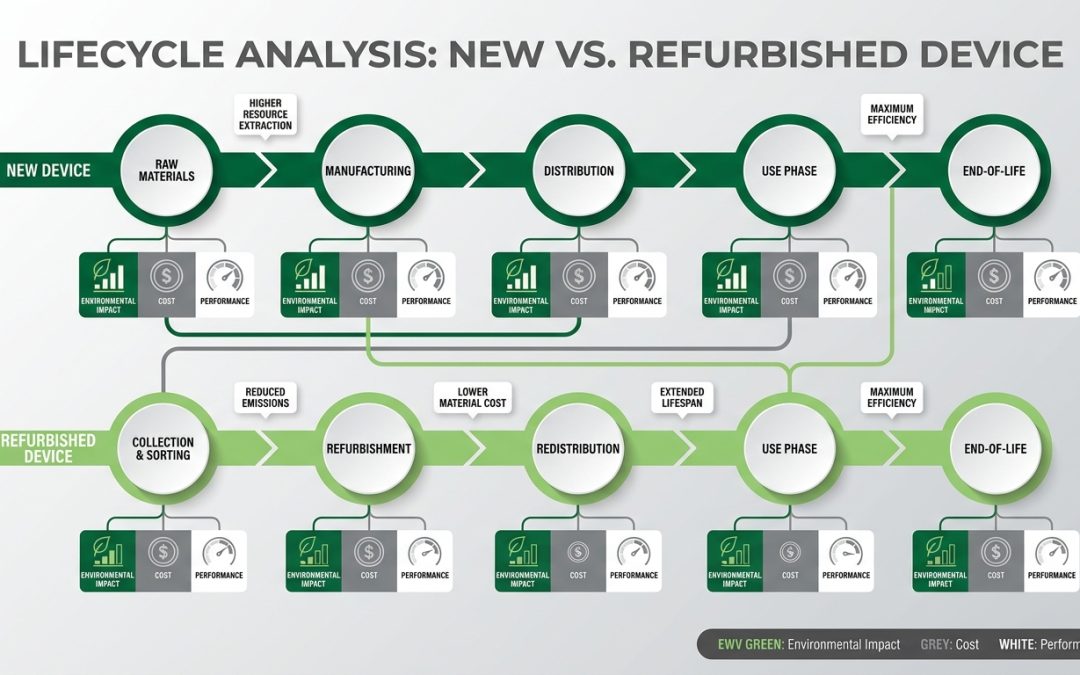
What Lifecycle Analysis Tells Us
Lifecycle analysis (LCA) is a methodology for assessing the total environmental impact of a product from raw material extraction through manufacturing, use, and end-of-life disposal. When applied to electronic devices, LCA provides a comprehensive picture of the environmental cost that goes far beyond what most people consider. The results consistently show something that challenges conventional purchasing habits: buying refurbished devices is significantly better for the environment than buying new, and the margin isn’t even close.
Understanding why requires looking at where environmental impacts concentrate in an electronic device’s life. The answer might surprise you. It’s not the electricity the device consumes during years of daily use. It’s the manufacturing process that created it in the first place.
Where the Environmental Impact Really Sits
For a typical laptop, 70-80% of its lifetime carbon emissions occur during manufacturing. This includes mining and refining raw materials, fabricating semiconductor chips, assembling components, and transporting the finished product to market. The remaining 20-30% accumulates over years of use through electricity consumption.
The numbers are even more stark for smartphones. A study published in the Journal of Cleaner Production found that manufacturing accounts for approximately 85% of a smartphone’s total lifecycle emissions. The device’s entire operational phase, including charging it every day for several years, contributes a relatively small fraction of its total environmental footprint.
This distribution has a profound implication: any strategy that avoids manufacturing a new device delivers dramatically larger environmental benefits than any strategy focused on reducing usage-phase impacts. Using a more energy-efficient charger or enabling power-saving mode helps, but it’s marginal compared to simply using an existing device for longer.
The Refurbishment Environmental Advantage
When a device is refurbished rather than recycled and replaced with a new unit, the environmental calculus is compelling. The refurbishment process, which typically involves testing, cleaning, replacing worn components like batteries and keyboards, and re-installing software, consumes a tiny fraction of the energy and materials required to manufacture a new device.
A comprehensive LCA study comparing refurbished and new laptops found that a refurbished laptop’s total environmental impact was approximately 70% lower than a new equivalent across multiple impact categories including carbon emissions, water usage, mineral resource depletion, and toxic substance generation. The refurbishment process itself added only 2-5% additional impact to the device’s existing footprint.
For businesses, this means that procuring refurbished IT equipment where appropriate delivers measurable sustainability improvements. A company replacing 100 laptops with refurbished units instead of new ones avoids roughly the same amount of CO2 as taking 15-20 cars off the road for a year, depending on the specific models and manufacturing origins.
When Refurbished Makes Business Sense
The environmental case for refurbished devices is clear, but businesses also need equipment that meets performance, reliability, and security requirements. Refurbished devices make strong business sense in several common scenarios:
Standard office computing. For email, web browsing, document creation, and standard business applications, a three-year-old business-class laptop that’s been professionally refurbished performs perfectly well. Most office workers don’t need cutting-edge processors or the latest GPU.
Testing and development environments. Developers often need multiple machines for testing across configurations. Refurbished equipment provides cost-effective fleet expansion without the environmental cost of new manufacturing.
Education and training. Schools, universities, and corporate training facilities cycle through large numbers of devices that face heavy use. Refurbished business-class equipment often outlasts consumer-grade new equipment because business models are built to higher durability standards.
Short-term projects. When equipment is needed for a defined period, such as a construction project office, event management, or seasonal expansion, refurbished devices avoid the wasteful cycle of buying new and disposing of nearly-new equipment.
Where New Equipment Is Justified
Lifecycle analysis doesn’t suggest that new equipment is never appropriate. Several situations justify new procurement on environmental and practical grounds:
Significant energy efficiency improvements. When a new generation of equipment offers substantially lower power consumption than available refurbished units, the use-phase savings can offset manufacturing emissions, particularly for equipment that runs continuously like servers and networking gear. The crossover point depends on usage intensity and the efficiency gap between old and new models.
Performance-critical applications. Software development workstations, CAD/engineering stations, video editing rigs, and AI/ML computing require current-generation hardware to be productive. The economic cost of reduced productivity typically outweighs both the financial and environmental cost of new equipment.
Security requirements. Some regulated environments require hardware with specific security features, such as TPM chips meeting current specifications, that aren’t available in older refurbished equipment. However, this applies to fewer situations than commonly assumed.
Total Cost of Ownership Perspective
The financial lifecycle analysis often aligns with the environmental one. Refurbished business-class laptops typically cost 40-60% less than new equivalents. Even accounting for potentially shorter remaining lifespans and higher maintenance rates, the total cost of ownership frequently favours refurbished for appropriate use cases.
The key is matching equipment specification to actual workload requirements rather than defaulting to new. Many organisations over-spec their IT equipment, buying powerful machines for tasks that don’t require that power, then replacing them on fixed schedules regardless of whether they’re still performing adequately.
A lifecycle-aware approach to IT asset management considers both the financial and environmental costs at every stage. This includes extending assets in use through refurbishment and maintenance, procuring refurbished equipment where appropriate, and ensuring that equipment which has truly reached end of useful life is recycled responsibly so its materials can re-enter the supply chain.
The data from lifecycle analysis is unambiguous: the most environmentally impactful thing you can do with electronic equipment is keep it in productive use for as long as possible. Refurbishment is the primary mechanism for achieving this at scale.
EWV handles IT asset disposition (ITAD) end-to-end for Victorian businesses — from collection and data destruction through to certified recycling or refurbishment for resale. Get in touch for a tailored ITAD quote.