
Putting Numbers on the Carbon Question
Every electronic device carries an invisible carbon price tag from the moment it’s manufactured. When businesses make procurement decisions, they typically compare price, performance, and warranty terms. But the carbon footprint difference between buying new and buying refurbished is so significant that it deserves a place in that decision matrix, especially as organisations face growing pressure to report and reduce their Scope 3 emissions.
This article breaks down the actual carbon numbers for common IT equipment categories, comparing new manufacturing against refurbished alternatives. The data draws on published lifecycle assessments from manufacturers and independent research organisations.
Laptops: Where the Biggest Savings Are
A typical business laptop generates between 300 and 500 kg of CO2 equivalent during manufacturing. This figure includes raw material extraction, component fabrication (semiconductor manufacturing is particularly energy-intensive), assembly, and distribution. Apple publishes detailed product environmental reports showing their MacBook Pro 14-inch generates approximately 271 kg CO2e in production alone, while Dell and HP report similar figures for their commercial lines.
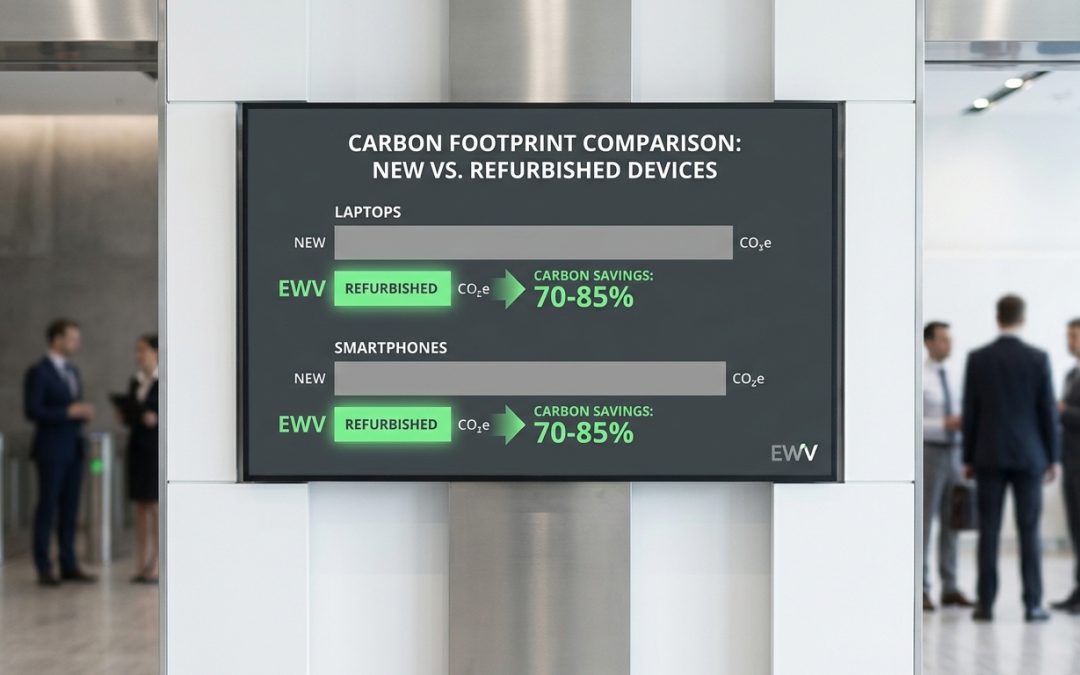
A refurbished laptop of equivalent specification generates approximately 50-80 kg CO2e for the refurbishment process itself. This covers testing, component replacement (typically battery and thermal paste), cleaning, software installation, packaging, and redistribution. The refurbishment carbon cost is roughly 15-20% of new manufacturing.
The math is straightforward. For every 100 refurbished laptops a business procures instead of new, the carbon saving is approximately 25,000-40,000 kg CO2e. That’s equivalent to roughly 6-10 return flights from Melbourne to London, or taking 8-13 average passenger cars off the road for a year.
New manufacturing: 300-500 kg CO2e
Refurbishment process: 50-80 kg CO2e
Carbon saving per unit: ~250-420 kg CO2e (approximately 70-80% reduction)
Desktop Computers and Workstations
Desktop computers generally have a higher manufacturing carbon footprint than laptops because they contain more material, including larger power supplies, bigger heatsinks, more extensive chassis, and often discrete graphics cards. A typical business desktop generates 400-700 kg CO2e in manufacturing, with high-performance workstations potentially exceeding 1,000 kg CO2e.
The refurbishment footprint for desktops is relatively low because components are more accessible and replaceable. RAM can be upgraded, storage can be swapped, and even processors can sometimes be replaced without scrapping the entire system. This modularity means refurbishment often extends a desktop’s useful life significantly with minimal additional environmental cost.
For organisations running desktop fleets, the carbon argument for refurbishment is particularly compelling. Desktops also have an advantage in the use-phase efficiency calculation. Because newer desktop processors often offer meaningful power efficiency improvements over models from three or more years ago, the use-phase carbon savings from new equipment can be more significant than for laptops. But the manufacturing savings from choosing refurbished still dominate in most scenarios unless the equipment is running under heavy load continuously.
Smartphones and Tablets
Smartphones carry a disproportionately high manufacturing carbon footprint relative to their size. A typical smartphone generates 50-80 kg CO2e during manufacturing. Given that the device weighs less than 200 grams, this makes smartphones one of the most carbon-intensive products per kilogram ever mass-produced.
The intensity comes from semiconductor manufacturing. Modern smartphone chips use fabrication processes with extreme energy requirements, and the supply chain for rare earth elements and other materials involves energy-intensive extraction and processing. The compact design also means more specialised manufacturing processes compared to larger devices.
Refurbished smartphones typically add only 5-10 kg CO2e for the refurbishment process, representing a 85-90% reduction compared to new manufacturing. Given that corporate smartphone fleets often number in the hundreds or thousands, the cumulative carbon savings from a refurbished-first procurement policy are substantial.
Monitors and Displays
Display manufacturing is energy-intensive due to the panel fabrication process. A typical 24-inch business monitor generates approximately 200-350 kg CO2e during manufacturing, with larger displays proportionally higher. The LCD or LED panel itself accounts for the majority of this footprint.
Monitors are also excellent candidates for refurbishment because display technology has matured significantly. A five-year-old business monitor often provides perfectly acceptable image quality for office work. The primary wear components, such as the backlight and power supply capacitors, can be assessed and addressed during refurbishment at minimal environmental cost.
Servers and Networking Equipment
Enterprise servers represent the highest individual carbon footprints in IT equipment. A single rack server can generate 1,000-3,000 kg CO2e during manufacturing, depending on configuration. The extensive use of high-performance processors, large quantities of RAM, multiple storage drives, and redundant power supplies all contribute.
However, servers are also where the use-phase efficiency argument is strongest. Servers typically run 24/7 under significant load, so energy efficiency improvements between hardware generations deliver continuous carbon savings throughout the use phase. For data centre environments, the use-phase carbon cost often exceeds manufacturing within 2-3 years, which can justify new procurement from a total lifecycle carbon perspective.
That said, refurbished servers remain compelling for development environments, testing infrastructure, edge computing, and SME server rooms where utilisation rates are lower. The carbon maths shifts based on how hard the equipment works and how much of the time.
Calculating Your Organisation’s Impact
For businesses working on Scope 3 emissions reporting, the procurement choice between new and refurbished equipment directly affects your reported footprint. Purchased goods and services (Scope 3, Category 1) is typically one of the largest emission categories for office-based businesses, and IT equipment is a significant contributor.
To estimate the carbon impact of your IT procurement decisions, you can use manufacturer-published Product Carbon Footprint data (available from most major brands) as the baseline for new equipment, then apply an approximate 70-80% reduction factor for equivalent refurbished equipment. This gives a reasonable estimate for reporting purposes, though exact figures depend on specific models and refurbishment processes.
The growing emphasis on ESG reporting means that these numbers are increasingly scrutinised by investors, customers, and regulators. Organisations that can demonstrate deliberate procurement choices to reduce embodied carbon in their IT fleet have a concrete sustainability story to tell, backed by quantifiable data rather than vague commitments.
The carbon numbers make the case clearly: refurbished IT equipment delivers dramatic emissions reductions compared to new manufacturing. Combined with the circular economy benefits of keeping resources in productive use, and the financial savings that typically accompany refurbished procurement, the case for a refurbished-first IT purchasing policy is compelling on every front.
EWV provides e-waste collection and recycling for Victorian businesses, responsibly processing electronic equipment through certified downstream partners. Book a collection to keep your e-waste out of landfill.