
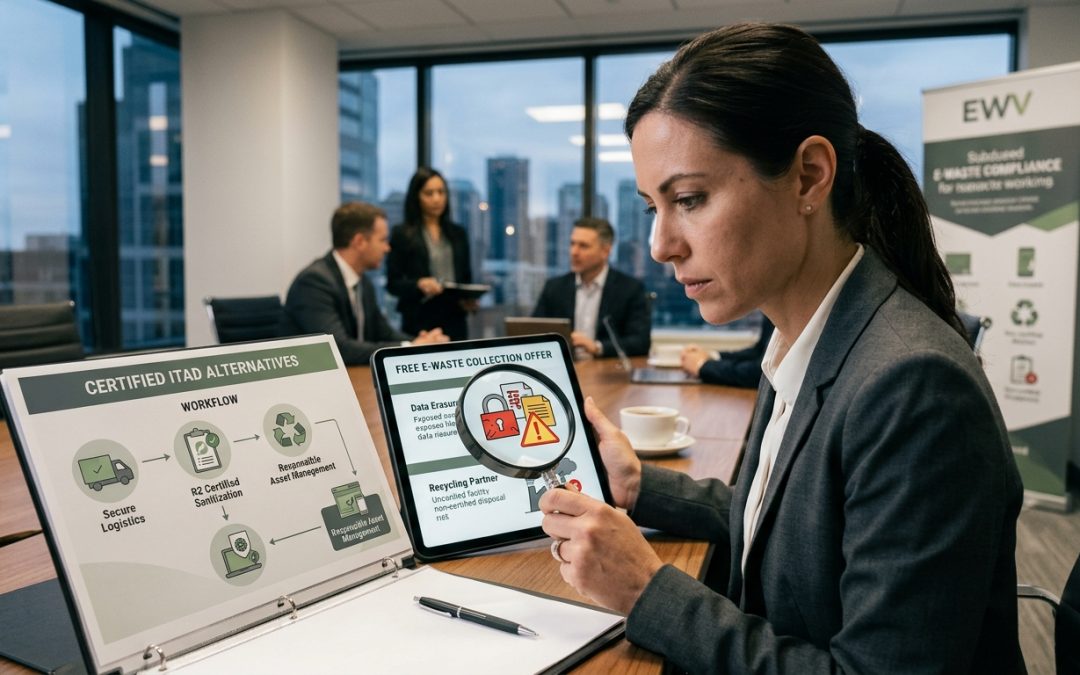
The Appeal of Free Collection
When a business needs to dispose of IT equipment, few offers sound better than “free e-waste collection.” No collection fees, no processing charges, no hassle. Someone comes, takes the old equipment away, and the problem is solved. But in the e-waste industry, free collection services often come with hidden costs that can far exceed what a professional, paid service would have charged. Understanding why some operators offer free collection, and what they might be cutting corners on, is essential for protecting your business.
This isn’t to say all free collection is problematic. Government-funded schemes like the NTCRS provide genuinely free collection for households and small businesses for covered product categories. But commercial “free” collection services targeting businesses with large volumes of IT equipment deserve closer scrutiny.
How “Free” Collection Works Economically
Legitimate e-waste processing costs money. Proper handling involves labour for sorting and disassembly, equipment for data destruction, certified downstream processing for hazardous materials, compliance documentation, and transport logistics. A professional operation covering these costs needs to charge fees or generate revenue from the collected equipment to stay viable.
Free collection operators typically make their money in one of several ways:
The most legitimate model involves cherry-picking valuable equipment for resale while recycling the rest. If a business is retiring recent-model laptops, servers, or networking equipment, the resale value may exceed the cost of collection and processing. This is essentially an informal ITAD arrangement, but the business typically receives no share of the resale value and has limited visibility into how the equipment is handled.
A more concerning model involves exporting equipment to countries with lower processing standards. Some operators collect equipment in Australia, perform minimal sorting, and ship containers to facilities in Southeast Asia, Africa, or other regions where labour costs are lower and environmental regulations may be less stringently enforced. While legal in some circumstances, this raises ethical and potentially legal questions about environmental responsibility.
The most problematic operators simply dump or improperly process portions of the collected material. They take the valuable components, such as circuit boards with precious metals, and dispose of the rest through the cheapest available means, which may include landfill, illegal dumping, or processing without proper environmental controls.
The Data Security Risk
The biggest hidden cost of free e-waste collection for businesses is the data security exposure. Free collection operators may not provide certified data destruction, or they may promise it without actually performing it to the required standard. When equipment changes hands without proper data sanitisation, your organisation’s data goes with it.
Consider what’s typically on a retired business laptop: email archives, cached login credentials, browser history with saved passwords, customer databases, financial records, strategic documents, and network configuration details. If this device ends up in a second-hand market without proper data wiping, the consequences can be severe.
Under the Privacy Act 1988 and Australian Privacy Principles, organisations have obligations to take reasonable steps to destroy personal information when it’s no longer needed. Using a collection service that doesn’t provide NIST 800-88 compliant data destruction with certificates of destruction for each device means you can’t demonstrate compliance with these obligations.
The cost of a data breach resulting from improperly disposed equipment can run into hundreds of thousands or millions of dollars when accounting for notification costs, legal fees, regulatory penalties, customer remediation, and reputational damage. Against this risk, paying for professional certified data destruction is one of the cheapest insurance policies a business can buy.
Environmental Compliance Risks
In Victoria, the e-waste landfill ban that took effect on 1 July 2019 means electronic waste cannot legally be sent to landfill. Businesses bear responsibility for ensuring their e-waste is handled in compliance with this ban, regardless of which collection service they use. If a free collection operator dumps material illegally, the original generator of that waste may face regulatory scrutiny.
The general environmental duty under Victoria’s Environment Protection Act 2017 requires businesses to minimise risks of harm to human health and the environment from their activities, including waste disposal. Using an unvetted free collection service without verifying their processing methods could be seen as failing to meet this duty.
Legitimate processors can provide chain of custody documentation showing where your equipment went and how it was processed. They hold relevant environmental permits and can demonstrate compliance with waste processing regulations. Free collection operators may not provide any of this documentation, leaving your business unable to prove proper disposal if questions arise.
What to Look For in a Legitimate Service
Whether you pay for e-waste collection or use a service that recovers costs through equipment value, the provider should meet certain minimum standards:
Transparent processing. They should be willing to explain exactly what happens to collected equipment, including downstream processing partners, export arrangements (if any), and disposal methods for non-recyclable fractions. Reluctance to discuss processing details is a red flag.
Documented data destruction. For any equipment that stored data, the provider should offer certified data sanitisation with individual device certificates including serial numbers and sanitisation method details.
Environmental certifications or permits. Look for relevant environmental management certifications and check that the operator holds appropriate waste processing permits for their jurisdiction.
Insurance and liability coverage. Professional operators carry appropriate insurance. If something goes wrong, whether it’s a data breach or an environmental incident, there should be accountability.
Written agreements. Any e-waste collection arrangement should be documented in a service agreement that specifies processing standards, data destruction requirements, and liability terms. A handshake deal with a “free” collector provides no legal protection.
The Bottom Line
Free e-waste collection isn’t inherently bad, but it requires the same due diligence you’d apply to any other service provider handling your organisation’s assets and data. The cheapest option isn’t the cheapest if it results in a data breach, environmental penalty, or reputational damage.
Professional ITAD services that charge transparent fees or share value recovery from equipment resale provide accountability, documentation, and risk mitigation that “free” operators typically cannot match. When the true cost of risk is factored in, paying for proper processing is almost always the more economical choice.
EWV helps Victorian businesses manage e-waste and IT asset disposal compliantly and sustainably — including collection, certified data destruction, and recycling. Contact us for a free quote.