
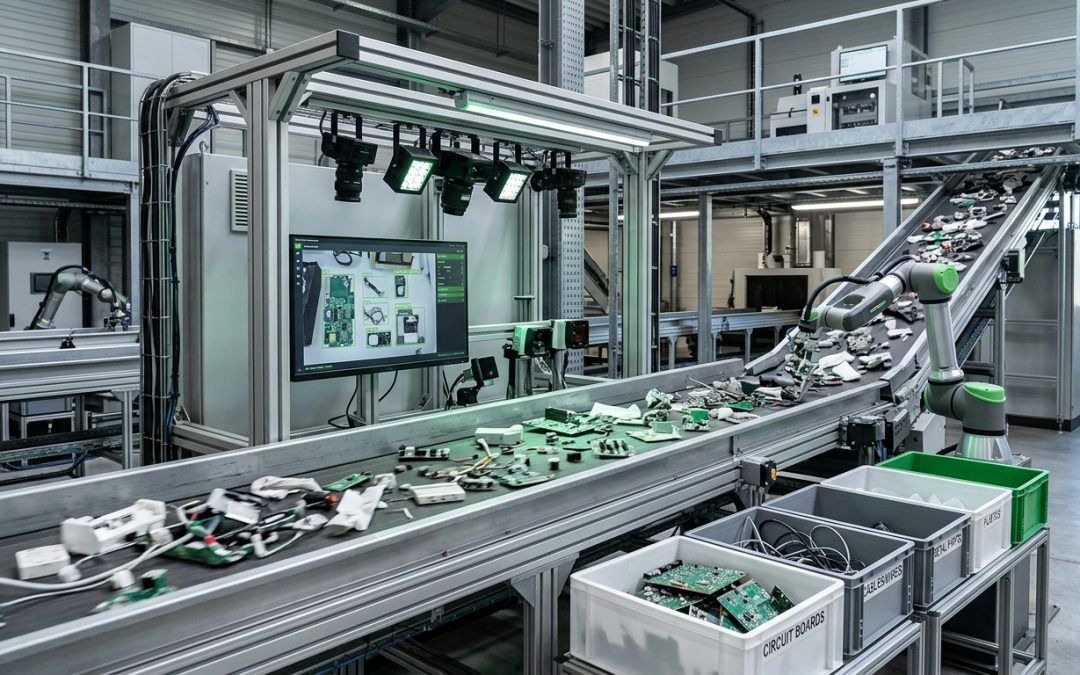
Why E-Waste Sorting Is So Challenging
Electronic waste is one of the most complex waste streams to process. A single batch of e-waste can contain thousands of different materials: dozens of metal types, multiple plastic polymers, ceramics, glass, composite materials, and hazardous substances. Each material type requires different processing methods, and contamination between streams reduces the quality and value of recovered materials. Traditional manual sorting is labour-intensive, slow, inconsistent, and exposes workers to hazardous materials. This is where artificial intelligence is beginning to transform the industry.
AI-powered sorting systems combine computer vision, machine learning, and robotic manipulation to identify, classify, and separate e-waste components faster and more accurately than human workers. While still evolving, these systems represent one of the most promising technological advances in e-waste processing and could significantly improve both the economics and environmental outcomes of recycling.
How AI Sorting Works
Modern AI sorting systems for e-waste typically combine several technologies working in concert:
Computer vision uses high-resolution cameras, sometimes combined with hyperspectral imaging or X-ray fluorescence sensors, to capture detailed images and material composition data for each item on a conveyor belt. The visual data captures shape, colour, size, surface texture, and identifying marks like labels or logos. Spectroscopic sensors can identify material composition at the molecular level.
Machine learning models trained on large datasets of e-waste images classify each item in real time. These models learn to distinguish between different device types (phones, tablets, laptops, circuit boards, cables), identify specific components (batteries, hard drives, RAM modules, screens), and detect material composition (copper, aluminium, various plastic types). The models improve continuously as they process more items and receive feedback on classification accuracy.
Robotic arms or pneumatic actuators physically separate the classified items into appropriate processing streams. Delta robots with vacuum grippers or mechanical fingers can pick individual items from a conveyor at speeds of 60-120 picks per minute, far exceeding sustained human sorting rates while maintaining consistency across an entire shift.
Applications in E-Waste Processing
Pre-sorting incoming material. AI systems can classify devices as they arrive at a processing facility, routing them to appropriate processing lines. Smartphones go to one line, laptops to another, peripherals to a third. This initial triage step speeds up the entire downstream process and reduces contamination between streams.
Component identification after disassembly. Once devices are disassembled (either manually or through automated processes), AI systems can identify and sort individual components. Circuit boards are separated by type and value, batteries are isolated for specialist processing, and hazardous components are flagged for appropriate handling.
Material stream purification. After mechanical shredding, AI-guided sorting removes contaminants from material streams. This is particularly valuable for plastic sorting, where different polymer types must be separated to produce usable recyclate. Near-infrared spectroscopy combined with AI classification can distinguish between plastic types that look identical to the human eye.
Quality control. AI vision systems can inspect processed material streams for contamination, verifying that separated materials meet purity standards before they’re shipped to downstream processors. This automated quality assurance catches issues that might be missed in manual spot-checking.
The Economic Impact
AI sorting addresses one of the fundamental economic challenges of e-waste recycling: the cost of labour-intensive manual processing. In countries like Australia with high labour costs, manual sorting is a significant portion of total processing expense. AI systems offer several economic advantages:
Higher throughput means more material processed per shift, spreading fixed facility costs across greater volume. This improves the economics of processing lower-value material that might otherwise be uneconomical to sort manually.
Better material recovery translates directly to revenue. When AI systems achieve higher sorting accuracy, less valuable material ends up in low-value mixed streams. More copper goes to copper processing, more gold-bearing circuit boards go to precious metals recovery, and contamination losses decrease.
Reduced workplace hazards lower insurance costs, workers’ compensation claims, and the expense of protective equipment and health monitoring for workers in manual sorting roles. Workers can be redeployed to higher-skilled roles like system operation, maintenance, and quality management.
The capital cost of AI sorting systems is significant, but rapidly declining as the technology matures and competition increases. For large-scale processing operations, the return on investment is typically achieved within 2-4 years through labour savings and improved material recovery value.
Challenges and Limitations
AI sorting for e-waste is promising but not without challenges:
Training data requirements. Machine learning models need large, accurately labelled datasets to achieve high classification accuracy. E-waste is enormously diverse, with new device types and designs constantly entering the waste stream. Models need ongoing retraining to handle devices they haven’t seen before.
Physical handling complexity. While AI can identify items accurately, physically handling irregular, tangled, or damaged e-waste components remains difficult for robotic systems. Cables, flexible circuit boards, and shattered screens present manipulation challenges that current robotic grippers don’t always handle well.
Integration with existing facilities. Retrofitting AI sorting into existing e-waste processing lines requires significant engineering work. Conveyor speeds, lighting conditions, spatial constraints, and material flow patterns all need to accommodate the requirements of vision systems and robotic manipulators.
Variability of input material. E-waste streams vary significantly by geography, source (consumer versus commercial), and time period. A system trained on one region’s e-waste mix may perform poorly when processing material from a different source. Continuous model adaptation is necessary.
What This Means for the Industry
AI-powered sorting is one of several technologies reshaping how e-waste is processed, alongside advances in recycling methods, automated disassembly, and hydrometallurgical recovery. Together, these technologies are making it economically viable to recover more materials from electronic waste while reducing environmental and health impacts of processing.
For Australian e-waste processors, adopting AI sorting technology will become increasingly important for competitiveness as the volume of e-waste grows and regulatory standards for material recovery tighten. Facilities that invest in these capabilities will be better positioned to handle the growing complexity and volume of the electronic waste stream.
For businesses generating e-waste, the advancement of AI sorting means that choosing responsible processors who invest in technology will yield better environmental outcomes. The circular economy depends on high-quality material recovery, and AI is one of the key enablers making that recovery more efficient and economically viable.
EWV helps Victorian businesses manage e-waste and IT asset disposal compliantly and sustainably — including collection, certified data destruction, and recycling. Contact us for a free quote.