
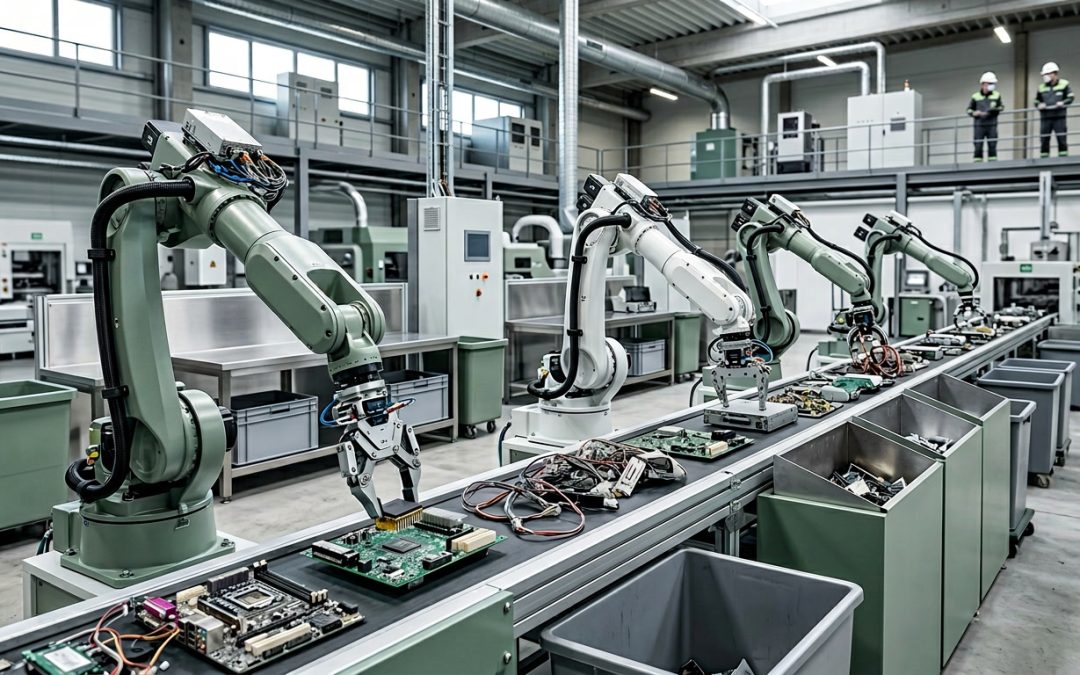
Why Manual Disassembly Can’t Scale
The global volume of electronic waste is growing at roughly 3-5% annually, yet the capacity to process it responsibly hasn’t kept pace. One of the key bottlenecks is disassembly. Before e-waste can be recycled effectively, devices need to be taken apart so that batteries can be safely removed, hazardous components can be isolated, valuable parts can be recovered for reuse, and different material streams can be separated for appropriate processing. This disassembly work is overwhelmingly manual, and that creates fundamental scalability problems.
Manual disassembly is slow, labour-intensive, and exposes workers to hazardous substances. It’s also inconsistent, with variations in technique and thoroughness between individual workers and across shifts. As e-waste volumes grow and labour costs rise, the economics of purely manual disassembly become increasingly challenging. Robotic automated disassembly offers a pathway to processing more material, more safely, and more efficiently.
Current State of Automated Disassembly
Robotic disassembly of electronics is still an emerging field, but it’s advancing rapidly. Several approaches are being developed and piloted globally:
Targeted component removal robots focus on extracting specific high-value or hazardous components from devices. Apple’s “Daisy” robot, for example, can disassemble 23 models of iPhone at a rate of 200 per hour, extracting 15 different materials for recycling. Each robot processes specific device types, using vision systems to identify the model and adjust its disassembly sequence accordingly.
Collaborative robots (cobots) work alongside human operators in hybrid disassembly lines. The robot handles repetitive or hazardous tasks, such as removing screws, prying open cases, and extracting batteries, while human workers handle tasks requiring judgement and dexterity that current robotics can’t match. This approach captures many of the benefits of automation while maintaining the flexibility that pure human disassembly provides.
Force-controlled manipulation is a key enabling technology. Unlike traditional industrial robots that follow rigid programmed paths, force-controlled robots can feel resistance and adjust their actions accordingly. This is critical for disassembly tasks where the force required varies between individual units due to differences in adhesive age, fastener tightness, or component condition.
The Technical Challenges
Automating e-waste disassembly is significantly harder than automating manufacturing assembly, and understanding why helps explain where the technology stands today:
Product variety. A manufacturing line typically assembles one product model at a time. A disassembly line receives a mixed stream of devices spanning dozens of manufacturers, hundreds of models, and multiple product generations. Each device may need a different disassembly sequence, different tools, and different force profiles. The robot must either be programmed for each variation or use adaptive intelligence to figure it out in real time.
Unknown condition. Products on a manufacturing line are new and consistent. Devices arriving for disassembly may be damaged, corroded, modified, missing components, or in unknown condition. A robot designed to remove a specific screw may encounter a stripped head, a missing screw, or corrosion that’s fused the fastener to the chassis. Handling these exceptions gracefully is one of the hardest challenges in automated disassembly.
Adhesive joints. Modern electronics make extensive use of adhesive bonding, which is inherently difficult to automate for disassembly. Adhesive properties change with age, temperature, and chemical exposure, making the force and technique required unpredictable. Heat application, solvent softening, and mechanical prying all work but require adaptive control that current systems are still refining.
Safety-critical components. Lithium-ion batteries require careful handling during removal because puncturing or deforming them risks thermal runaway. Automated battery removal needs reliable force limiting, position sensing, and fail-safe mechanisms to prevent dangerous situations. This is one area where the safety stakes are high enough that robust automation actually offers advantages over manual handling, provided the systems are properly engineered.
Where Automation Is Already Working
Despite the challenges, automated disassembly is already operational in several contexts:
Hard drive processing is one of the most automated e-waste disassembly tasks. The standardised form factors (3.5″ and 2.5″) and consistent construction of hard drives make them well-suited to robotic processing. Automated lines can remove covers, extract platters, separate magnets, and sort components at high speed. This is commercially viable because hard drives contain valuable rare earth magnets and recoverable aluminium.
CRT monitor processing has been automated at several facilities globally. The consistent geometry and the need to safely handle lead-containing glass makes CRTs a good candidate for automated disassembly using cutting tools and vacuum systems.
Circuit board depopulation uses automated systems to remove components from circuit boards before downstream processing. Infrared heating systems melt solder connections while robotic tools or vibration separates components, enabling recovery of chips, connectors, and other parts that have reuse or recycling value.
The Research Frontier
Academic and industry research is pushing automated disassembly capabilities in several directions:
Digital twin integration. Using manufacturer CAD data and product databases to provide robots with knowledge of internal structure before beginning disassembly. If the system knows the exact screw locations, component layout, and material composition of a specific product model, it can plan an optimal disassembly sequence without exploratory probing.
Reinforcement learning. Training robots through trial and error in simulated environments, then transferring learned skills to physical systems. This approach can develop novel disassembly strategies that human programmers might not consider, particularly for devices with unusual construction.
Multi-robot coordination. Using teams of specialised robots, each optimised for different disassembly tasks, working on the same device simultaneously or in sequence. This mirrors how human disassembly lines distribute tasks but with the speed and consistency advantages of automation.
Implications for the Industry
Automated disassembly won’t replace human workers in e-waste processing entirely, at least not in the foreseeable future. The diversity and unpredictability of the e-waste stream means human judgement and adaptability remain essential, particularly for unusual or damaged devices. But automation will increasingly handle the high-volume, standardised, and hazardous tasks where robots excel.
For Australia’s e-waste sector, the development of automated disassembly technology matters for several reasons. It addresses the labour cost challenge that makes some material recovery uneconomical. It reduces worker exposure to hazardous substances. And it enables processing capacity to scale with the growing e-waste volume rather than being constrained by available skilled labour.
The circular economy for electronics depends on efficient, high-quality disassembly to recover maximum value from retired devices. As automated disassembly technology matures and becomes more accessible, it will be one of the key enablers for scaling responsible e-waste recycling to match the scale of the problem.
EWV helps Victorian businesses manage e-waste and IT asset disposal compliantly and sustainably — including collection, certified data destruction, and recycling. Contact us for a free quote.