
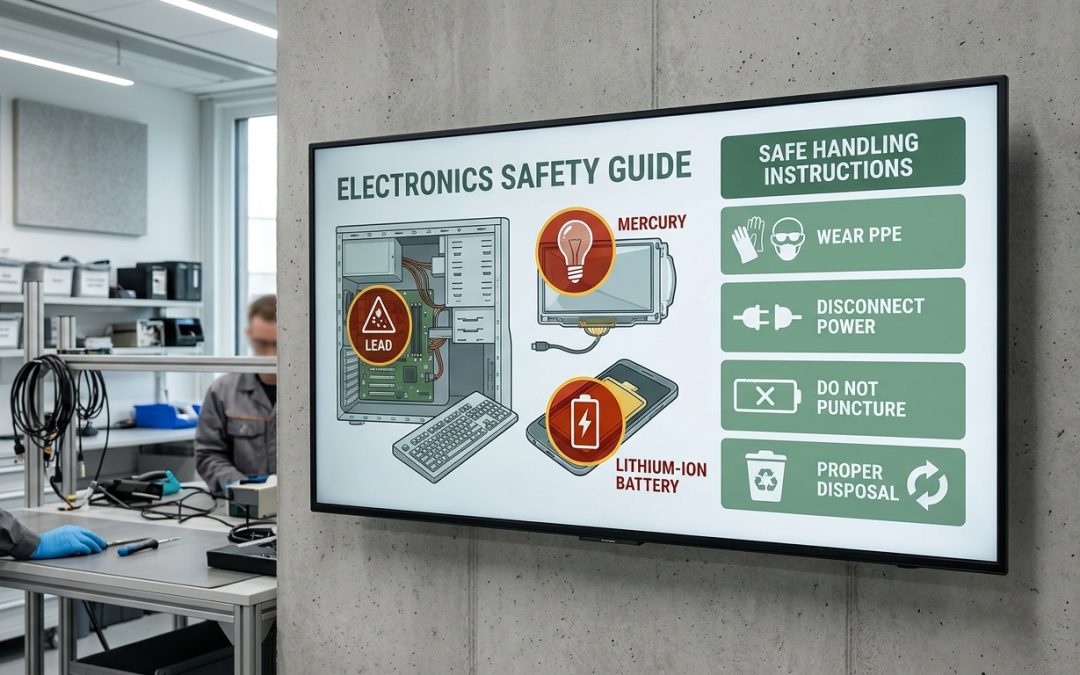
What’s Hiding Inside Your Old Devices
Electronic devices look harmless enough sitting on a shelf, but inside they can contain a surprising array of hazardous materials. Knowing what these materials are, where they’re found, and why they matter helps you understand why e-waste needs special handling and why it should never go in the general waste bin. You don’t need to become a chemist, but a basic awareness of common hazardous components makes you a more informed consumer and disposer of electronics.
Lead
Where it’s found: Lead is present in solder used to attach components to circuit boards in older electronics. Pre-2006 devices (before the EU RoHS Directive pushed manufacturers toward lead-free solder) contain significant amounts. Lead is also found in the glass of cathode ray tube (CRT) monitors and televisions, where a single CRT can contain 2-4 kg of lead.
Why it’s hazardous: Lead is a potent neurotoxin. Even low-level exposure affects brain development in children and causes neurological, cardiovascular, and kidney problems in adults. Lead is persistent in the environment and accumulates in soil and water when e-waste is landfilled.
How to identify: You can’t visually identify lead solder on a circuit board without testing, but as a general rule, older electronics (pre-2006) contain more lead than newer ones. CRT monitors and TVs are the biggest single source of lead in household e-waste and are easy to identify by their heavy glass screens and deep, bulky form factor.
Mercury
Where it’s found: Mercury is present in the cold cathode fluorescent lamps (CCFLs) used as backlights in older LCD monitors, laptop screens, and flat-panel TVs manufactured before approximately 2012-2014. Some switches and relays in older electronics also contain mercury. Compact fluorescent light bulbs (CFLs) contain small amounts of mercury vapour.
Why it’s hazardous: Mercury is a powerful neurotoxin that accumulates in biological systems. It can evaporate at room temperature, creating inhalation risks when mercury-containing components are broken. Mercury contamination of waterways leads to bioaccumulation in fish, which is how most human exposure occurs.
How to identify: If your LCD monitor or laptop was manufactured before about 2014 and uses CCFL backlighting rather than LED backlighting, it likely contains mercury. Newer LED-backlit displays don’t contain mercury. The manufacturing date on the device label gives a reasonable indicator.
Cadmium
Where it’s found: Cadmium appears in older nickel-cadmium (NiCd) rechargeable batteries, in some semiconductor components, and in the phosphor coatings of older CRT displays. While NiCd batteries have largely been replaced by nickel-metal hydride and lithium-ion types, they’re still found in older cordless phones, power tools, and emergency lighting.
Why it’s hazardous: Cadmium is a known carcinogen. Chronic exposure through inhalation or ingestion causes kidney damage and bone disease. Like lead and mercury, cadmium accumulates in the environment and enters food chains when released from landfilled e-waste.
How to identify: NiCd batteries are typically marked with “NiCd” or “Nickel-Cadmium” on the battery casing. They’re most common in devices manufactured before the mid-2000s. If you have old rechargeable batteries, particularly large cylindrical or rectangular packs from cordless tools or phones, check the labelling.
Lithium-Ion Batteries
Where they’re found: In virtually every portable device made in the last 15 years. Smartphones, laptops, tablets, wireless earbuds, power banks, electric toothbrushes, power tools, e-bikes, and countless other devices use lithium-ion batteries.
Why they’re hazardous: Lithium-ion batteries are an immediate physical hazard rather than a toxicity concern. When damaged, punctured, or exposed to excessive heat, they can experience thermal runaway, a rapid, uncontrollable increase in temperature that can cause fires or explosions. This is the primary reason batteries must never go in any bin, as crushing in collection trucks triggers this reaction.
How to identify: Most lithium-ion batteries are marked “Li-ion” or with the lithium battery symbol. However, many are hidden inside devices and not directly visible. As a general rule, if a device charges via USB or has a built-in rechargeable battery, it contains lithium-ion cells. Swollen batteries (the case is bulging) are particularly dangerous and should be handled with extra care.
Brominated Flame Retardants (BFRs)
Where they’re found: In the plastic housings, circuit boards, and cable insulation of many electronic devices. BFRs are added to make plastics fire-resistant and are particularly common in devices that generate heat, such as computers, monitors, and power supplies.
Why they’re hazardous: Many BFRs are persistent organic pollutants that don’t break down in the environment. Some are endocrine disruptors that affect hormone systems. When e-waste containing BFRs is burned (whether deliberately or in waste facility fires), it can release toxic dioxins and furans.
How to identify: You can’t identify BFRs by looking at a device. Newer electronics increasingly use halogen-free flame retardants, but older devices (pre-2010) are more likely to contain regulated BFRs. Proper recycling facilities test for BFRs during plastic sorting to ensure contaminated plastics are handled appropriately.
Other Hazardous Materials
Beryllium is found in some connectors and springs in electronics. It’s a toxic material that’s dangerous when inhaled as dust during dismantling.
Arsenic is present in small quantities in some semiconductor compounds, particularly gallium arsenide used in LED and laser components.
Polyvinyl chloride (PVC) in cable insulation releases hydrochloric acid and potentially dioxins when burned.
What This Means for You
You don’t need to handle your old electronics with hazmat gloves. During normal use and handling, these hazardous materials are safely contained within the device. The risks arise when devices are improperly dismantled, crushed in waste processing, or left to degrade in landfill over years.
The practical takeaway is simple: e-waste needs to go to proper recycling facilities where trained workers with appropriate equipment can safely disassemble devices, isolate hazardous components, and process materials through controlled channels. That’s the whole point of the regulations and collection infrastructure that exist around e-waste. By getting your old electronics to the right place, you’re ensuring these hazardous materials are handled safely rather than released into the environment.
EWV helps Victorian businesses manage e-waste and IT asset disposal compliantly and sustainably — including collection, certified data destruction, and recycling. Contact us for a free quote.