
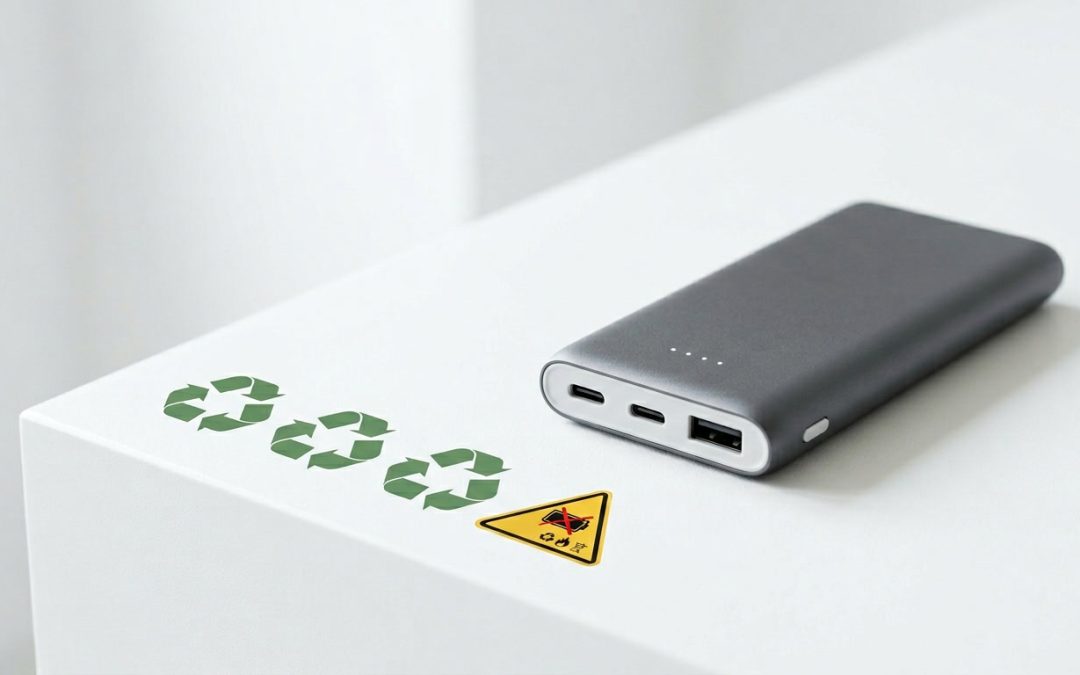
Power Banks Are Batteries, and That Changes Everything
A power bank is essentially a large lithium-ion battery in a plastic case. And while that makes it incredibly useful for charging your phone on the go, it also makes it one of the more hazardous items in your household e-waste when it reaches end of life. Power banks should never go in any bin, whether general waste, recycling, or even standard e-waste bins at some facilities. They require specific handling because of the fire and chemical risks associated with lithium-ion battery chemistry.
Why Power Banks Need Special Care
The lithium-ion cells inside a power bank store a substantial amount of energy. A typical 10,000 mAh power bank contains roughly the same energy as 3-4 smartphone batteries combined. When these cells are damaged, whether through physical impact, puncture, or internal degradation, they can enter thermal runaway, a rapid, uncontrollable heating reaction that can reach temperatures exceeding 600°C and cause fires or small explosions.
This is exactly what happens when power banks end up in waste collection trucks or recycling facility sorting lines. The compression forces in a garbage truck are more than enough to puncture a lithium cell, and the resulting fire can spread rapidly through surrounding waste. Power banks have been identified as one of the leading causes of waste vehicle fires in Australia.
As power banks age, the internal cells degrade. Older units may have cells with weakened internal separators that are more prone to short-circuiting. A power bank that barely holds a charge anymore is actually more dangerous from a disposal perspective than when it was new, because the degraded cells are more susceptible to failure modes.
How to Dispose of a Power Bank
Battery recycling drop-off points are the primary disposal channel. B-cycle collection points at Aldi, Officeworks, Battery World, and many other retailers accept power banks for recycling. These collection points have proper storage containers designed for lithium batteries.
Council transfer stations accept power banks, usually in their dedicated battery or e-waste collection area. Staff at these facilities are trained to handle lithium batteries appropriately.
Hazardous waste collection events run by some councils specifically target items like power banks that need careful handling.
When transporting a power bank to a recycling point, take basic precautions. Tape over the charging ports with electrical tape or masking tape to prevent accidental short-circuiting. Don’t transport it loose in a bag with metal objects like keys or coins that could bridge contacts. If the power bank is damaged or swollen, place it in a non-flammable container (ceramic dish or metal tin) for transport.
What NOT to Do
Don’t put it in any bin. Not the general waste, not the recycling bin, not the green waste. The fire risk is real and immediate.
Don’t try to open it. Disassembling a power bank exposes you to the lithium cells, which can short-circuit if the internal structure is disturbed. Leave disassembly to professional recyclers.
Don’t put it in water to “discharge” it. Water and lithium react violently. This is dangerous and does not make the battery safer.
Don’t stockpile large numbers. If you’ve accumulated multiple old power banks, don’t store them all together in a drawer. The combined energy content of several power banks creates a more serious fire risk. Dispose of them promptly rather than accumulating a collection.
When to Replace Rather Than Keep Using
Power banks don’t last forever. Most lithium-ion cells lose significant capacity after 300-500 charge cycles, which for a regularly used power bank means 2-4 years of useful life. Signs that a power bank should be retired include holding significantly less charge than when new (50% or less of original capacity), taking much longer to charge devices, getting unusually warm during use, and any physical damage to the casing.
Using a degraded power bank past its useful life doesn’t just give poor performance, it also increases the risk of cell failure. When a power bank is no longer reliably useful, it’s time to retire it to a recycling point.
Buying Considerations for Next Time
When replacing your power bank, look for units from reputable brands that use quality cells and include proper safety circuits (overcharge protection, over-discharge protection, short-circuit protection, and temperature monitoring). Ultra-cheap power banks from unknown brands may cut corners on these safety features, which increases both the risk during use and the hazard at end of life.
Consider whether you actually need the capacity you’re buying. A smaller power bank with fewer cells is a smaller hazard at end of life and a lighter item to carry. Match the capacity to your actual needs rather than defaulting to the biggest unit available.
Power banks have become everyday carry items for millions of Australians, and managing them responsibly at end of life is an important part of e-waste management. A quick trip to a battery recycling point is all it takes to keep these high-energy devices out of the waste stream where they can cause real harm.
EWV helps Victorian businesses manage e-waste and IT asset disposal compliantly and sustainably — including collection, certified data destruction, and recycling. Contact us for a free quote.