
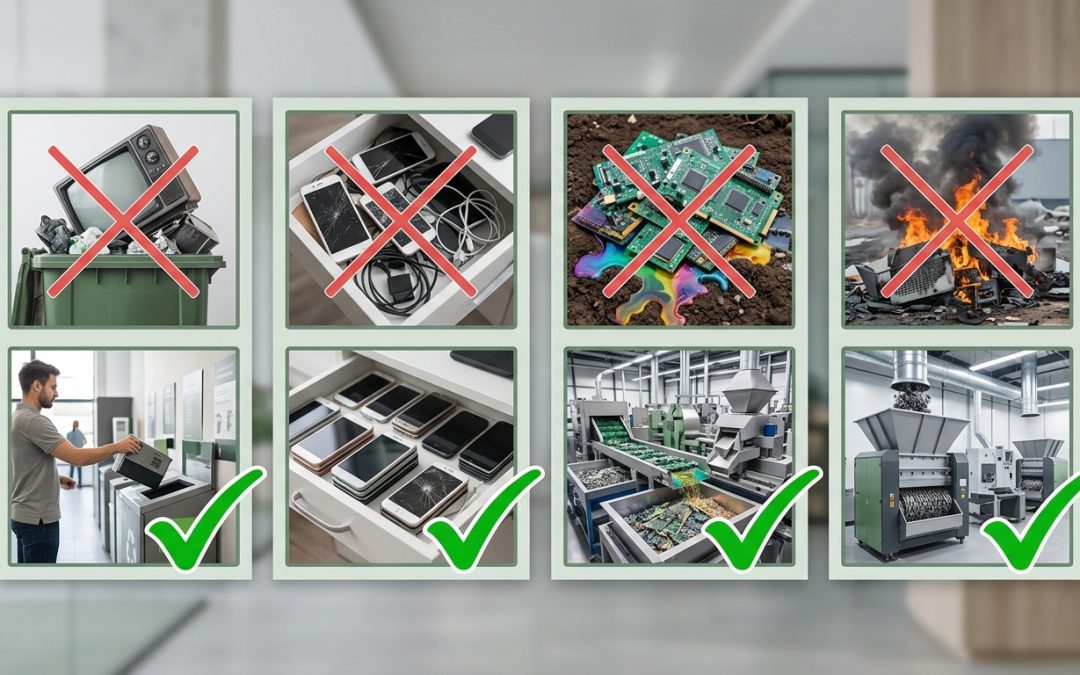
Separating Fact from Fiction on E-Waste
Electronic waste is surrounded by misconceptions. Some are harmless misunderstandings, while others lead people to make decisions that harm the environment or compromise their data security. Getting the facts straight about e-waste matters because what you believe directly affects what you do with your old electronics.
Let’s work through the most common myths and set the record straight.
Myth 1: Throwing One Device in the Bin Doesn’t Make a Difference
This is probably the most widespread and most damaging myth. It’s the classic “my contribution is too small to matter” thinking, and it falls apart under any scrutiny.
The reality: Australia generates over 500,000 tonnes of e-waste per year, and that number comes from millions of individual decisions. Every phone, laptop, or toaster that goes into general waste adds to the total. In Victoria, sending e-waste to landfill has been illegal since July 2019 precisely because the cumulative impact is significant. A single smartphone contains hazardous materials including lead, mercury, and lithium that can contaminate soil and groundwater. Multiply that by millions of devices, and the impact is enormous.
The same logic applies in reverse. Every device properly recycled is materials recovered, hazardous substances safely contained, and demand for virgin mining slightly reduced. Individual actions absolutely matter when aggregated across a population.
Myth 2: Deleting Files and Emptying the Recycle Bin Erases Your Data
This myth persists because the terminology is misleading. When you “delete” a file, your computer removes the pointer to where the file is stored but doesn’t actually erase the data itself. The data remains on the drive and can be recovered using freely available software until it’s overwritten by new data.
Even formatting a hard drive doesn’t guarantee the data is gone. A quick format only rebuilds the file system structure. A full format overwrites data with zeros on traditional hard drives, but the process is different for SSDs due to how they manage data internally.
To properly erase data, you need purpose-built tools that overwrite the entire storage medium following recognised standards like NIST 800-88. For devices that can’t be reliably wiped, such as damaged drives, physical destruction is the only certain method.
Our data destruction guide explains the different methods in detail.
Myth 3: All E-Waste Recycling Is the Same
Dropping your old electronics at any collection point might feel like you’ve done your part, but the quality of recycling varies enormously between operators. Some facilities use advanced processes to recover 95% or more of materials. Others simply shred everything and recover basic metals while sending the rest to landfill.
At the worst end of the spectrum, some operators have been caught stockpiling collected e-waste in warehouses rather than processing it, or exporting unsorted waste to developing countries where it’s processed by unprotected workers in dangerous conditions.
- They hold AS/NZS 5377 certification for e-waste handling
- They can explain their downstream processing chain
- They welcome facility visits
- They provide documentation of what happened to your materials
- They hold a current EPA licence for their facility
Myth 4: E-Waste Just Gets Shipped to Developing Countries
This was more true in the past than it is today, but the myth persists. Australia has signed the Basel Convention, which restricts the export of hazardous waste including e-waste to developing countries. Legitimate Australian recyclers process materials domestically or export only to facilities in countries with equivalent environmental standards.
That said, illegal exports do still occur, which is why choosing a reputable recycler matters. The existence of bad actors doesn’t invalidate the entire recycling system. It means you need to be thoughtful about who you trust with your e-waste.
The majority of Australian e-waste recycling happens domestically. Recovered metals may be exported for further refining at specialist smelters, but this is processed, sorted material going to regulated facilities, not raw e-waste being dumped.
Myth 5: It Costs More to Recycle Electronics Than to Mine New Materials
This is a common misconception that ignores the full picture. When you account for the total environmental and social costs of mining, recycling is significantly more cost-effective for many materials.
Consider gold: there’s roughly 300 grams of gold in a tonne of old mobile phones, compared to 1-5 grams in a tonne of gold ore. The energy required to recover gold from recycled electronics is a fraction of what’s needed for mining, processing, and refining virgin ore. Similar economics apply to copper, palladium, and other valuable metals.
The challenge is that recycling infrastructure requires upfront investment, and collecting scattered consumer devices is logistically complex. But the per-unit economics are favourable for most materials, and they improve as recycling technology advances and virgin material costs rise.
Myth 6: Old Electronics Are Worthless
Many people assume their old devices have zero value, which leads them to throw things away rather than recycling or selling them. Even broken electronics have material value, and functional older devices often have more resale value than people expect.
A smartphone that’s three or four years old and still working can fetch $50-$200 on marketplace platforms, depending on the model. Working laptops, even older ones, have value to budget-conscious buyers, students, and charities. Even completely non-functional devices have value as source materials for recycling, particularly those containing precious metals.
The materials inside a single smartphone include around $1-2 worth of precious metals at current prices. That doesn’t sound like much, but across millions of devices, it represents significant recoverable value. A tonne of circuit boards can yield more precious metals than a tonne of ore from some of the world’s richest mines.
Myth 7: Factory Reset Makes a Phone Completely Safe to Sell
A factory reset is a good start, but it’s not always sufficient to make data completely unrecoverable, particularly on older devices. Modern smartphones with hardware encryption do a better job, as a factory reset destroys the encryption keys, making data practically unrecoverable even if it still exists on the storage chip.
However, older phones without hardware encryption may leave data recoverable after a reset. And many people forget to sign out of accounts, remove SIM cards, or disable device tracking features before performing the reset, which creates different kinds of problems for the next user.
The safest approach is to sign out of all accounts, remove SIM and memory cards, perform the factory reset, and then verify by going through the initial setup process as if you were a new user to confirm nothing carries over. For computers, use dedicated wiping software rather than relying on the operating system’s built-in reset function.
Myth 8: Batteries Can Go in Regular Recycling
This is not just wrong, it’s dangerous. Lithium-ion batteries, the type found in smartphones, laptops, tablets, and most rechargeable devices, can catch fire or explode when damaged, punctured, or crushed. This happens regularly at recycling facilities and waste management centres when batteries end up in general recycling or waste streams.
Batteries need to go through dedicated battery recycling programs. In Australia, B-cycle provides battery recycling points at major supermarkets and hardware stores. Many electronics retailers also accept batteries for recycling. For business quantities, specialised battery recyclers handle collection and processing.
Before disposing of any loose batteries, tape over the terminals with electrical tape or masking tape to prevent short circuits during transport and storage.
Myth 9: E-Waste Recycling Isn’t Regulated
Australian e-waste recycling operates under a significant regulatory framework. State and federal laws govern how electronic waste is collected, stored, transported, and processed.
Victoria led the way with its e-waste landfill ban in 2019. The federal Product Stewardship Act 2011 established frameworks for producer responsibility. The National Television and Computer Recycling Scheme requires manufacturers and importers to fund recycling infrastructure. The Basel Convention restricts international movement of e-waste. State EPA licencing requirements govern processing facilities.
The regulatory environment is actually one of the more comprehensive frameworks compared to many other waste streams. For a full overview, see our guide to e-waste laws and regulations in Australia.
Myth 10: You Should Stockpile Old Electronics “Just in Case”
This is the quiet myth that probably affects more people than any other. Keeping old devices “just in case” seems harmless but actually creates problems. Batteries degrade and can become safety hazards over time. Data on old devices remains at risk of exposure. The devices lose whatever resale or donation value they had. And hoarding delays the recovery of valuable materials that could be put back into use.
The best time to deal with an old device is when you replace it. The second best time is now. Either way, making an informed decision based on facts rather than myths ensures the best outcome for your data, your wallet, and the environment.
For more on the complete lifecycle of electronics, explore our guide on what happens to your old electronics.
EWV helps Victorian businesses manage e-waste and IT asset disposal compliantly and sustainably — including collection, certified data destruction, and recycling. Contact us for a free quote.