
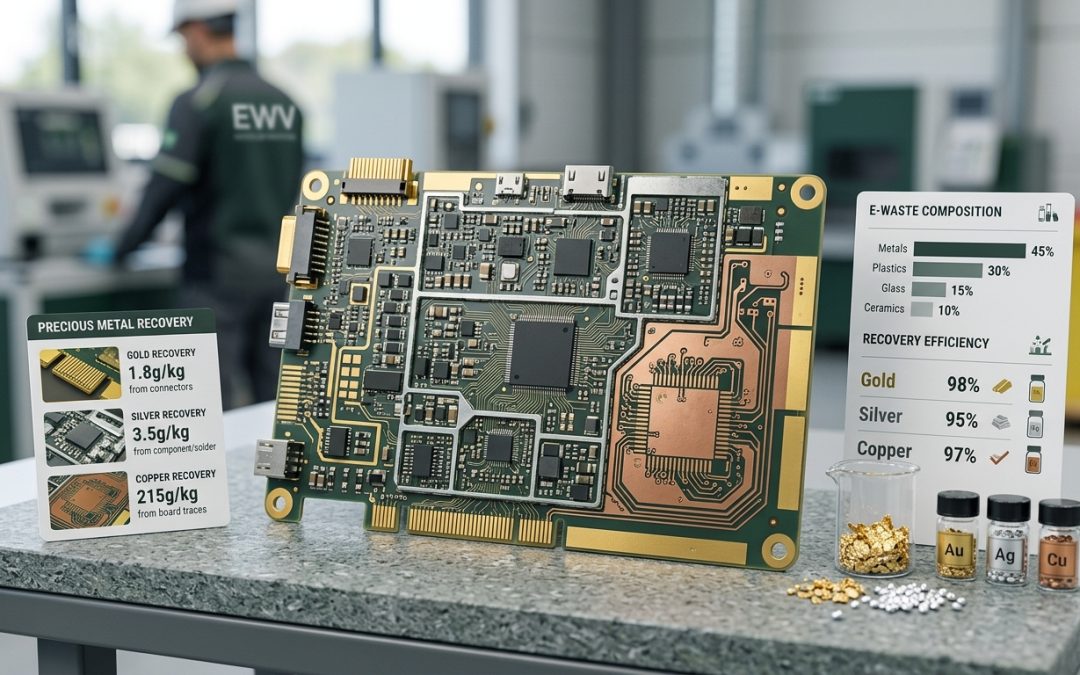
A Goldmine in Your Drawer
Every old phone, laptop, and circuit board sitting forgotten in a drawer contains something surprisingly valuable: precious metals. Gold, silver, platinum, and palladium are all essential components in modern electronics, used for their unique properties as conductors, contact surfaces, and corrosion-resistant connectors. The concentration of precious metals in electronic waste is often higher than in the ores mined from the earth, making e-waste one of the richest “urban mines” on the planet.
Understanding what’s inside your old devices explains why proper recycling matters so much, both for the environment and for the economy. These aren’t trivial amounts when aggregated across millions of devices.
Gold: The Star of Electronic Recycling
Gold is used in electronics because it’s an excellent conductor that doesn’t corrode. You’ll find it on circuit board connectors, edge contacts (the gold-coloured fingers on RAM sticks and expansion cards), bonding wires inside processor chips, and connector pins throughout devices.
A single smartphone contains approximately 0.03 grams of gold. That sounds tiny, but consider the scale. A tonne of mobile phones, roughly 10,000 handsets, contains around 300 grams of gold. Compare that to gold mining, where a tonne of ore from a high-grade mine might yield just 5-10 grams. Recovering gold from e-waste is 40-60 times more concentrated than mining it from the ground.
At current gold prices, the gold in a single phone is worth about $3-5. Multiply that by the estimated 25 million unused phones sitting in Australian homes, and there’s roughly $75-125 million worth of gold just in stockpiled mobile phones across the country.
Silver: The Hidden Workhorse
Silver is actually more abundant in electronics than gold, though less valuable per gram. It’s used extensively in solder, switches, contacts, and increasingly in the silver paste that forms the conductive pathways in circuit boards.
A typical laptop contains around 0.3-1 gram of silver, spread across solder joints, keyboard contacts, and circuit board traces. Televisions, particularly older plasma and LCD models, contain silver in their circuitry and connection points. Even humble items like calculators and remote controls contain small amounts.
Silver recovered from e-waste goes straight back into manufacturing. It’s used in new electronics, solar panels, medical devices, and industrial applications. The quality of recycled silver is identical to newly mined silver, making it a perfect candidate for circular recovery.
Platinum and Palladium: The Quiet Valuables
Platinum group metals (PGMs) are used in electronics for their exceptional resistance to heat and corrosion. Hard drives contain platinum in their magnetic storage platters, and palladium is used in multi-layer ceramic capacitors found on virtually every circuit board.
The amounts per device are extremely small, measured in milligrams rather than grams. But palladium in particular has become increasingly valuable, sometimes exceeding the price of gold. The tiny quantities in each device become significant when millions of devices are processed together.
These metals are also critical for other industries, particularly automotive catalytic converters and hydrogen fuel cell technology. Recovering them from e-waste reduces pressure on mining operations and helps secure supply chains for emerging clean energy technologies.
- Smartphone: 0.03g gold, 0.3g silver, trace platinum/palladium
- Laptop: 0.1-0.3g gold, 0.5-1g silver, trace PGMs
- Desktop PC: 0.2-0.5g gold, 1-3g silver, small amounts of PGMs
- Server: 0.5-1g+ gold, 3-5g silver, measurable PGMs
Values vary by model, age, and manufacturer
Copper: Not Precious, but Incredibly Valuable
While not technically a precious metal, copper deserves mention because it’s the single most valuable material by weight in most electronic devices. Copper makes up 10-20% of a typical circuit board’s weight and is found throughout devices in wiring, connectors, heat sinks, and motor windings.
A single computer can contain 700 grams to over a kilogram of copper. Across all the e-waste generated in Australia each year, that represents thousands of tonnes of recoverable copper. Recycled copper uses 85% less energy to produce than copper from virgin ore, making its recovery a significant environmental win.
Rare Earth Elements: Small but Strategic
Rare earth elements are used in magnets, speakers, vibration motors, and display technologies. Neodymium and dysprosium are found in the powerful magnets inside hard drives, phone speakers, and vibration motors. Europium, terbium, and yttrium are used in display phosphors. Lanthanum appears in camera lenses and battery electrodes.
These elements aren’t precious in the traditional sense, but they’re strategically critical. China controls roughly 60% of rare earth mining and 90% of processing, creating supply chain vulnerabilities for the rest of the world. Recovering rare earths from e-waste is an active area of research and development, with several Australian companies working on commercial-scale recovery processes.
The challenge with rare earth recycling is that these elements are used in very small quantities across many components, making extraction complex. But as recovery technology improves and supply concerns grow, e-waste is increasingly seen as a vital secondary source.
Why Aren’t We Recovering More?
If e-waste is so rich in valuable materials, why isn’t more of it being recycled? The answer comes down to collection rates, economics, and technology.
Collection remains the biggest challenge. Globally, less than 20% of e-waste is formally recycled. In Australia, the rate is better but still far from comprehensive. Millions of devices sit in drawers, end up in general waste, or are exported to countries with less rigorous recycling infrastructure.
Economics play a role too. While precious metals are valuable, the cost of collecting, transporting, sorting, and processing scattered consumer devices is significant. Recycling is most economical at scale, which is why business and institutional e-waste streams (where large volumes of similar devices are available) tend to achieve better recovery rates than consumer streams.
Technology is continuously improving. Modern hydrometallurgical and pyrometallurgical processes achieve recovery rates above 95% for gold and silver from circuit boards. Research into more efficient recovery of rare earths and other critical materials is advancing rapidly.
The Environmental Case for Metal Recovery
Beyond the economic value, recovering metals from e-waste avoids the enormous environmental damage caused by mining. Gold mining is particularly destructive, involving large-scale land clearing, massive water consumption, and the use of toxic chemicals like cyanide and mercury in extraction processes.
For every gram of gold recovered from e-waste rather than mined from ore, roughly 1-2 tonnes of earth doesn’t need to be excavated and processed. The energy savings are equally significant. Refining recycled gold uses a fraction of the energy required to extract it from ore.
The same environmental logic applies to every recoverable metal. Less mining means less habitat destruction, less water contamination, less energy consumption, and fewer greenhouse gas emissions. E-waste recycling isn’t just about managing waste. It’s about reducing the need for one of the most environmentally damaging industries on the planet.
For more on the environmental dimensions of e-waste, explore our article on the true environmental cost of electronic waste.
What You Can Do
Every device you recycle rather than throw away contributes to this metal recovery system. The single most impactful action is getting your old electronics to a proper recycling stream rather than letting them sit unused or go to landfill.
For individuals, this means using council e-waste drop-off points, retailer take-back programs, and dedicated phone recycling programs like MobileMuster. For businesses, partnering with a certified e-waste recycler or ITAD provider ensures maximum material recovery along with proper data destruction and compliance documentation.
The precious metals in your old devices are too valuable, and their extraction from the earth too damaging, to simply throw them away. Recycling closes the loop and keeps these finite resources in productive use.
For a full walkthrough of the recycling process, see our guide on what happens to old electronics, and for the broader circular economy perspective, explore our article on the circular economy for electronics.
EWV helps Victorian businesses manage e-waste and IT asset disposal compliantly and sustainably — including collection, certified data destruction, and recycling. Contact us for a free quote.