
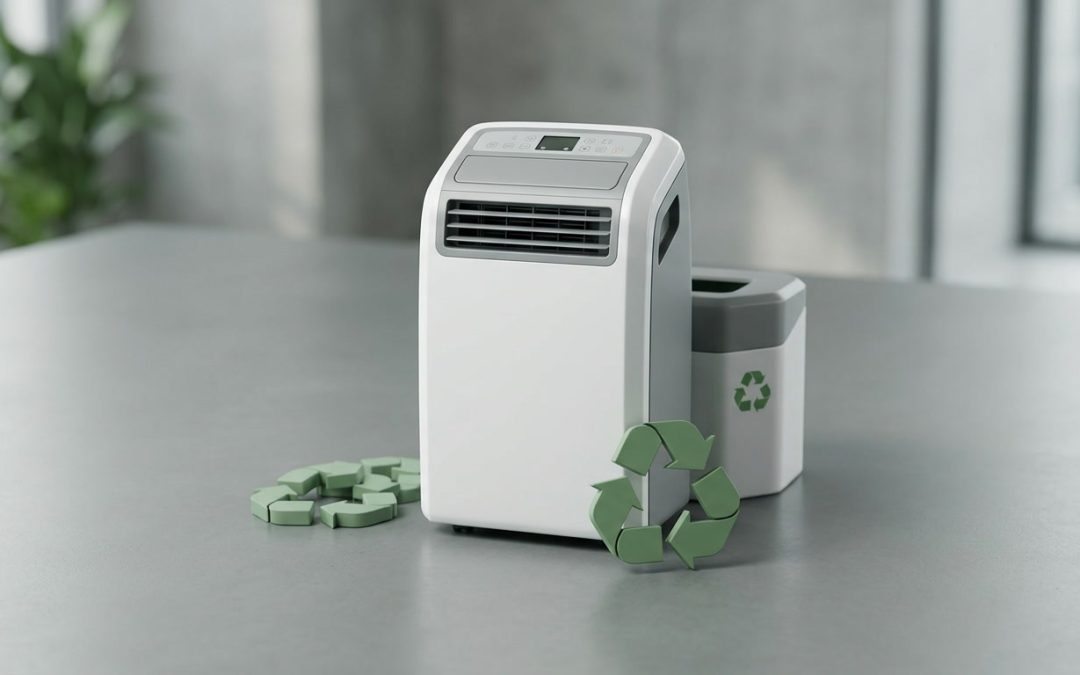
Portable Air Conditioners Can’t Go in the Bin
When a portable air conditioner dies or gets replaced, many people are tempted to leave it on the kerb or throw it in the skip. But portable air conditioners contain refrigerant gases that are potent greenhouse gases, and disposing of them improperly is both illegal and environmentally damaging. A single unit contains enough refrigerant to have the equivalent warming effect of driving a car for thousands of kilometres.
Proper disposal requires a bit more effort than dropping it at the tip, but it’s straightforward once you know the process.
Why Portable ACs Need Special Handling
The refrigerant gas inside a portable air conditioner is the primary reason it needs specialist disposal. Most portable units manufactured in the past decade use R-410A or R-32 refrigerant. Older units may contain R-22 (now banned for production under the Montreal Protocol) or R-134a.
R-410A has a global warming potential (GWP) of 2,088, meaning one kilogram released to the atmosphere has the same warming effect as 2,088 kilograms of CO2. R-32 is better at 675 GWP, but still significant. A typical portable AC unit contains 300-800 grams of refrigerant, which translates to the equivalent of 200-1,600 kilograms of CO2 if released.
Under the Ozone Protection and Synthetic Greenhouse Gas Management Act 1989, releasing refrigerant to the atmosphere in Australia is illegal. Fines can be substantial, and for good reason: the environmental damage is real and measurable.
Beyond the refrigerant, portable ACs also contain a compressor with oil that may be hazardous, copper tubing and heat exchangers, electronic control boards and sensors, and a motor with copper windings.
- Refrigerant gas (R-410A, R-32, or R-22) – must be professionally recovered
- Compressor with oil – hazardous waste component
- Copper tubing and heat exchangers – valuable recyclable metal
- Electronic controls and circuit boards – e-waste
- Fan motor with copper windings – recyclable
- Plastic housing and components – recyclable by type
- Filter material – general waste
Option 1: Council Collection
Most Victorian councils accept portable air conditioners through their e-waste or hard rubbish collection services. This is often the simplest option for households.
Check your council’s website or contact them to confirm they accept refrigerated appliances. Most council transfer stations and resource recovery centres have the facilities to handle refrigerant-containing equipment, either processing it on-site or sending it to specialist facilities.
When using council services, you don’t need to do anything to the unit beforehand. Don’t attempt to remove the refrigerant yourself. Simply deliver the unit intact to the collection point.
Some councils include portable ACs in their periodic hard rubbish kerbside collections. If this is available in your area, it’s the most convenient option, though you may need to book a collection slot and wait for the next available date.
Option 2: Retailer Take-Back
If you’re buying a new air conditioner, ask the retailer if they offer take-back of the old unit. Many appliance retailers and specialist air conditioning suppliers will arrange removal of old equipment when delivering new units.
This is a convenient option because it happens automatically during delivery, you don’t need to transport the heavy old unit yourself, and the retailer’s logistics partner typically has arrangements with licensed processors for proper disposal.
Ask specifically whether the old unit will be properly degassed and recycled, not just dumped. Reputable retailers work with licensed waste processors, but it’s worth confirming.
Option 3: Licensed Refrigerant Recovery
For a more hands-on approach, you can arrange for a licensed refrigerant technician to degas the unit before recycling the remaining components.
In Australia, only technicians holding an Australian Refrigeration Council (ARC) licence are legally allowed to handle refrigerants. A licensed tech will connect recovery equipment to the unit’s service ports, extract the refrigerant into a recovery cylinder, and provide documentation that the gas was properly recovered.
Once the refrigerant is removed, the unit is essentially scrap metal and e-waste that can be handled through standard recycling channels. The metal components (copper, aluminium, steel) have scrap value, and the electronic components go to e-waste recycling.
This option costs $50-150 for the degassing service but ensures proper handling and gives you flexibility in how you recycle the remaining components.
What Not to Do
Several common disposal methods for portable ACs are either illegal, dangerous, or both:
Don’t put it in general waste or skip bins. The refrigerant will be released when the unit is crushed or compacted at the landfill, and in Victoria, e-waste in general bins is illegal.
Don’t cut any refrigerant lines or attempt to “drain” the gas yourself. This releases refrigerant directly to the atmosphere and may expose you to frostbite or oxygen displacement in enclosed spaces.
Don’t disassemble the sealed refrigerant system. The compressor, condenser, evaporator, and connecting tubing form a sealed system that should only be opened by a licensed technician with proper recovery equipment.
Don’t leave it on the kerb hoping someone will take it. An abandoned air conditioner is likely to end up in landfill rather than being properly processed, and you may be liable for illegal dumping depending on your local regulations.
Can It Be Repaired Instead?
Before disposing of a portable AC, it’s worth checking whether it can be repaired. Common faults that are often fixable include blocked or dirty filters (the most common cause of poor performance), failed fans or fan motors, electronic control board issues, and clogged condensate drains.
If the compressor has failed or there’s a refrigerant leak, repair becomes more expensive and may not be worth it for a portable unit. The general rule is that if the repair cost exceeds 50% of the replacement cost, and the unit is more than five years old, replacement is usually the better option.
For units still under warranty, contact the manufacturer before disposing of them. Even if the warranty period has technically passed, some manufacturers offer goodwill repairs for known issues with specific models.
Selling or Donating a Working Unit
If your portable AC still works and you’re replacing it for an upgrade or because you’ve installed a split system, selling or donating it gives the unit a longer useful life.
Working portable ACs sell well on marketplace platforms, particularly heading into summer. Include the brand, model, cooling capacity (in kW or BTU), and energy rating in your listing. Clean the filters and give the unit a wipe-down before photographing it.
Charities and community organisations sometimes accept working air conditioners, particularly for vulnerable community members during heat events. Contact local community services organisations to see if there’s a need.
The Environmental Perspective
Proper disposal of a single portable air conditioner prevents the release of refrigerant equivalent to hundreds or thousands of kilograms of CO2. When you multiply that across the thousands of units disposed of in Australia each year, the cumulative environmental impact of proper versus improper disposal is substantial.
The metals recovered through recycling, particularly copper and aluminium, also represent significant environmental savings compared to mining new materials. A portable AC contains several kilograms of recoverable metals that go back into the manufacturing supply chain when properly recycled.
Taking the time to dispose of a portable air conditioner properly is one of those situations where a small amount of individual effort has a genuinely meaningful environmental impact. For more on responsible disposal of all types of electronics and appliances, see our complete guide to e-waste recycling in Australia.
EWV helps Victorian businesses manage e-waste and IT asset disposal compliantly and sustainably — including collection, certified data destruction, and recycling. Contact us for a free quote.