
Where IT Disposal Meets the Essential Eight
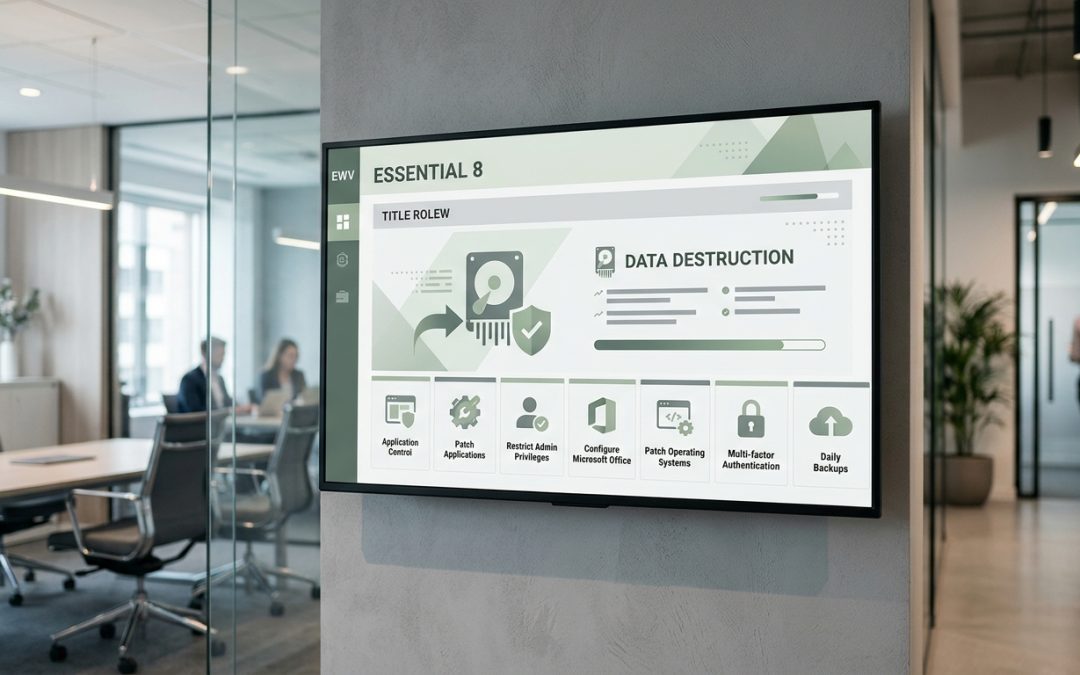
The Australian Signals Directorate’s (ASD) Essential Eight is the baseline cybersecurity framework recommended for all Australian organisations, and it’s mandatory for Commonwealth government entities. While the Essential Eight focuses primarily on preventing and limiting cyber intrusions, several of its mitigation strategies have direct implications for how IT assets should be handled at end of life.
Organisations that invest in Essential Eight compliance for their active systems but neglect disposal processes create a gap that undermines their overall security posture.
The Essential Eight Strategies and Disposal
Four of the eight strategies have particular relevance to IT asset disposal:
Application Control: This strategy restricts which applications can execute on systems. At disposal time, the concern is that decommissioned devices may contain approved applications with embedded credentials, API keys, or configuration data. Before disposal, applications should be properly decommissioned, not just deleted. Credentials and keys embedded in application configurations need to be revoked, and the storage media needs to be sanitised to prevent recovery of application data that could be used to access live systems.
Patch Applications and Patch Operating Systems: These two strategies require keeping software up to date. Their relevance to disposal is indirect but important: unpatched devices that are kept in service beyond their useful life because “they still work” create security vulnerabilities. Devices that can no longer be patched should be prioritised for disposal rather than kept running. End-of-support operating systems and applications are a significant risk vector, and the Essential Eight’s patching requirements effectively mandate their retirement.
Restrict Administrative Privileges: Administrative accounts on decommissioned devices pose a risk if the devices are improperly disposed of. If someone recovers admin credentials from a wiped-but-not-properly-sanitised device, and those credentials are reused across other systems (a common practice despite being discouraged), the disposal failure becomes a live security incident.
- Application Control: Revoke credentials and decommission apps before disposal
- Patch Applications: Retire devices that can no longer receive patches
- Patch Operating Systems: Dispose of end-of-support OS devices promptly
- Restrict Admin Privileges: Ensure admin credentials on disposed devices can’t compromise live systems
- Multi-factor Authentication: Deregister MFA tokens/devices during decommissioning
ASD’s Information Security Manual (ISM) and Disposal
The Essential Eight is a subset of the broader ASD Information Security Manual (ISM), which provides much more detailed guidance on IT asset disposal. The ISM’s media sanitisation and destruction controls are among the most prescriptive in any Australian framework.
The ISM categorises information using the Australian Government security classification system: UNOFFICIAL, OFFICIAL, OFFICIAL:Sensitive, PROTECTED, SECRET, and TOP SECRET. The required sanitisation method depends on the classification level of the data on the device.
For OFFICIAL and OFFICIAL:Sensitive data, the ISM recommends sanitisation through overwriting the entire media at least once (Clear), or using the ASD-approved cryptographic erasure process. For PROTECTED data, Purge-level sanitisation is required, which uses techniques that make data recovery infeasible even with advanced laboratory methods. For SECRET and TOP SECRET, physical destruction is mandatory, with specific destruction methods and particle sizes specified.
While the ISM is mandatory only for Commonwealth government entities, many state governments, defence contractors, and organisations in the government supply chain adopt its requirements either voluntarily or contractually.
Maturity Levels and Disposal Expectations
The Essential Eight uses a maturity model with four levels (0 through 3), where Level 3 represents the most comprehensive implementation. Higher maturity levels imply more rigorous disposal practices, even though disposal isn’t explicitly addressed in the maturity model itself.
At Maturity Level 1, organisations should have basic disposal processes that include data wiping before equipment leaves the premises. At Maturity Level 2, disposal processes should be documented, consistently applied, and include verification steps. At Maturity Level 3, disposal should be fully integrated into the asset lifecycle, with comprehensive documentation, regular auditing, and alignment with ISM controls.
Organisations targeting higher maturity levels should ensure their disposal practices don’t create a weak point that undermines their overall security posture. An organisation at Essential Eight Maturity Level 3 that disposes of equipment without proper sanitisation has a significant inconsistency in its security framework.
Credential and Key Management at Disposal
One of the most overlooked aspects of secure disposal is managing the credentials and cryptographic keys associated with decommissioned equipment.
When a device is decommissioned, all of the following should be addressed: local account passwords should be considered compromised and any reused passwords on other systems should be changed. Domain accounts that were exclusively used on the device should be disabled. API keys and tokens stored on the device should be revoked. Certificates installed on the device should be revoked. VPN configurations should be removed from the VPN server. Wi-Fi credentials used by the device should be rotated if the network uses pre-shared keys. MFA tokens or authenticator apps associated with the device should be deregistered.
This credential lifecycle management is a natural extension of the Essential Eight’s focus on access control and authentication. A properly decommissioned device shouldn’t have any active credentials that could be exploited.
Government Contractors and Supply Chain
Organisations in the Australian government supply chain face particular pressure to align their disposal practices with ASD standards. Defence contracts commonly include clauses requiring compliance with the ISM’s media sanitisation controls. Government procurement frameworks increasingly require suppliers to demonstrate Essential Eight compliance, which implicitly includes proper lifecycle management of IT assets.
The Defence Industry Security Program (DISP) requires participating organisations to maintain security standards that include appropriate equipment disposal. Failure to properly dispose of equipment that held government data can result in contract termination, exclusion from future tenders, and potential criminal penalties under the Crimes Act for mishandling classified information.
Even for non-government organisations, adopting ASD’s disposal guidelines demonstrates a mature security posture that can be a competitive advantage in tender processes and client relationships.
Practical Implementation
For organisations implementing or improving their disposal practices in alignment with the Essential Eight and ISM:
Step 1: Classify your data. Understand what sensitivity level of data exists on each device category. This determines the required sanitisation method.
Step 2: Map devices to classification levels. A server in your finance department may hold PROTECTED-equivalent data. A reception desk computer may only hold OFFICIAL data. The disposal process should be proportionate.
Step 3: Select appropriate sanitisation methods. Use ASD’s ISM guidance to choose the right method for each classification level. For most business data, NIST 800-88 Purge-level sanitisation is appropriate. For highly sensitive data, physical destruction may be warranted.
Step 4: Document and verify. Every disposal event should be documented with asset details, data classification, sanitisation method, verification results, and responsible personnel.
Step 5: Manage credentials. Ensure all credentials, keys, and access rights associated with disposed devices are revoked before or immediately after disposal.
- Classify data on each device using government or equivalent classification
- Apply ISM-recommended sanitisation method for the classification level
- Verify sanitisation was successful before releasing equipment
- Revoke all credentials, keys, and certificates associated with the device
- Maintain disposal records with classification, method, and verification details
- Use ASD-approved tools and methods where available
- Audit disposal processes at least annually
The Essential Eight is a foundation, not a ceiling. Organisations that extend its principles to include comprehensive disposal practices build a security posture that protects data throughout its entire lifecycle, not just while it’s actively in use.
For more on the technical aspects of data sanitisation, see our NIST 800-88 guide and our complete guide to data destruction.
EWV handles IT asset disposition (ITAD) end-to-end for Victorian businesses — from collection and data destruction through to certified recycling or refurbishment for resale. Get in touch for a tailored ITAD quote.