
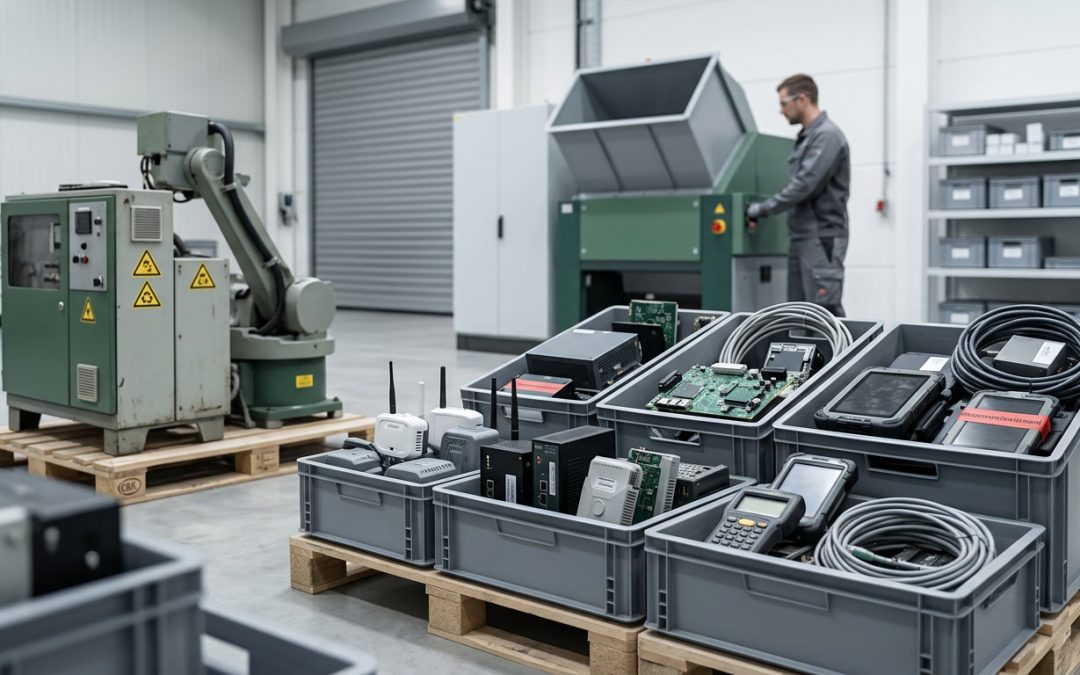
The Growing Challenge of IoT Disposal
The Internet of Things (IoT) has expanded the definition of what constitutes a data-bearing device. Smart sensors, connected cameras, industrial controllers, building automation systems, wearable devices, and thousands of other IoT endpoints all collect, process, and store data. When these devices reach end of life, they present data destruction challenges that are fundamentally different from traditional IT equipment.
The sheer diversity of IoT devices, combined with their non-standard storage architectures and limited management interfaces, makes them one of the most difficult categories of equipment to sanitise effectively.
What Data IoT Devices Store
The types of data found on IoT devices vary enormously depending on the device’s purpose, but common categories include sensor readings and telemetry data (temperature, pressure, motion, location, environmental conditions), configuration settings including network credentials (Wi-Fi passwords, API keys, MQTT broker addresses), authentication tokens and certificates used to communicate with cloud platforms, user data and profiles (for consumer IoT like smart home devices), video and audio recordings (security cameras, smart speakers, doorbells), access control data (smart locks, badge readers, biometric scanners), and operational logs that may reveal patterns of activity.
Even seemingly simple devices can hold surprisingly sensitive information. A smart thermostat knows when you are home. A connected printer stores document contents. An industrial sensor may reveal proprietary manufacturing parameters.
Why IoT Devices Are Hard to Sanitise
Several characteristics of IoT devices make data destruction particularly challenging.
Non-standard storage: Unlike computers with removable hard drives, IoT devices typically use embedded flash memory (eMMC, NOR flash, NAND flash) soldered directly to the device’s circuit board. This storage cannot be removed and sanitised separately. It can only be accessed through the device’s own interfaces or through physical destruction of the entire device.
Limited management interfaces: Many IoT devices have minimal management capabilities. Consumer devices may only offer a factory reset through a physical button, with no way to verify the completeness of the reset. Industrial devices may have proprietary management interfaces that do not include data sanitisation functions.
No standard sanitisation commands: Embedded flash in IoT devices generally does not support the firmware-level sanitise commands (like ATA Secure Erase or NVMe Sanitize) available on computer storage devices. This limits software-based sanitisation options.
Distributed data: IoT devices typically communicate with cloud platforms, and data collected by the device may be stored both locally on the device and remotely in cloud services. Sanitising the device does not eliminate cloud-stored data, which must be addressed separately.
Scale: IoT deployments can involve hundreds or thousands of devices. The logistics of collecting, inventorying, and sanitising large numbers of small devices across multiple locations can be operationally complex.
Sanitisation Methods for IoT Devices
Factory reset: Most IoT devices offer a factory reset function that returns the device to its original configuration, clearing user data, network credentials, and custom settings. The effectiveness of factory reset varies by manufacturer and device. Some perform a thorough erasure of user data areas, while others simply reset the configuration database without overwriting the underlying storage.
For consumer IoT devices and lower-sensitivity industrial devices, factory reset is generally the primary software-based sanitisation option. Where possible, verify the factory reset by powering on the device afterward to confirm it enters the initial setup state and does not retain any previous configuration.
Firmware reflashing: Some IoT devices support firmware updates that overwrite the entire flash memory with a new firmware image. Reflashing the device with the manufacturer’s stock firmware can overwrite areas that a factory reset might not address. This method requires access to the appropriate firmware image and flashing tools.
Physical destruction: For IoT devices that contained sensitive data, or for devices where the effectiveness of software-based sanitisation cannot be verified, physical destruction is the most reliable option. The entire device, including the embedded flash memory, is shredded or crushed to prevent data recovery.
Given the low individual value of most IoT devices, physical destruction is often the most practical and cost-effective approach for large-scale IoT disposal.
Cloud and Account Decommissioning
Sanitising the physical IoT device is only part of the process. Most IoT devices are registered with cloud services, manufacturer accounts, or management platforms that hold copies of the device’s data and configuration.
Before or after sanitising the physical device, deregister the device from its cloud platform, delete associated cloud-stored data, revoke API keys and authentication tokens, remove the device from any management consoles, and close or clean up associated manufacturer accounts.
Failing to decommission the cloud side of an IoT deployment can leave data accessible through cloud APIs even after the physical device has been destroyed.
Industry-Specific Considerations
Certain IoT applications involve particularly sensitive data. Healthcare IoT devices (patient monitors, insulin pumps, connected diagnostic equipment) may store protected health information. Building automation systems may reveal security-sensitive information about access patterns and building operations. Industrial IoT in manufacturing may hold proprietary process parameters. Automotive IoT systems may contain location history and driver behaviour data.
For these higher-sensitivity applications, physical destruction of the device combined with cloud data deletion provides the most thorough sanitisation approach.
IoT devices are multiplying rapidly in every sector, and their disposal requirements are only going to become more complex. Addressing IoT data destruction now, before the volume becomes unmanageable, is a smart investment in future compliance readiness.
EWV provides NIST 800-88 certified data destruction for Victorian businesses, covering software-based erasure and physical destruction with full chain-of-custody documentation. Request a quote to discuss your requirements.