
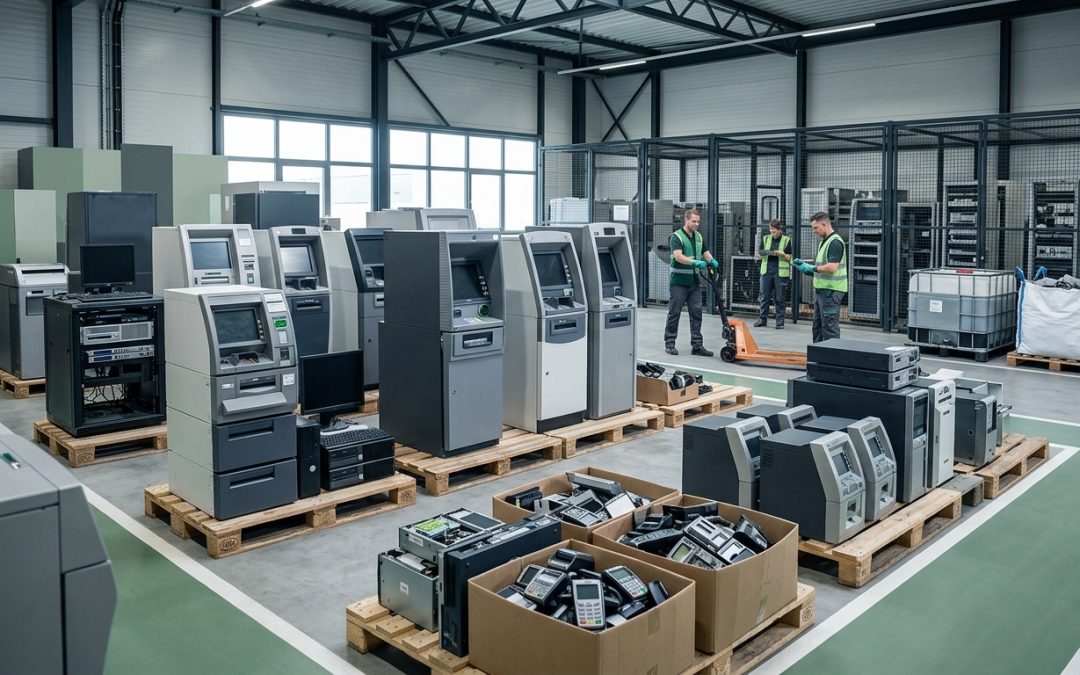
High-Security Disposal for Financial Hardware
Automated Teller Machines (ATMs) and banking terminals are among the most security-sensitive IT devices in operation. They process financial transactions, store encryption keys, contain authentication credentials, and interact directly with banking networks. When these devices reach end of life, their disposal requires the highest standards of data destruction, strict chain-of-custody controls, and compliance with both financial regulations and payment industry standards.
What ATMs and Banking Terminals Store
ATMs are essentially purpose-built computers running specialised financial software. The internal components typically include one or more hard drives or SSDs running the ATM operating system and application software, encrypted communication modules that connect to banking networks, cryptographic processors (Hardware Security Modules or HSMs) that manage encryption keys for PIN processing, card reader components that may retain transaction data, and cash dispenser controllers with transaction logs.
The data stored across these components can include transaction logs containing account numbers, timestamps, and amounts. Software and configuration files that reveal details about the banking network infrastructure. Encryption keys used for PIN translation and network authentication. Customer interaction logs from the ATM’s screen and keypad. Network configuration data including VPN settings, IP addresses, and server endpoints. Security camera footage from the ATM’s built-in camera. And software licence keys and authentication certificates for the banking application.
Regulatory and Compliance Framework
ATM and banking terminal disposal falls under multiple regulatory frameworks simultaneously. PCI DSS requires that any device that has stored, processed, or transmitted cardholder data be securely disposed of, with the destruction documented and verifiable. APRA Prudential Standard CPS 234 requires authorised deposit-taking institutions to manage information security risks, including the disposal of IT assets.
The Payment Card Industry PIN Security Requirements (PCI PIN) impose specific obligations around the disposal of HSMs and other cryptographic devices that have been used for PIN processing. These requirements are more stringent than general PCI DSS media destruction requirements and may mandate physical destruction of the HSM under witnessed conditions.
Banking industry guidelines from organisations like the Australian Payments Network provide additional guidance on the secure handling and disposal of payment infrastructure.
Hardware Security Modules
The HSM within an ATM is the most security-critical component. It stores the cryptographic keys used to encrypt PINs and authenticate transactions. These keys, if compromised, could potentially be used to intercept or manipulate financial transactions.
HSMs are designed to be tamper-resistant, with mechanisms that automatically destroy stored keys if physical tampering is detected. However, relying on tamper-detection alone during disposal is not sufficient. HSMs should be handled according to the key management procedures specified in PCI PIN requirements, which typically involve zeroising (electronically clearing) the HSM’s key storage before physical destruction of the device.
The zeroisation process is performed through the HSM’s management interface and should be documented with a timestamp and the identity of the person who performed it. After zeroisation, the HSM should be physically destroyed to prevent any possibility of key recovery.
Drive Sanitisation
The ATM’s internal storage drives contain the operating system, transaction logs, and application data. These drives should be sanitised using NIST 800-88 Purge-level methods at minimum, given the sensitivity of financial data. For most banking institutions, physical destruction of the drives is preferred for the additional assurance it provides.
If the ATM uses encrypted drives, cryptographic erasure (destruction of the encryption keys) followed by physical destruction provides a belt-and-braces approach that satisfies the most stringent compliance requirements.
Chain of Custody
ATM disposal requires particularly rigorous chain-of-custody controls. From the moment the ATM is decommissioned until all components have been destroyed, every transfer, movement, and handling step should be documented. The chain of custody should record who authorised the decommissioning, who removed the ATM from its location, how the ATM was transported (including vehicle details and security measures), where the ATM was stored pending destruction, who performed the data sanitisation and physical destruction, and when each step occurred.
Given the physical size and weight of ATMs, transportation typically requires specialist logistics. The transport should use vehicles with GPS tracking and secure cargo areas, and the ATM should not be left unattended during transit.
Physical Destruction Process
For ATM components, physical destruction should be comprehensive. All storage media (HDDs, SSDs, flash modules) should be shredded to an appropriate particle size. The HSM should be physically destroyed after zeroisation. Card reader components should be destroyed to prevent reuse in skimming attacks. Network and communication modules should be destroyed to prevent recovery of configuration data.
The destruction should be witnessed by an authorised representative of the bank or financial institution, and photographic evidence should be captured at each stage. The physical destruction methods used should be documented in the certificate of destruction.
Banking Terminal Kiosks
Beyond traditional ATMs, financial institutions deploy various other terminal types that require secure disposal, including self-service kiosks for account management, coin counting machines that may store transaction data, cheque deposit terminals with scanner modules that cache cheque images, and foreign currency exchange terminals. Each of these terminal types may contain storage devices, network configuration, and transaction data that must be addressed during disposal.
ATM and banking terminal disposal represents the highest end of data destruction requirements. The combination of financial data sensitivity, regulatory obligations, and the physical complexity of these devices demands a specialist approach that leaves no room for shortcuts.
EWV helps Victorian businesses manage e-waste and IT asset disposal compliantly and sustainably — including collection, certified data destruction, and recycling. Contact us for a free quote.