
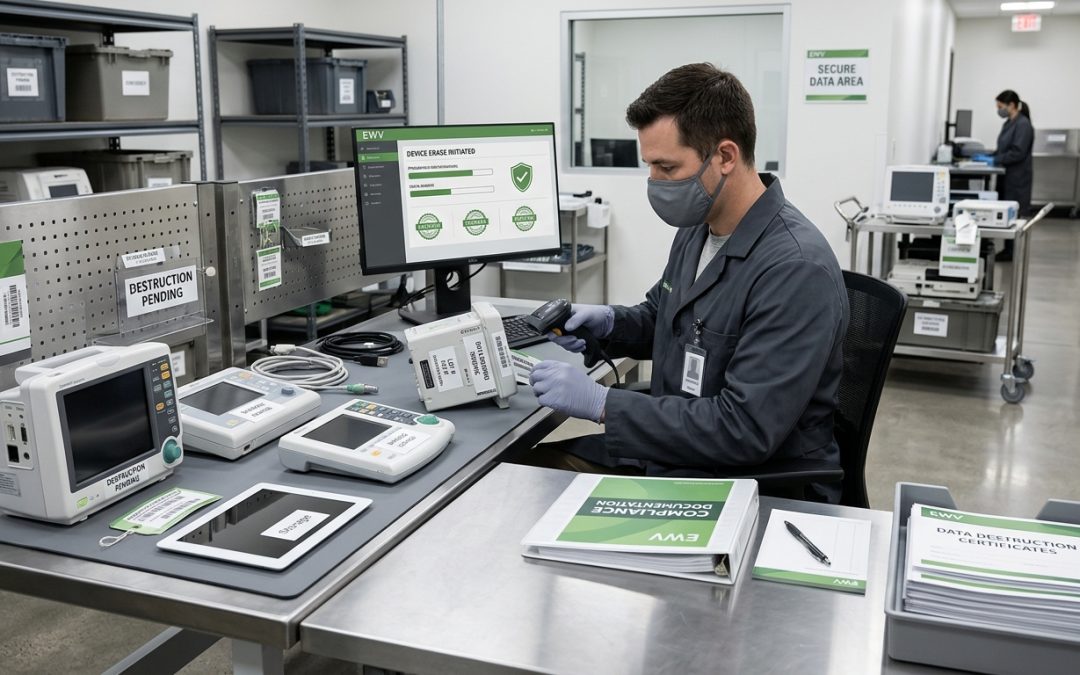
When Healthcare Equipment Contains Patient Data
Medical devices have evolved from simple mechanical instruments into sophisticated computing platforms that collect, process, and store patient data. From diagnostic imaging equipment to patient monitors, infusion pumps to laboratory analysers, modern medical devices contain storage media that may hold protected health information (PHI). When these devices reach end of life, the data they contain must be destroyed in compliance with both healthcare privacy legislation and data protection standards.
What Medical Devices Store
The types of data stored by medical devices vary widely depending on the device category, but common data elements include patient names, dates of birth, and medical record numbers. Diagnostic images (X-rays, CT scans, MRI images, ultrasound images). Test results and measurements (blood analysis, vital signs, ECG readings). Treatment records and device programming (infusion rates, ventilator settings). Clinician notes and observations entered at the device. Network configuration and credentials for connecting to hospital information systems. HL7 and DICOM communication logs containing patient data. And audit logs of device usage and user access.
The amount of data stored varies significantly. A high-end MRI scanner may have terabytes of patient imaging data on its internal storage. A patient monitor may store a few days of vital sign recordings. A connected infusion pump may store a history of drug administration records. Even devices that transmit data to central systems in real time may cache data locally as a backup or performance buffer.
Healthcare Privacy Legislation
In Australia, medical device data destruction is governed by multiple layers of legislation. The Privacy Act 1988 (Cth) and the Australian Privacy Principles apply to private sector healthcare organisations. State health records legislation, such as the Health Records Act 2001 (Vic), imposes additional obligations on health service providers in Victoria.
These laws require that personal health information be destroyed or de-identified when it is no longer needed for the purpose it was collected. However, they must be read alongside retention requirements that specify minimum periods for retaining patient records. In Victoria, health records must generally be retained for a minimum of seven years from the date of last service for adult patients, and until the patient turns 25 for records created when they were a minor.
Medical device data should not be destroyed until the applicable retention period has expired and the data has been transferred to the patient’s permanent health record or another approved storage system.
Regulatory Considerations
Medical devices in Australia are regulated by the Therapeutic Goods Administration (TGA). While the TGA’s primary focus is device safety and efficacy rather than data destruction, some TGA requirements intersect with disposal practices. Devices that are recalled or withdrawn from the market may have specific disposal requirements. Device manufacturers may have obligations to retain certain data from deployed devices for post-market surveillance.
Organisations should check with the device manufacturer for any model-specific disposal guidelines and verify that no TGA-related obligations prevent data destruction.
Sanitisation Challenges for Medical Devices
Medical devices present several unique data destruction challenges.
Proprietary systems: Many medical devices run proprietary operating systems and use non-standard storage configurations. Standard data wiping tools may not be compatible with these systems. The device manufacturer’s guidance on data clearing should be followed where available.
Embedded storage: Smaller medical devices often use embedded flash storage that cannot be removed for independent sanitisation. The device’s own software is the only means of clearing data from these devices.
Network-connected devices: Medical devices connected to hospital networks may store authentication credentials, server addresses, and HL7/DICOM interface configurations. These should be cleared to prevent exposure of network infrastructure details.
Leased and loaned equipment: Many medical devices, particularly high-value imaging equipment, are leased from manufacturers or distributors. Data destruction responsibilities when returning leased equipment should be clearly defined in the lease agreement. Do not assume the leasing company will handle data destruction.
Sanitisation Methods
Manufacturer-provided data clearing: Most modern medical devices include a data management function that allows patient data to be exported, archived, or deleted. Use these built-in functions as the first step. The device’s service manual typically documents the procedure for clearing all patient data.
Drive removal and sanitisation: For devices with standard removable drives (many diagnostic workstations and imaging systems use standard SATA drives), remove the drives and sanitise them using NIST 800-88 compliant methods. This approach provides the most thorough sanitisation and the most comprehensive documentation.
Physical destruction: For devices with embedded storage that cannot be accessed through standard interfaces, or for devices that contained particularly sensitive data, physical destruction of the storage components ensures complete data elimination.
Service engineer assistance: For complex devices like MRI scanners, CT scanners, and linear accelerators, the manufacturer’s service engineer may need to assist with data clearing. This is especially true for devices where the storage is integrated into the device in a way that requires specialised knowledge to access.
DICOM and PACS Considerations
Diagnostic imaging devices communicate using the DICOM (Digital Imaging and Communications in Medicine) standard and typically send images to a Picture Archiving and Communication System (PACS) for long-term storage. Before disposing of an imaging device, verify that all images have been successfully transferred to the PACS. The device’s local image store should then be cleared completely.
Some DICOM devices cache images from other devices on the network for display purposes. This cached data may include patient images from studies performed on other equipment. Clearing the local image cache is an essential step that is easy to overlook.
Medical devices hold some of the most sensitive personal information in existence. Ensuring that patient data is properly destroyed at the end of a device’s life is both a legal obligation and a fundamental aspect of maintaining the trust that patients place in healthcare organisations.
EWV provides NIST 800-88 certified data destruction for Victorian businesses, covering software-based erasure and physical destruction with full chain-of-custody documentation. Request a quote to discuss your requirements.