
Managing Policyholder Data at End of Life
Insurance companies collect and store extensive personal and financial information about their policyholders. From the initial application through to claims processing and settlement, the insurance lifecycle generates data that includes health histories, financial details, property information, vehicle records, and claims documentation that may contain highly sensitive material. When IT equipment in an insurance organisation reaches end of life, this accumulated policyholder data requires careful destruction.
What Insurance IT Systems Store
Policy administration systems hold policyholder personal details, policy terms and coverage, premium payment histories, and underwriting assessments. Claims management systems contain claims lodgement details, investigation reports, medical reports and assessments, repair estimates and invoices, settlement calculations, and litigation files. Underwriting systems store risk assessment data, actuarial models, pricing algorithms, and reinsurance arrangements.
Customer portals and CRM systems hold communication histories, complaint records, and customer interaction logs. Document management systems store policy documents, claims correspondence, medical certificates, police reports, and expert assessments. Analytics platforms may contain aggregated data used for fraud detection, pricing models, and market analysis.
Regulatory Framework
Insurance companies in Australia are regulated by APRA (for general insurers and life insurers), ASIC (for market conduct and product disclosure), and the OAIC (for privacy compliance). Each regulator has requirements that affect data handling and disposal.
APRA Prudential Standard CPS 234 applies to APRA-regulated insurers, requiring information security capabilities that include secure disposal of information assets. The Insurance Contracts Act 1984 and associated regulations affect record retention requirements. The Life Insurance Act 1995 imposes additional requirements for life insurers.
Claims records must be retained for periods that account for limitation periods for potential future claims. In many cases, this means retaining records for at least seven years after the policy expires or the claim is settled. For long-tail insurance classes (such as professional indemnity, public liability, and workers compensation), the retention period may extend well beyond this.
Health Information Sensitivity
Health and life insurance operations involve particularly sensitive data. Health declarations on insurance applications contain detailed medical histories. Claims files for health, life, income protection, and workers compensation policies may contain medical reports, specialist assessments, hospital records, and mental health information.
This health information is subject to additional protections under the Privacy Act and state health records legislation. Equipment that stored health-related insurance data should be sanitised to the highest practical standard, with physical destruction recommended for media containing detailed medical records.
Fraud Investigation Data
Insurance companies maintain fraud investigation files that may contain surveillance footage, investigator reports, witness statements, and evidence gathered during claims investigations. This data is sensitive both because of its content and because premature disclosure could compromise ongoing investigations or legal proceedings.
Before disposing of IT equipment that may contain fraud investigation data, verify with the investigations team that no active investigations or legal proceedings require the data to be preserved. Equipment containing fraud investigation data should be sanitised to NIST 800-88 Purge level at minimum.
Destruction Standards
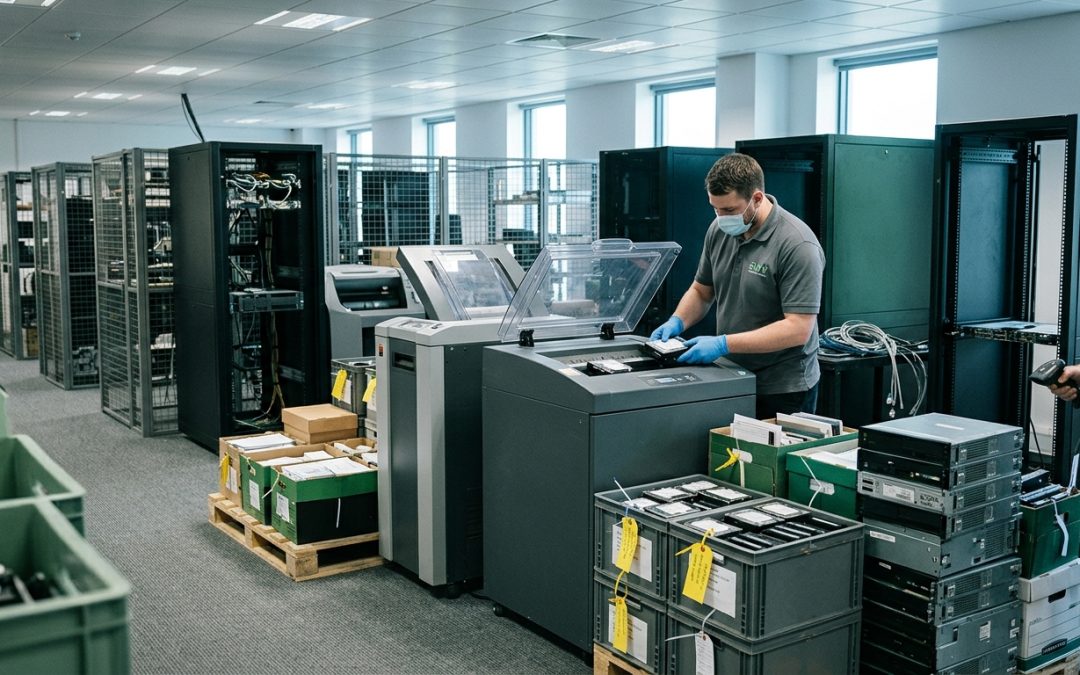
Given the regulatory environment and data sensitivity, insurance companies should apply rigorous destruction standards across all IT equipment. All storage media should be sanitised to NIST 800-88 Purge level at minimum. Equipment that contained health information, fraud investigation data, or detailed financial records should be considered for physical destruction. Chain-of-custody documentation should be maintained for all disposed assets.
Insurance companies hold deeply personal information about their policyholders, often collected during the most difficult times in people’s lives. Ensuring this data is properly destroyed at end of life honours the trust policyholders place in their insurer and meets the sector’s extensive regulatory obligations.
EWV helps Victorian businesses manage e-waste and IT asset disposal compliantly and sustainably — including collection, certified data destruction, and recycling. Contact us for a free quote.