
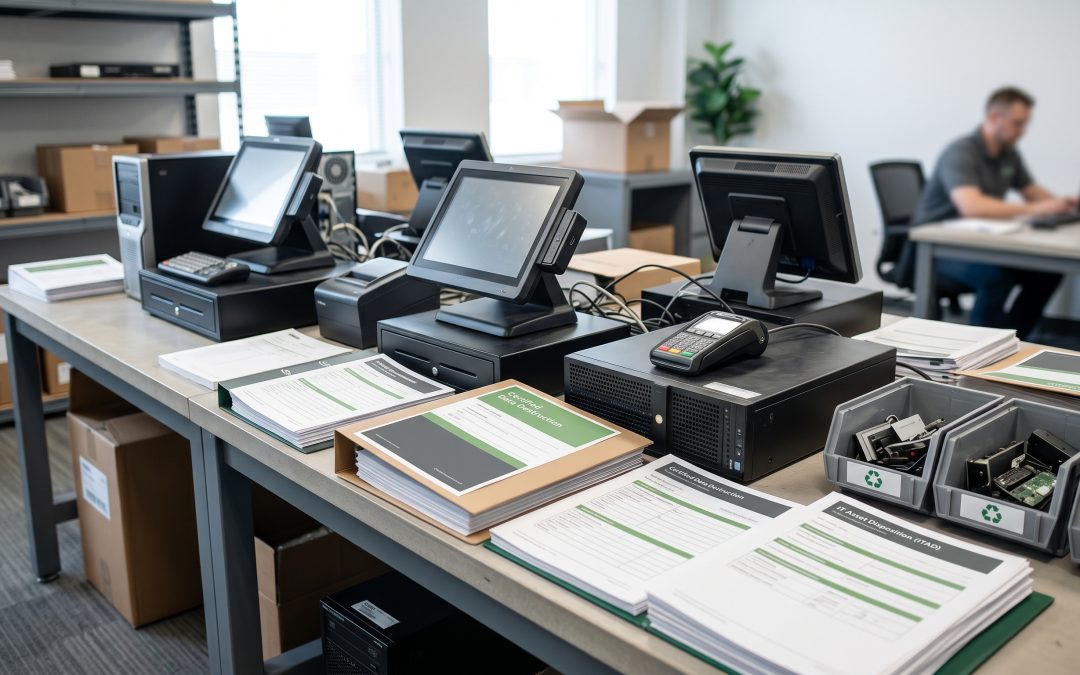
Why Retail Businesses Face Unique Data Destruction Challenges
Retail businesses collect enormous volumes of customer data every single day. From point-of-sale terminals processing card transactions to CRM platforms storing purchase histories, loyalty program details, and personal preferences, the retail sector handles some of the most sensitive consumer information of any industry.
When POS systems, payment terminals, back-office servers, and store computers reach end of life, the data they contain doesn’t disappear on its own. Without proper data destruction procedures, retailers risk exposing customer payment details, personal information, and purchasing patterns to unauthorised parties.
Types of Data Found on Retail IT Equipment
Retail environments generate and store data across a surprisingly wide range of devices. POS terminals often retain transaction logs, card data fragments, and employee login credentials in local storage. Even when payment processing is handled through cloud-based systems, local caches and temporary files can contain sensitive information.
CRM systems represent another major data repository. These platforms typically store customer names, email addresses, phone numbers, physical addresses, purchase histories, and behavioural data used for marketing segmentation. When the servers or workstations running these systems are decommissioned, all of that data needs to be thoroughly destroyed.
Beyond the obvious systems, retailers should also consider data stored on inventory management terminals, warehouse scanners, digital signage systems with network credentials, security camera DVRs, and employee scheduling computers. Each of these devices can contain information that poses a risk if it falls into the wrong hands.
Regulatory Requirements for Retail Data Destruction
Australian retailers must comply with the Australian Privacy Act 1988 and the Australian Privacy Principles (APPs), which require organisations to take reasonable steps to destroy personal information when it is no longer needed for the purpose it was collected. For retailers handling payment card data, the Payment Card Industry Data Security Standard (PCI DSS) adds another layer of requirements.
PCI DSS Requirement 9.8 specifically addresses the destruction of media containing cardholder data. Retailers must render cardholder data on electronic media unrecoverable using methods consistent with industry-accepted standards. This means simple deletion or basic formatting of POS system drives is not sufficient to meet compliance obligations.
Common Mistakes in Retail Data Disposal
One of the most frequent errors retailers make is treating POS terminal disposal as a simple hardware swap. When upgrading to new terminals, old units are sometimes returned to vendors, donated, or discarded without any data sanitisation. Even terminals that appear to have been factory reset can retain recoverable data in flash storage.
Multi-location retailers face an additional challenge: consistency. A head office might have clear data destruction policies, but if individual store managers handle equipment disposal independently, there is no guarantee those policies are being followed. Without centralised oversight, some locations may simply discard old equipment or pass it along without proper data wiping.
Another common oversight involves backup media. Retailers often maintain local backups of transaction data, employee records, and inventory databases. When stores close or systems are upgraded, these backup tapes, external drives, or USB devices may be overlooked in the disposal process.
Best Practices for Retail Data Destruction
Developing a comprehensive data destruction policy starts with creating a complete inventory of all devices and media that store data across every retail location. This inventory should include POS terminals, back-office computers, servers, networking equipment, mobile devices used by staff, scanners, and any removable storage media.
For POS systems and payment terminals, data sanitisation should follow NIST 800-88 guidelines, using either software-based purging or physical destruction depending on the media type and sensitivity of the data. Solid-state storage in modern POS terminals may require cryptographic erasure to ensure complete data removal.
CRM databases stored on servers should be sanitised before decommissioning, with verification that all copies, including replicas, backups, and disaster recovery instances, have been addressed. It is not enough to wipe the primary server if backup copies of customer databases still exist on other media.
For multi-location retailers, establishing a centralised disposal process ensures consistency. This might involve collecting end-of-life equipment from all stores at a central warehouse for processing, or engaging a certified IT asset disposition provider with the capacity to handle multiple locations under a single chain-of-custody framework.
Building a Retail-Specific Disposal Workflow
An effective retail data destruction workflow should include several key stages. First, equipment should be identified and tagged at the store level when it is flagged for replacement. Asset tags should record the device type, serial number, and the types of data it may contain.
Second, devices should be securely transported to a processing facility or handled on-site by qualified personnel. During transit, equipment should be tracked and stored in locked containers or secure areas to prevent unauthorised access.
Third, data destruction should be performed using methods appropriate to the storage media and data classification. Each device should receive a certificate of destruction documenting the method used, the date, and the personnel involved. These certificates form part of the retailer’s data breach prevention documentation.
Finally, the process should be auditable. Records should be maintained for a minimum period aligned with both PCI DSS requirements and the Australian Privacy Act’s expectations, typically at least seven years for financial data.
Protecting Your Retail Business and Your Customers
Retail data breaches consistently rank among the most damaging in terms of both financial cost and reputational harm. Customers trust retailers with their payment details and personal information, and that trust is difficult to rebuild once broken. By implementing thorough data destruction processes across all locations and device types, retailers can protect both their customers and their business from the consequences of improper disposal.
The investment in proper data destruction is minimal compared to the potential cost of a breach. With the right policies, consistent execution, and proper documentation, retail businesses can confidently manage the full lifecycle of their IT assets from deployment through to secure disposal.
EWV provides NIST 800-88 certified data destruction for Victorian businesses, covering software-based erasure and physical destruction with full chain-of-custody documentation. Request a quote to discuss your requirements.