
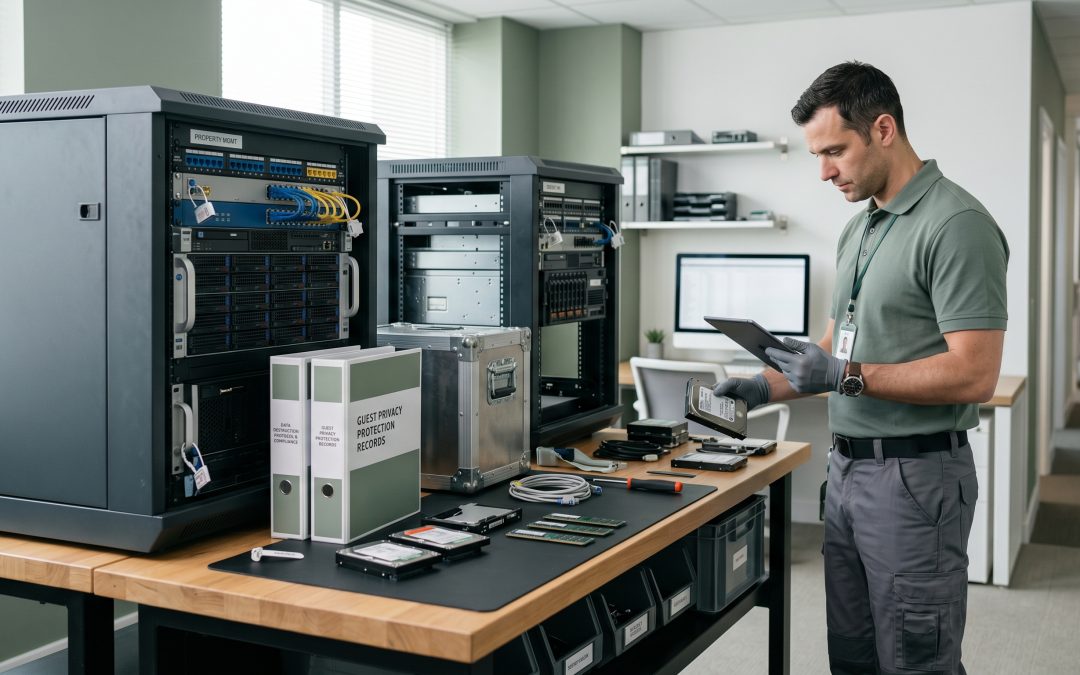
Why the Hospitality Industry Faces Significant Data Destruction Risks
Hotels, resorts, and hospitality businesses collect deeply personal information from every guest who walks through their doors. From passport scans and credit card details at check-in to Wi-Fi usage logs and room access records during a stay, hospitality IT systems accumulate a comprehensive picture of each guest’s identity, movements, and preferences. When these systems reach end of life, the data they contain presents a substantial security risk if not properly destroyed.
The hospitality sector’s high rate of technology turnover compounds this risk. Property management systems, point-of-sale terminals, in-room entertainment systems, keycard encoders, and guest-facing kiosks are all regularly upgraded or replaced. Each device transition creates an opportunity for data exposure if disposal processes are not robust.
Types of Guest Data Stored on Hospitality Systems
Property management systems (PMS) are the backbone of hotel data storage. These platforms typically hold guest names, addresses, phone numbers, email addresses, passport or driver’s licence details, credit card information, stay histories, room preferences, loyalty program data, and special requests including dietary requirements or accessibility needs.
Point-of-sale systems in hotel restaurants, bars, spas, and gift shops process payment transactions and may retain card data fragments, transaction logs, and customer spending patterns. Even cloud-based POS systems often cache data locally on the terminal hardware.
Less obvious data repositories include keycard systems that log room entry times, CCTV systems with footage of guest movements, in-room tablets or entertainment systems that may store Wi-Fi credentials or browsing history, and conference or event management platforms containing corporate client details and attendee information.
Back-of-house systems add further data exposure points. HR systems with employee records, accounting platforms, procurement databases, and housekeeping management tools all contain information that requires proper handling at end of life.
Regulatory Requirements for Hospitality Data
Australian hospitality businesses must comply with the Australian Privacy Act 1988, which requires reasonable steps to destroy personal information when it is no longer needed. Hotels that accept international guests may also need to consider overseas privacy regulations, particularly the EU’s GDPR for European guests and similar frameworks in other jurisdictions.
The Payment Card Industry Data Security Standard (PCI DSS) applies to any hospitality business that processes credit card payments, which is virtually all of them. PCI DSS requirements around media destruction are specific and prescriptive, requiring that cardholder data be rendered unrecoverable using industry-accepted methods.
Hotels that collect passport information or government-issued identification for identity verification purposes face additional obligations around the handling and destruction of this sensitive identity data.
Common Hospitality Data Disposal Failures
One of the most frequent failures in hospitality data disposal involves property renovations and technology upgrades. When a hotel undergoes a refurbishment, the focus is on getting new systems operational quickly. Old POS terminals, in-room devices, back-office computers, and networking equipment are often removed by contractors and disposed of without any data sanitisation.
Franchise and management agreement transitions create another risk. When a hotel changes brands or management companies, the outgoing operator’s data may remain on systems that are inherited by the incoming party. Without clear contractual provisions about data destruction during transitions, guest data from the previous operator can persist on equipment that is now controlled by a different organisation.
Seasonal and temporary properties, such as pop-up hotels or event venues, often use equipment that is moved between locations. This mobile technology may contain guest data from multiple properties and events, making tracking and destruction more complex.
Individual property managers sometimes dispose of equipment locally without involving centralised IT teams. A hotel manager who arranges for old computers to be picked up by a local recycler may not realise that those machines contain years of guest records that have not been wiped.
Best Practices for Hospitality Data Destruction
Effective hospitality data destruction starts with a comprehensive inventory of all data-bearing devices across the property. This inventory should go beyond standard IT assets to include POS terminals, keycard systems, CCTV DVRs, in-room technology, digital signage, and any networked equipment with local storage.
Property management system databases should be sanitised following NIST 800-88 standards before server decommissioning. Given the volume of personal and financial data these systems contain, verification of successful sanitisation is essential. For servers containing payment card data, the destruction process should meet PCI DSS requirements.
POS terminals and payment devices should never be returned, resold, or recycled without thorough data wiping. Even terminals that appear to store data in the cloud may retain local caches, transaction logs, or configuration data that includes sensitive information.
For hotel chains and multi-property operators, establishing a centralised disposal process ensures consistency across all locations. Working with a certified IT asset disposition provider who can service multiple properties under a single agreement simplifies compliance and documentation.
Developing a Property-Level Disposal Protocol
Each property should have a documented disposal protocol that integrates with the hotel’s broader data security framework. This protocol should specify who is authorised to initiate equipment disposal, how devices are secured between decommissioning and destruction, and what documentation is required at each stage.
Staff training is particularly important in hospitality, where employee turnover tends to be high. New staff involved in technology management should be briefed on data destruction requirements as part of their onboarding. Clear, simple procedures reduce the risk of well-meaning but uninformed staff disposing of equipment improperly.
During property transitions, whether due to renovation, rebranding, or change of management, a specific data destruction checklist should be followed. This checklist should cover all data-bearing systems and confirm that guest data from the outgoing operation has been properly destroyed before new systems are deployed.
Earning and Maintaining Guest Trust
Guests trust hotels with their most personal details, from home addresses and passport numbers to credit card information and travel patterns. That trust is the foundation of the hospitality business, and protecting it requires attention to data security throughout the entire technology lifecycle, including the final step of secure disposal. A proactive approach to data destruction demonstrates the same commitment to guest care that defines excellent hospitality service.
EWV provides NIST 800-88 certified data destruction for Victorian businesses, covering software-based erasure and physical destruction with full chain-of-custody documentation. Request a quote to discuss your requirements.