
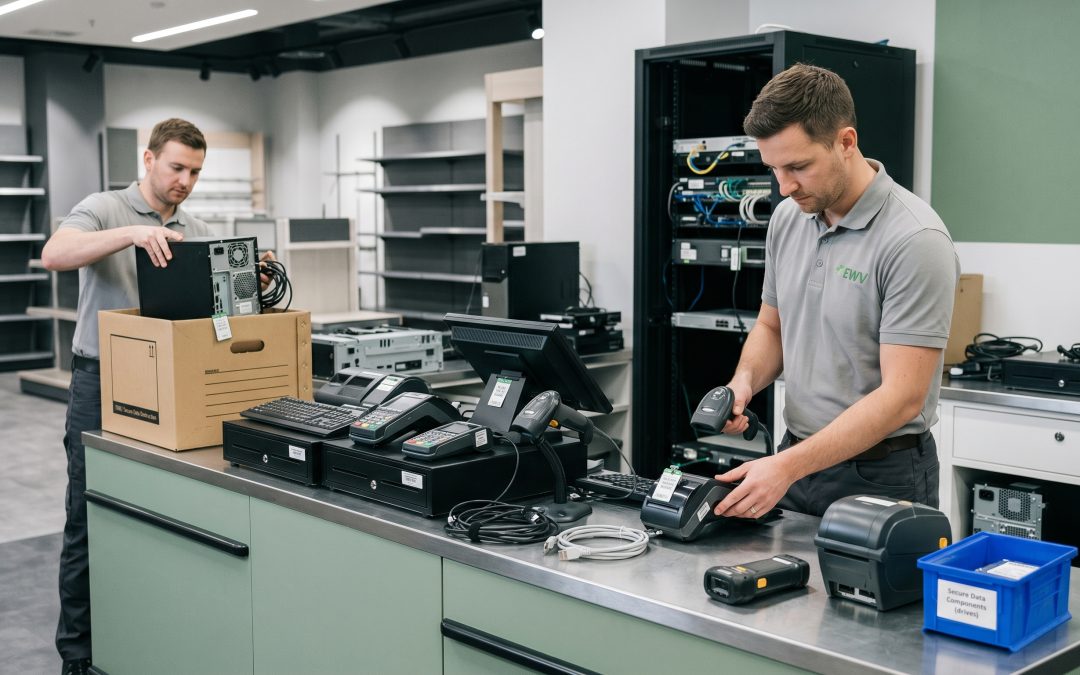
The Data Challenge of Closing a Retail Location
Closing a retail store, whether a single location or part of a broader network restructure, involves dismantling an IT environment that has been collecting customer data for years. Point-of-sale terminals, back-office computers, inventory management systems, security cameras, and customer-facing technology all contain information that must be properly handled before the premises are vacated and equipment is removed.
The urgency of retail closures, driven by lease deadlines, clearance sales, and staff departures, creates pressure that can lead to IT equipment being handled carelessly. Store managers focused on final stock disposal, fixture removal, and landlord requirements may not prioritise data security on the IT equipment being cleared from the space.
Data Stored Across Retail Store Systems
POS terminals are the most obvious data repositories in a retail environment. These systems process payment card transactions and may retain card data fragments, transaction logs, customer purchase histories, and refund records. Even POS systems that process payments through cloud-based platforms can cache data locally on the terminal hardware.
Back-office computers in retail stores typically run inventory management software, accounting applications, staff scheduling systems, and email clients. These machines accumulate operational data including supplier details, pricing information, sales reports, employee records, and business correspondence over the full life of the store.
Loyalty program databases may be stored locally, containing customer names, contact details, purchase histories, and reward balances. For stores that operated their own loyalty programs rather than chain-wide systems, this data may exist only on the local store’s equipment.
CCTV systems record footage of customers and staff, often retaining weeks or months of recordings on local DVRs or NVRs. This footage contains identifiable images of individuals and is subject to privacy legislation. Security access control systems may also store employee biometric data such as fingerprints used for time-and-attendance tracking.
Customer-facing kiosks, digital signage systems with network connectivity, self-service checkouts, and in-store Wi-Fi infrastructure all represent additional data points that need to be addressed during closure.
Planning the IT Closure Process
IT equipment handling should be integrated into the store closure plan from the outset. Before the clearance sale begins and before fixtures start being removed, the IT systems need attention. Ideally, data destruction should be one of the first activities in the closure sequence, while the store still has power, staff, and security.
Start by creating a complete inventory of all IT equipment in the store. Walk through every area, including the sales floor, stockroom, office, break room, loading dock, and any secure areas. Document every device with its type, location, and the category of data it may contain.
Determine which data needs to be migrated and which can be destroyed. Sales data, customer records, and employee information that is needed by the parent company should be transferred to central systems before the local equipment is wiped. Financial records that must be retained for tax purposes should be archived.
Coordinate with the company’s IT team or ITAD provider to schedule data destruction. For chain retailers closing a single store, the company’s standard disposal process should be followed. For independent retailers closing their business, the guidance on company closure IT disposal applies.
Handling POS Systems
POS terminals require particular attention due to the payment card data they process. Before any terminal leaves the store, all locally stored data should be destroyed following NIST 800-88 standards. For terminals with embedded storage that cannot be easily accessed, consult the POS vendor about secure decommissioning procedures.
If POS terminals are being returned to a leasing company or vendor, the store is responsible for data destruction before return. Do not assume the vendor will handle data removal. The Australian Privacy Act and PCI DSS both place this responsibility on the entity that collected the data.
Payment processing hardware, including card readers, PIN pads, and contactless terminals, may contain encryption keys and configuration data. These devices should be decommissioned according to the payment processor’s procedures and not simply discarded.
CCTV and Security Systems
CCTV DVRs and NVRs typically contain hard drives with weeks or months of surveillance footage. This footage includes identifiable images of customers and staff, making it personal information under privacy legislation. The drives in CCTV equipment should be sanitised or physically destroyed before the equipment is removed from the store.
Access control systems that use biometric data, such as fingerprint scanners for staff time-and-attendance, store this biometric data locally. Biometric information is classified as sensitive information under the Privacy Act and requires secure destruction. The access control system vendor may need to be involved to ensure all biometric data is properly removed.
Coordinating with Landlords and Contractors
When vacating a retail premises, the landlord and their contractors will often be involved in the final cleanup. Communicate clearly that IT equipment must not be removed or disposed of by anyone other than authorised IT personnel or the appointed ITAD provider. Equipment left behind by the tenant becomes the landlord’s property, and with it, the data it contains leaves your control.
If a make-good clause in the lease requires removal of all fixtures and fittings, ensure that IT equipment removal is handled by people who understand the data security requirements, not general removalists or demolition contractors.
Documentation and Compliance
Document every piece of IT equipment removed from the store and the data destruction method applied. Certificates of destruction for each device should be retained as part of the store closure records. For chain retailers, these certificates should be filed centrally where they can be accessed if questions arise about how data from the closed store was handled.
A retail store closure is a significant operational event that touches every aspect of the business. Ensuring that customer data, employee records, and payment information are properly destroyed before the final handover protects the organisation’s reputation, satisfies regulatory obligations, and demonstrates the same standard of care that customers experienced while the store was open.
EWV helps Victorian businesses manage e-waste and IT asset disposal compliantly and sustainably — including collection, certified data destruction, and recycling. Contact us for a free quote.