
The Scale of the IoT Disposal Problem
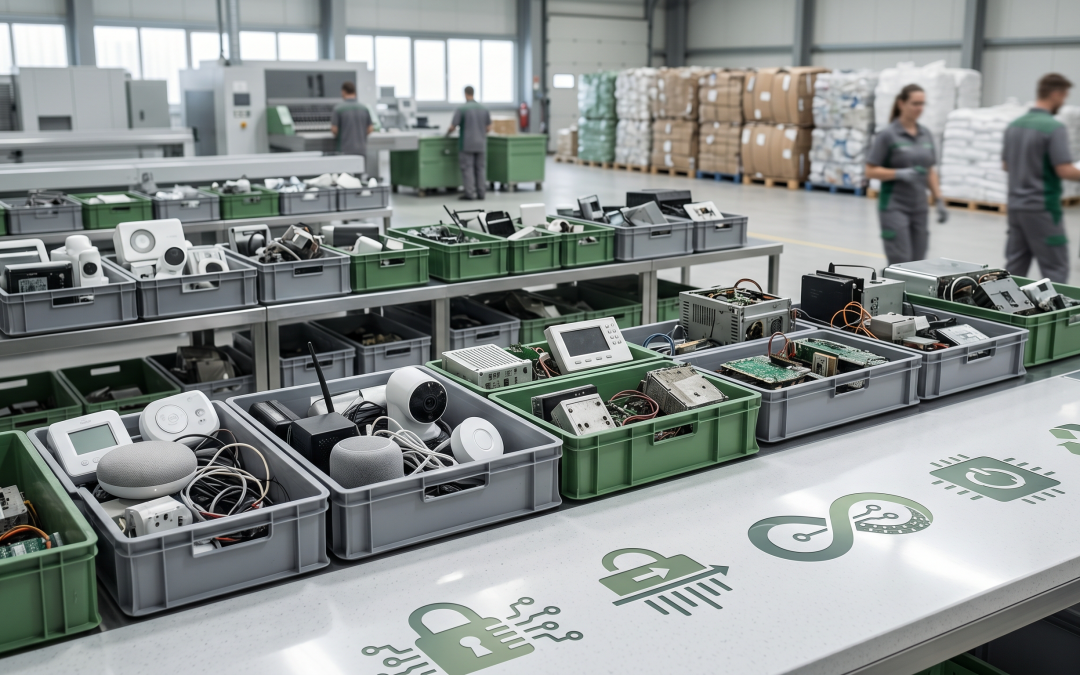
The Internet of Things has quietly flooded organisations with data-bearing devices that exist outside traditional IT management. Smart sensors, connected cameras, environmental monitors, building automation controllers, smart locks, asset trackers, wearable devices, and hundreds of other connected things are deployed across offices, warehouses, retail spaces, and field operations. Each of these devices collects, stores, and transmits data. And each of them will eventually need to be disposed of.
The challenge is that IoT devices are often invisible to IT teams. They are deployed by facilities management, operations, security, or individual departments without IT involvement. They may not appear in IT asset registers. They may not be covered by existing disposal policies. And when they reach end of life, they are frequently discarded as electronic waste without any consideration for the data they contain.
What Data Do IoT Devices Store?
The data footprint of IoT devices varies enormously depending on the device type. Smart security cameras store video footage and may retain facial recognition data, access logs, and motion detection records. Building management systems store temperature readings, occupancy data, and access patterns that can reveal detailed information about how a building and its occupants operate.
Environmental sensors in industrial settings record conditions that may constitute trade secrets, such as manufacturing parameters, production rates, and quality metrics. Asset tracking devices maintain location histories that reveal operational patterns, supply chain routes, and logistics strategies.
Connected medical devices store patient health data. Smart meters record energy consumption patterns. Fleet telematics devices log vehicle movements and driver behaviour. Even seemingly innocuous devices like smart light bulbs may store Wi-Fi credentials that could provide network access.
Beyond the operational data they collect, IoT devices also store configuration data including network credentials, API keys, authentication tokens, and connection strings for cloud platforms. This configuration data could enable unauthorised access to the organisation’s network or cloud infrastructure if recovered from a disposed device.
Why IoT Disposal Is Different from Traditional IT Disposal
IoT devices present several characteristics that make standard IT disposal approaches difficult to apply. They are physically diverse, ranging from tiny sensors to large industrial controllers. They use proprietary operating systems and storage formats that standard sanitisation tools cannot access. They may have embedded storage that cannot be removed or independently wiped.
Many IoT devices have no user interface for performing data deletion. There is no screen to navigate, no keyboard to type commands, and no USB port to connect sanitisation tools. The only way to interact with some devices is through their cloud management platform, which may not offer a secure erase function.
The sheer number of devices in a typical IoT deployment creates a volume challenge. An organisation might have dozens of servers and hundreds of laptops, but thousands of IoT devices. Processing each device individually through a data destruction workflow is not practical at this scale.
Firmware-level data persistence is another concern. Even performing a factory reset on an IoT device may not clear all stored data, as some information may be embedded in non-volatile memory that the reset process does not address.
Approaches to IoT Data Destruction
For IoT devices with removable storage such as SD cards or small SSDs, removing and separately destroying the storage media is the most straightforward approach. The device housing can then be recycled as standard e-waste without data concerns.
For devices with embedded storage that cannot be removed, manufacturer documentation should be consulted for any supported secure erase or factory reset procedures. Where these exist, they should be performed before disposal. However, the reliability of manufacturer-provided reset functions varies, and for sensitive environments, additional measures may be warranted.
Physical destruction of the entire device, or at minimum the circuit board containing the storage components, provides the highest assurance for IoT devices that cannot be reliably wiped through software. Small IoT devices can be processed through standard electronic media shredders.
For cloud-connected IoT devices, data destruction must address both the device and the cloud platform. Deregistering the device from its cloud management platform, deleting stored data from the cloud, and revoking any API keys or certificates associated with the device are all necessary steps alongside physical device handling.
Building IoT into Asset Management
The first step toward managing IoT disposal is bringing IoT devices into the organisation’s asset management framework. Every connected device deployed on the organisation’s network or premises should be registered, tracked, and subject to the same lifecycle management as traditional IT assets.
This requires collaboration between IT, facilities, operations, and any other teams that deploy IoT devices. A policy requiring IT approval or notification for any IoT device deployment ensures that new devices are captured in the asset register from the outset.
Procurement specifications for IoT devices should include data destruction capabilities as a selection criterion. Devices that support secure erase, have removable storage, or provide documented destruction procedures should be preferred over devices that offer no end-of-life data management options.
Regulatory Considerations
IoT devices that collect personal information are subject to the same Australian Privacy Act obligations as any other data collection system. A smart camera that records identifiable individuals, a wearable that tracks employee movements, or a sensor that collects data linked to specific people all fall under privacy regulation.
Victoria’s e-waste landfill ban applies to IoT devices that contain electronic components. These devices must be recycled through appropriate e-waste channels rather than sent to landfill, adding an environmental dimension to the disposal process.
As IoT adoption continues to accelerate across every sector of the Australian economy, organisations that proactively address IoT data destruction will avoid the growing risk of breaches through overlooked, unmanaged connected devices. The time to bring IoT into your disposal framework is now, before the number of devices makes the task unmanageable.
EWV helps Victorian businesses manage e-waste and IT asset disposal compliantly and sustainably — including collection, certified data destruction, and recycling. Contact us for a free quote.