
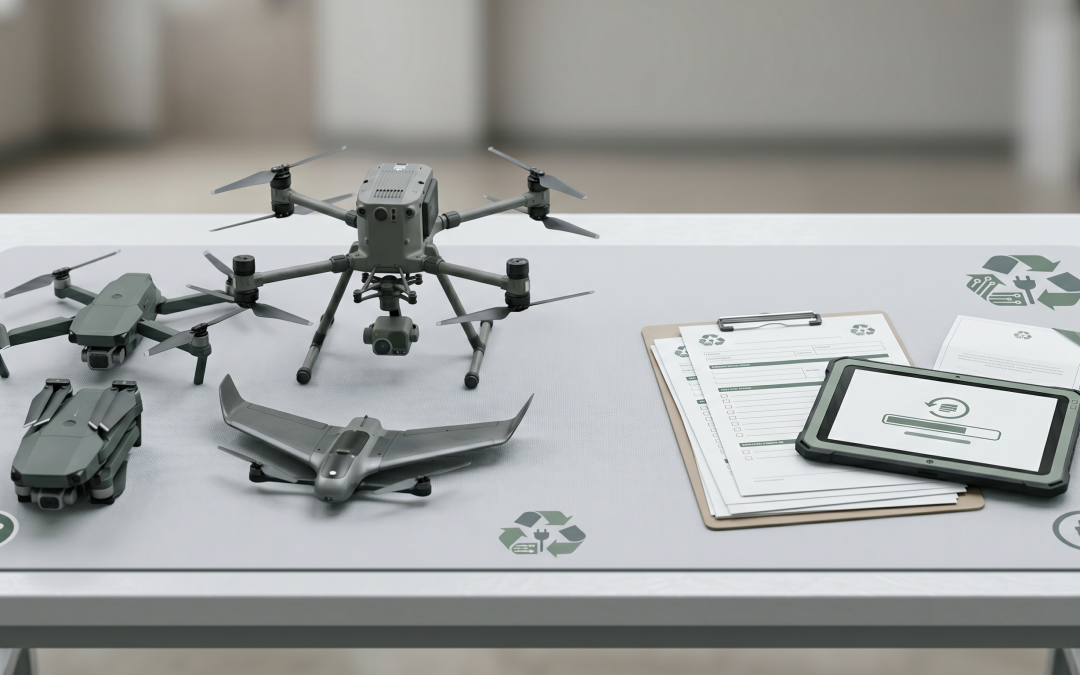
The Data Payload of Commercial Drones
Commercial drones have become essential tools across industries including construction, agriculture, mining, real estate, media, emergency services, and infrastructure inspection. These unmanned aerial vehicles carry sophisticated electronics including cameras, GPS modules, flight controllers, and data storage systems that accumulate significant volumes of sensitive data during their operational life. When drones are retired, damaged, or replaced, the data they carry requires the same security attention as any other IT asset.
The commercial drone market in Australia is growing rapidly, with CASA-registered operators spanning every sector. As early-generation commercial drones age out of service and are replaced by more capable models, the industry faces an emerging disposal challenge that combines data security, environmental responsibility, and aviation compliance considerations.
Types of Data Stored on Drones
Flight logs record every mission the drone has flown, including GPS coordinates, altitude, speed, duration, and flight path. For drones used in sensitive applications such as security surveillance, infrastructure inspection, or law enforcement, flight logs reveal exactly where the drone has been and what areas it has surveyed. For commercial operators, flight logs may expose client locations and operational patterns.
Imagery and video captured during flights may be stored on removable media (SD cards) or on internal storage. Aerial photography of properties, construction sites, agricultural land, and infrastructure contains geolocation metadata and may capture identifiable individuals, vehicle registration plates, and property details. For real estate and mapping operators, stored imagery has clear privacy implications.
Sensor data from specialised payloads such as thermal cameras, multispectral sensors, LiDAR systems, and gas detection equipment contains technical data that may be commercially sensitive or subject to contractual confidentiality obligations.
Controller and ground station equipment stores mission planning data, waypoint coordinates, mapping boundaries, and communication logs. The ground station laptop or tablet used to control the drone may contain more data than the drone itself, including client correspondence, project files, and processed deliverables.
Network and account credentials including Wi-Fi passwords, cloud platform logins, and manufacturer account credentials may be stored on both the drone and its controller for automated connectivity and data syncing.
Regulatory Considerations
CASA regulations govern drone operation in Australia but do not specifically address data destruction at end of life. However, the Australian Privacy Act applies to personal information captured by drones, including identifiable imagery of individuals and property-specific data.
Drone operators working under contract to government agencies, defence organisations, or critical infrastructure operators may have specific contractual obligations regarding data handling and destruction. These contracts often specify that all data, including that stored on the drone itself, must be destroyed at the end of the engagement.
For operators holding CASA Remote Pilot Licences or Remote Operator Certificates, maintaining professional standards around data handling supports the credibility and trustworthiness of the commercial drone industry.
Data Destruction for Drone Equipment
Start with removable storage media. SD cards, microSD cards, and any removable drives should be removed from the drone and processed through standard data destruction methods. For cards containing sensitive imagery, physical destruction provides the highest assurance. SD cards are inexpensive, and the cost of replacement is negligible compared to the risk of data exposure.
For internal storage on the drone itself, perform a factory reset through the manufacturer’s app or ground station software. DJI, the dominant commercial drone manufacturer, provides a factory reset function through the DJI Fly and DJI Pilot apps. Other manufacturers offer similar capabilities. Verify that the reset has cleared flight logs, cached imagery, and account credentials.
Ground station computers, tablets, and controllers should undergo NIST 800-88 compliant data sanitisation if they are being disposed of. These devices often contain more aggregated data than the drone itself, including mission planning databases, processed deliverables, and client information.
Deregister the drone from any manufacturer cloud platforms. DJI FlightHub, Pix4D, DroneDeploy, and similar platforms may retain flight data, imagery, and mapping products in the cloud. Removing the drone from these platforms and deleting associated cloud data ensures that the disposed drone’s operational history is not accessible through cloud accounts.
For drones used in government, defence, or critical infrastructure work, consider physical destruction of the drone’s electronics rather than relying solely on software-based data clearing. The embedded nature of storage in drone flight controllers makes verification of software clearing difficult.
Environmental Disposal
Drones contain lithium polymer batteries, electronic circuit boards, motors, and composite materials that require appropriate recycling. Victoria’s e-waste landfill ban applies to drone electronics. Batteries should be handled separately through battery recycling programs due to the fire risk associated with lithium polymer cells.
For commercial operators disposing of drone fleets, engaging a certified ITAD provider familiar with drone equipment ensures both data security and environmental compliance. The provider can handle data destruction, battery safe handling, and materials recycling through appropriate channels.
An Emerging Disposal Category
As the commercial drone industry matures and early-generation equipment reaches end of life in increasing volumes, establishing clear data destruction practices for drone equipment is becoming essential. Operators who build data handling into their standard operating procedures, from mission planning through to equipment retirement, demonstrate the professionalism and security awareness that clients increasingly expect from commercial drone services.
EWV provides NIST 800-88 certified data destruction for Victorian businesses, covering software-based erasure and physical destruction with full chain-of-custody documentation. Request a quote to discuss your requirements.