
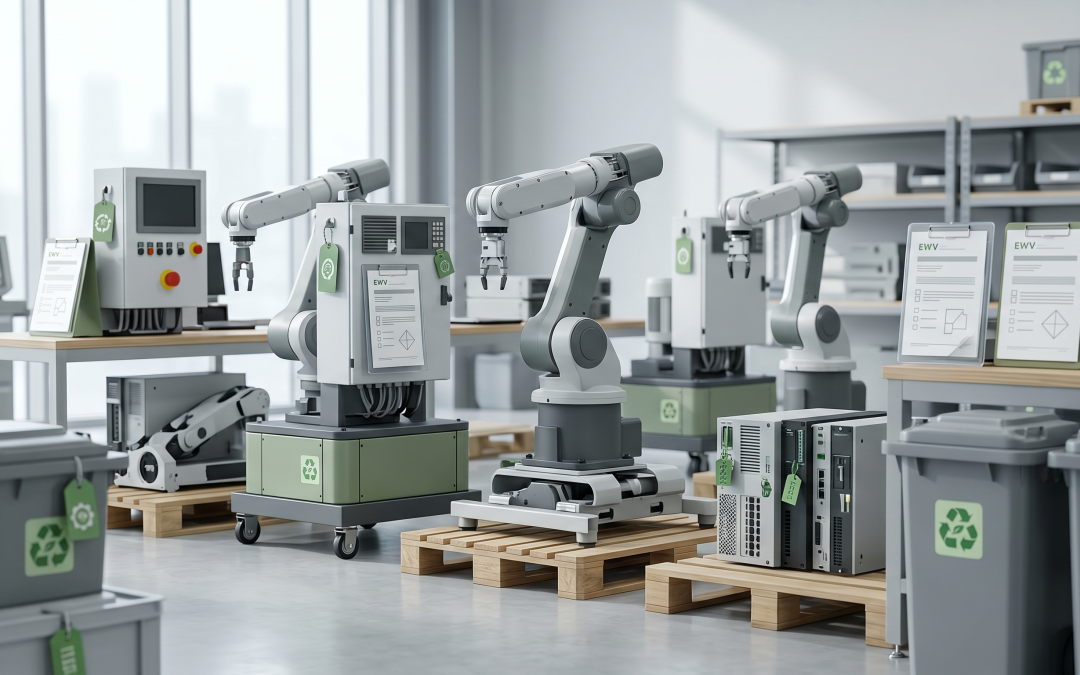
Robots and automation equipment are transforming industries from manufacturing and logistics to healthcare and agriculture. As these systems age, break down, or become obsolete, disposing of them creates data security considerations that many organisations have not yet fully accounted for. Modern robots are far more than mechanical arms; they are networked computers with extensive data storage capabilities.
What Data Do Robots Actually Store?
Today’s industrial robots and automation systems are surprisingly data-rich. A typical robotic system might store programming code and motion sequences that represent proprietary manufacturing processes, network credentials and communication configurations for connecting to factory systems, sensor calibration data and quality inspection parameters, operator access logs and authentication credentials, and production data including cycle counts, error logs, and performance metrics.
Collaborative robots (cobots) working alongside humans may also store safety zone configurations, force-sensing parameters, and interaction logs. Autonomous mobile robots (AMRs) used in warehouses retain detailed facility maps, navigation paths, and inventory location data.
Why Standard IT Disposal Processes Fall Short
Most organisations have reasonably mature processes for disposing of laptops, servers, and network equipment. But robotic systems present challenges that standard IT asset disposition workflows were not designed to handle.
First, data in robotic systems is often distributed across multiple internal components. A single robot might have a main controller with a hard drive or SSD, a teach pendant with its own storage, vision system cameras with onboard memory, and various peripheral controllers each with embedded flash storage. Missing even one of these components during sanitisation leaves data exposed.
Second, many robotic systems use proprietary operating systems and storage formats. The data wiping tools commonly used for Windows or Linux systems may not work on a robot controller running a manufacturer-specific operating system. This means organisations may need to work with the robot manufacturer or use physical destruction methods to ensure complete data removal.
Industry-Specific Risks
The sensitivity of data on robotic equipment varies significantly by industry. In automotive manufacturing, robot programs encode precise welding patterns, adhesive application sequences, and assembly tolerances that represent decades of process refinement. If a competitor obtained this data from improperly disposed equipment, the competitive implications could be substantial.
In pharmaceutical manufacturing, robotic systems involved in drug production may store batch records, formulation parameters, and quality control data subject to regulatory requirements. Healthcare robots used in surgical settings or patient care may have processed or stored protected health information.
Logistics and warehouse automation systems store facility layouts, inventory management algorithms, and throughput data that could be commercially sensitive. Even agricultural robots may contain proprietary data about crop management strategies, field mapping, and yield optimisation techniques.
A Structured Approach to Robot Disposal
Organisations decommissioning robotic equipment should follow a systematic process that accounts for the unique characteristics of these systems.
Start with a complete inventory of all data storage points within each system. This typically requires input from the automation engineering team, as storage locations in robotic systems are not always obvious. Request technical documentation from the manufacturer if available, as this will identify storage components that might otherwise be missed.
Classify the data stored on each component according to your organisation’s data protection policies. Not all data on a robot requires the same level of protection. Motion programs for a generic pick-and-place operation may be low risk, while custom process recipes could be highly confidential.
For components with accessible standard storage (hard drives, SSDs, USB storage), apply established data sanitisation standards. For embedded storage and proprietary systems, consult with the manufacturer about secure erasure options. Where software-based sanitisation is not possible or verifiable, physical destruction of the storage media is the safest approach.
Environmental Considerations
Robotic equipment often contains materials that require careful environmental handling during disposal. Batteries (particularly lithium-ion packs in mobile robots), circuit boards with heavy metals, hydraulic fluids, and specialised lubricants all need proper management. In Victoria, electronic components from robotic systems fall under the state’s e-waste landfill ban, meaning they cannot simply be sent to general waste.
The growing volume of robotic equipment reaching end of life is creating new challenges for the recycling industry. Many robotic components contain valuable materials including rare earth magnets, copper windings, and precious metals in circuit boards that can be recovered through proper recycling processes.
Planning Ahead
As automation becomes more prevalent across all industries, organisations should integrate robot and automation equipment into their IT asset disposal policies from the outset. This means including robotic systems in asset registers, establishing data classification protocols for automation data, and building relationships with disposal providers who have experience with industrial robotics. Treating robots as just another category of equipment to manage through their full lifecycle, including secure end-of-life handling, is the most effective approach.
EWV helps Victorian businesses manage e-waste and IT asset disposal compliantly and sustainably — including collection, certified data destruction, and recycling. Contact us for a free quote.