
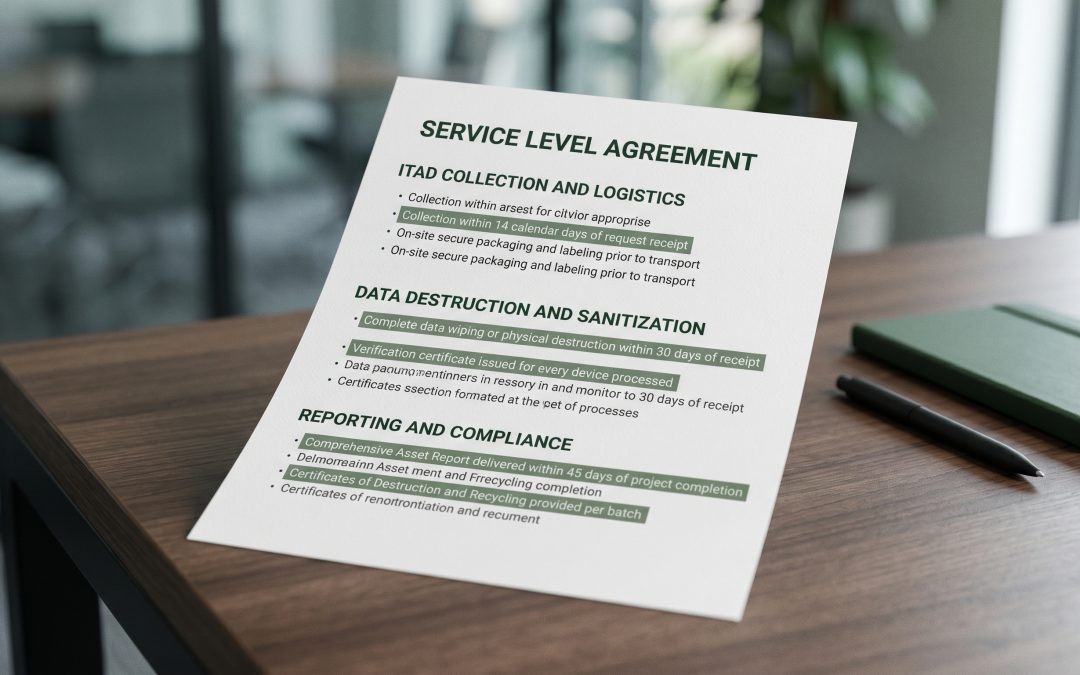
A Service Level Agreement with your ITAD provider sets clear expectations for both parties and provides a framework for measuring performance. Without defined SLAs, you are relying on goodwill and assumptions, which rarely produces consistent results over time. The best ITAD relationships are built on measurable commitments that both sides understand and agree to upfront.
Why SLAs Matter in ITAD
ITAD is not like ordering office supplies. The consequences of poor performance range from data breaches and compliance failures to missed financial opportunities from delayed remarketing. An SLA transforms vague promises into specific, measurable commitments that you can hold your provider accountable for.
SLAs also protect your provider by setting realistic expectations. If your organisation expects same-day collection but has not communicated that requirement, frustration is inevitable on both sides. A well-drafted SLA prevents these misunderstandings.
Key SLA Metrics for ITAD
Several categories of metrics should be covered in an ITAD SLA. For collection and logistics, define the response time for collection requests (for example, within 48 business hours of request), the collection window (arrival within a specified timeframe), the handling of urgent or priority collections, and procedures for rescheduling or cancelled collections.
For data destruction, specify the turnaround time from receipt to completed destruction, the maximum time equipment can sit unprocessed at the provider’s facility, the timeframe for issuing certificates of destruction, and the process for handling devices that fail software sanitisation (escalation to physical destruction).
For reporting, define when regular reports are due (monthly, quarterly), the turnaround time for ad-hoc reporting requests, the level of detail required in reports, and the format and delivery method for reports and certificates.
Data Security SLAs
Data security deserves its own section in your SLA because the consequences of failure are severe. Key commitments should include that all data-bearing devices will be processed according to specified standards (such as NIST 800-88), that devices will be stored in a secure, access-controlled environment from receipt until processing, that the provider will maintain specified certifications throughout the contract term, that any security incidents will be reported within a defined timeframe (such as 24 hours), and that the provider will cooperate fully with any security audits or investigations.
Consider including a requirement for regular security audits of the provider’s facility, either conducted by your team or by an independent third party.
Environmental SLAs
Environmental commitments should also be measurable. Useful SLA metrics include landfill diversion rate (typically expressed as a percentage, with 95% or higher being a reasonable target), compliance with all applicable e-waste regulations, regular environmental reporting including weight of materials recycled and CO2e avoided, no export of e-waste to non-OECD countries, and maintenance of environmental certifications.
Value Recovery SLAs
If your ITAD arrangement includes value recovery through remarketing, the SLA should address turnaround time from receipt to testing and listing, the reporting frequency for resale activity, payment terms and timelines, the process for agreeing on pricing for high-value assets, and the handling of unsold inventory after a defined period.
Understanding the full scope of ITAD services helps you identify which SLA categories are most relevant to your situation.
Penalties and Remedies
An SLA without consequences for non-performance is just a wish list. Define what happens when SLAs are not met. Options include service credits or fee reductions for missed targets, escalation procedures for repeated failures, the right to audit following any SLA breach, and termination rights for serious or persistent non-compliance.
Keep penalties proportional. Minor delays in collection scheduling warrant different consequences than failures in data destruction processes. The goal is to incentivise good performance, not to create an adversarial relationship.
Review and Adjustment
SLAs should not be static. Schedule regular reviews, at least annually, to assess whether the agreed metrics are still appropriate. Your needs may change as your organisation grows, your equipment mix evolves, or regulations change. Similarly, your provider may identify SLA targets that are unrealistic given operational realities and propose adjustments.
Use SLA review meetings as an opportunity to discuss the overall relationship, share feedback in both directions, and identify areas for improvement. The best ITAD partnerships are collaborative, with SLAs providing the structure for continuous improvement rather than a tool for blame.
Documentation and Access
Ensure that SLA performance data is easily accessible to both parties. Many ITAD providers offer online portals where clients can track collection status, view processing progress, and download reports and certificates. If your provider offers such a platform, incorporate its use into your SLA framework so that performance can be monitored in real time rather than only assessed retrospectively.
EWV handles IT asset disposition (ITAD) end-to-end for Victorian businesses — from collection and data destruction through to certified recycling or refurbishment for resale. Get in touch for a tailored ITAD quote.